
TABLE OF CONTENTS
- What Is a General Trading Licence in Dubai?
- General Trading Licence vs Standard Trade Licence — What Is the Difference?
- What Activities Are Covered Under a General Trading Licence?
- Why Dubai Is the Best City for General Trading Business
- Mainland vs Free Zone — Which Jurisdiction Should You Choose?
- Step-by-Step Process: How to Get a General Trading Licence in Dubai
- Documents Required for a General Trading Licence
- General Trading Licence Cost in Dubai (2026 Breakdown)
- VAT, Corporate Tax and Customs Duty Obligations
- How SmartBiz Can Help You Get Your General Trading Licence
- Frequently Asked Questions (FAQs)
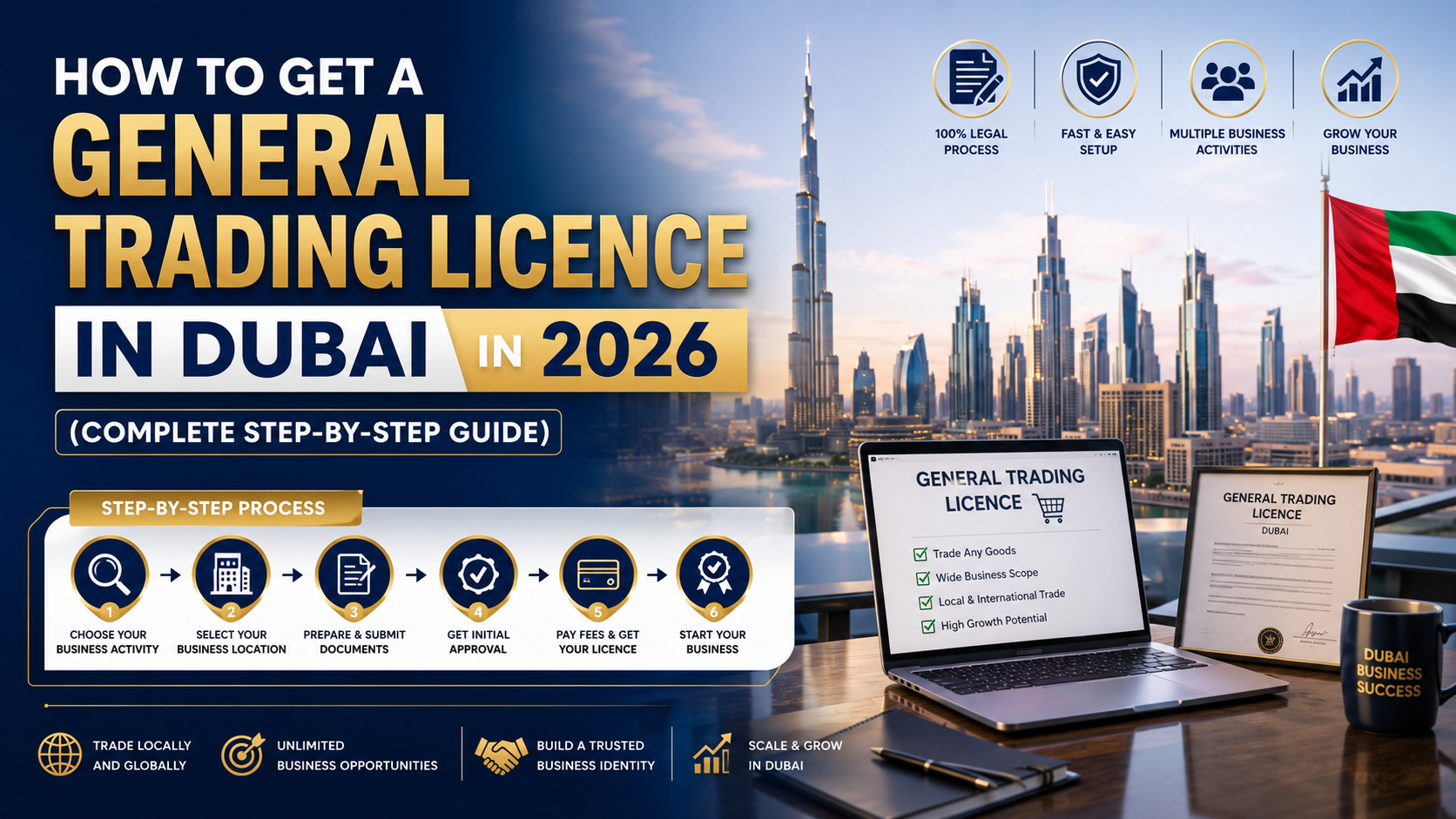
HOW TO GET A GENERAL TRADING LICENCE IN DUBAI IN 2026 (COMPLETE STEP-BY-STEP GUIDE)
If you are looking to start a trading company in Dubai, one of the first things you will need is a general trading licence. It is one of the most popular commercial licences issued in the UAE — and for good reason. It gives your business the flexibility to deal in multiple product categories under a single Dubai business licence, without applying for separate permits every time you add a new product line.
Whether you are a first-time entrepreneur or an experienced business owner relocating to the UAE, this guide will walk you through everything you need to know — from what the licence covers, to costs, documents, jurisdiction choices, and the exact step-by-step process to get your general trading licence in Dubai in 2026.
What Is a General Trading Licence in Dubai?
A general trading licence in Dubai is a type of commercial licence issued by the Dubai Department of Economy and Tourism (DET) or by one of Dubai’s free zone authorities. It authorises your company to import, export, buy, sell, and distribute a wide range of goods — both within the UAE and internationally — under a single permit.
What makes the general trading licence different from an ordinary trade licence is its breadth. Rather than restricting you to a single category of products, it permits you to deal across multiple, unrelated product lines. This makes it the preferred choice for entrepreneurs who want to keep their business flexible and scalable from day one.
Under a general trading licence UAE, you can deal in goods such as consumer electronics, clothing and textiles, furniture, household items, toys, machinery, industrial equipment, and thousands of other approved product categories — all under one licence.
It is worth noting, however, that certain goods — including pharmaceuticals, automobiles, alcohol, food items, and weapons — require additional approvals or separate licences from the relevant UAE regulatory authorities, even if you hold a general trading licence.
General Trading Licence vs Standard Trade Licence — What Is the Difference?
This is one of the most common questions asked by first-time entrepreneurs exploring business setup in Dubai. Here is a clear breakdown:
| Feature | General Trading Licence | Standard Trade Licence |
|---|---|---|
| Products covered | Wide range of unrelated goods | Specific goods listed on the licence |
| Flexibility | Very high — add new products easily | Low — restricted to stated activities |
| Import/export rights | Included | May require separate approvals |
| Ideal for | Multi-category traders, importers, exporters | Single-product or specialised traders |
| Cost | Slightly higher | Generally lower |
In short: if you want to trade in a single, defined category — say, only office stationery — a standard trade licence is sufficient. But if your business model involves dealing in diverse products or you want room to grow into new categories, a general trading licence in Dubai is the smarter choice.
What Activities Are Covered Under a General Trading Licence?
A Dubai general trading licence permits your business to carry out the following activities:
- Import and export of a wide variety of consumer, commercial and industrial goods
- Wholesale trading — supplying goods to retailers, resellers and other businesses
- Retail trading — selling directly to end consumers
- Re-exporting goods to other markets via the UAE
- Operating warehouses, showrooms and storage facilities for traded goods
Popular product categories typically covered include: consumer electronics, textiles and garments, home appliances, furniture and décor, toys and sporting goods, stationery, building materials, machinery, tools, and general merchandise.
Activities that require additional approvals (not automatically included):
- Automobiles and spare parts
- Pharmaceutical and medical products
- Food and beverages
- Precious metals and gemstones
- Weapons and ammunition
If your business involves any of the above categories, our team at SmartBiz can help you identify which additional approvals are required and guide you through the process.
Why Dubai Is the Best City for General Trading Business
Dubai’s position as a global trading hub is no accident. It has been built deliberately, over decades, to attract businesses and entrepreneurs from every corner of the world. Here is why starting a trading company in Dubai makes exceptional commercial sense:
1. Gateway to Global Markets Dubai sits at the crossroads of Europe, Asia, Africa and the Middle East. With a general trading licence, you can distribute goods locally across the UAE or use Dubai as a re-export base to reach over 2 billion consumers across the region.
2. World-Class Logistics Infrastructure Jebel Ali Port — one of the busiest ports globally — and Dubai International Airport provide unmatched import and export capabilities. Combined with extensive warehousing, road networks, and logistics parks, the emirate supports smooth and efficient trading operations.
3. 100% Foreign Ownership Following landmark reforms to the UAE Commercial Companies Law, foreign investors can now hold 100% ownership of mainland companies in most commercial sectors — including general trading. There is no longer a mandatory requirement for a local Emirati partner in most cases.
4. Low Tax Environment The UAE remains one of the most tax-friendly business environments in the world. UAE corporate tax of 9% only applies to annual profits exceeding AED 375,000. Profits below this threshold remain fully exempt, making Dubai ideal for start-ups and SMEs. Learn more about how this affects your business through our Corporate Tax Registration and Corporate Tax Filing services.
5. Streamlined Licensing Process The DET (Dubai Department of Economy and Tourism) has significantly simplified the business licence application process. Initiatives like the Instant Licence allow entrepreneurs to obtain a mainland trading licence within as little as one business day, with no requirement for a physical office in the first year.
6. Strategic Free Zone Ecosystem Dubai is home to over 30 free zones, each offering tailored packages for traders — with benefits such as customs duty exemptions, dedicated import/export ports, and streamlined company registration.
Mainland vs Free Zone — Which Jurisdiction Should You Choose?
Choosing the right jurisdiction is one of the most important decisions you will make when setting up a trading company in Dubai. Each option has distinct advantages, and the right choice depends on your business model, target market, and budget.
Mainland (DET — Dubai Department of Economy and Tourism)
A mainland general trading licence allows your company to trade freely across the entire UAE market, open branches or offices anywhere in Dubai, and deal directly with government entities and local businesses without any restrictions.
Key advantages:
- Full access to the UAE mainland market — sell directly to UAE consumers and businesses without needing a local distributor
- Unlimited visa quota — sponsor as many employees as your office space allows
- Instant Licence option — DET’s Instant Licence can be issued within one working day; no office is required in the first year (an office becomes mandatory upon renewal)
- 100% foreign ownership now available in most commercial activities
- Suitable for retail outlets, showrooms and warehouses anywhere in Dubai
Typical total setup cost for a mainland general trading company (including licence fee, virtual office with Ejari registration for the first year, and initial approvals) starts from approximately AED 40,000–50,000.
For detailed guidance on mainland company setup, visit our Mainland Company Formation page.
Free Zone
Dubai’s free zone companies offer a streamlined and cost-effective alternative, particularly well-suited to businesses focused on international trade and re-export rather than direct retail within the UAE market.
Key advantages:
- 100% foreign ownership — no local partner required
- Customs duty exemptions within the free zone
- Full repatriation of profits and capital
- Dedicated ports and logistics facilities for import/export
- Fixed, transparent fee packages — often including visa quotas and flexi-desk space
- Packages starting from as low as AED 12,000–15,000 for basic setups with one visa quota
Important limitation: a free zone company cannot trade directly on the UAE mainland. If you wish to sell to mainland customers, you must either appoint a mainland-licensed distributor or explore a dual-licence arrangement through your free zone authority.
For a full comparison and personalised recommendation, explore our Free Zone Company Setup page.
Quick Jurisdiction Comparison
| Factor | Mainland | Free Zone |
|---|---|---|
| UAE Market Access | Full and unrestricted | Requires mainland distributor |
| Foreign Ownership | 100% (most activities) | 100% |
| Visa Quota | Unlimited (based on office size) | Fixed per package |
| Customs Duties | 5% on imports | Exempt within free zone |
| Starting Cost | AED 40,000–50,000 | AED 12,000–50,000+ |
| Office Requirement | Required from year 2 | Flexi-desk often sufficient |
| Best For | UAE retail, local B2B trade | Import/export, international trade |
Step-by-Step Process: How to Get a General Trading Licence in Dubai
Here is the complete, step-by-step process for obtaining your general trading licence in Dubai in 2026:
Step 1 — Choose Your Jurisdiction and Business Activities
Decide whether Dubai mainland or a free zone best suits your business model. List all the product categories you intend to trade in and confirm they are permitted under the general trading activities framework. If you need guidance at this stage, our business setup consultants at SmartBiz are available to help.
Step 2 — Select Your Legal Structure
Most general trading companies in Dubai are formed as a Limited Liability Company (LLC) with one or more shareholders. Free zone companies may be registered as an FZE (single shareholder) or FZCO (two or more shareholders), depending on the chosen free zone.
Step 3 — Reserve and Approve Your Trade Name
Submit your chosen company name for approval through the DET portal (for mainland companies) or through your chosen free zone authority. Key naming rules to follow:
- The name must not include offensive or sensitive terms
- Words such as “International”, “Global” or “Universal” may require special justification
- The name must be unique and not already in use
- It must be available in both English and Arabic transliterations
Step 4 — Apply for Initial Approval
Submit an initial approval application to the DET (for mainland) or your chosen free zone authority. This approval confirms that the government has no objection to your proposed business activity and company name. For free zone setups, this step is typically completed online.
Step 5 — Prepare Your Incorporation Documents
Gather all required documents (see the full list in the next section). For individual shareholders, this includes passport copies and Emirates IDs. For corporate shareholders, additional company documents will be required.
Step 6 — Secure Your Office or Flexi-Desk
A registered business address is mandatory for all UAE business licences. For mainland companies, you will need a physical office space with a tenancy contract registered through Ejari. For free zone setups, a flexi-desk arrangement is typically sufficient.
Step 7 — Draft and Sign the Memorandum of Association (MOA)
For mainland companies, the Memorandum of Association must be drafted and notarised. Free zone authorities generally provide standard template MOAs for their registered entities.
Step 8 — Obtain a Customs Code and Import/Export Registration
If your general trading business involves importing or exporting goods, you must register with the UAE Federal Customs Authority to obtain an import/export code. This is a one-time registration that enables your company to clear goods through UAE customs.
Step 9 — Pay Licence Fees and Collect Your Licence
Once all approvals are in place and your documents are accepted, pay the applicable government fees. Your general trading licence will then be issued. In many free zones — and through DET’s Instant Licence — a digital licence can be issued within one to three working days.
Step 10 — Open a Corporate Bank Account and Apply for Visas
With your general trading licence in Dubai in hand, you can proceed to open a corporate bank account with a UAE bank, apply for investor residence visas and employee visas, and begin trading operations. Our Bank Account Support and Employment Visa services are available to assist with both.
Documents Required for a General Trading Licence
Ensuring your documents are complete and correctly prepared before submission will save significant time and avoid delays.
For Individual Shareholders:
- Passport copy (all pages)
- Passport-sized photograph
- UAE residence visa copy (if already residing in the UAE)
- Emirates ID copy (if applicable)
For Corporate Shareholders:
- Certificate of Incorporation of the parent company
- Certificate of Incumbency
- Memorandum and Articles of Association of the parent company
- Board Resolution authorising the establishment of the new UAE company
Additional Requirements for Mainland (DET) Applications:
- Ejari-registered tenancy contract (physical office)
- Notarised Memorandum of Association
- Initial approval form submitted via the DET portal
- Dubai Chamber of Commerce registration (in most cases)
- Sector-specific approvals where applicable (e.g., Dubai Municipality for food trading; Ministry of Health for medical goods)
Additional Requirements for Free Zone Applications:
- Completed free zone authority application form
- Business plan (required by certain free zones)
- Proof of business address (flexi-desk agreement or office lease)
General Trading Licence Cost in Dubai — 2026 Breakdown
One of the most frequently asked questions is: how much does a general trading licence cost in Dubai? The honest answer is that it depends on your jurisdiction, visa requirements, and office setup. Here is a transparent breakdown:
| Jurisdiction / Setup | Approximate Cost (AED) | Notes |
|---|---|---|
| Mainland (DET) — Full Package | AED 40,000 – 50,000 | Includes licence fee, virtual office with Ejari, initial approvals |
| Free Zone — Entry Package | AED 12,000 – 20,000 | Basic package with 1 visa quota; no physical office |
| Free Zone — Standard Package | AED 20,000 – 50,000+ | Includes additional visa quotas, flexi-desk or office space |
| Mainland Licence Fee Only | AED 15,000 – 25,000 | Government fee component only |
Additional Costs to Factor In:
- Office rent / flexi-desk: Varies by location and size; can range from AED 8,000 to AED 60,000+ per year
- Investor / employee visa fees: Approximately AED 3,500–5,000 per person
- Ejari registration: AED 220 (mandatory for mainland tenancy contracts)
- Document attestation and translation: Especially relevant for foreign shareholders
- Customs code registration: One-time fee payable to the Federal Customs Authority
- Corporate bank account: Some banks require a minimum deposit; no government fee involved
Important: Costs can vary significantly based on your specific activity list, visa requirements, and chosen jurisdiction. Contact SmartBiz for a personalised cost estimate tailored to your business needs.
VAT, Corporate Tax and Customs Duty Obligations
Running a trading company in Dubai comes with certain tax and compliance responsibilities. Here is what you need to know:
UAE Corporate Tax
Since June 2023, the UAE has introduced a corporate tax of 9% on annual business profits exceeding AED 375,000. Profits at or below this threshold remain exempt — making the UAE one of the most competitive tax environments for small and medium-sized trading businesses. If you have not yet registered for corporate tax, our Corporate Tax Registration service can help, and our Corporate Tax Filing team can manage your ongoing compliance.
Value Added Tax (VAT)
A 5% VAT applies to most goods and services in the UAE. If your general trading company’s taxable supplies and imports exceed AED 375,000 per annum, VAT registration becomes mandatory. Businesses with taxable supplies between AED 187,500 and AED 375,000 may register voluntarily. Explore our VAT Registration and VAT Filing services to stay fully compliant.
Customs Duties
Mainland companies importing goods into the UAE are generally subject to a 5% customs duty on the CIF (Cost, Insurance and Freight) value of goods. Free zone companies, by contrast, benefit from customs duty exemptions within the free zone — however, they must pay applicable duties when importing goods into the UAE mainland market.
How SmartBiz Can Help You Get Your General Trading Licence
At SmartBiz, we specialise in end-to-end business setup in Dubai for entrepreneurs and investors from around the world. Our team of experienced consultants will guide you through every stage of the general trading licence application process — from jurisdiction selection and trade name registration to document preparation, government liaison, and post-licensing compliance.
Here is what we offer:
- Mainland Company Formation — full DET licence setup including MOA drafting, Ejari, initial approvals and Chamber registration
- Free Zone Company Setup — packages across Dubai’s leading free zones, tailored to your budget and requirements
- Offshore Company Formation — for holding structures and international trading entities
- Trader Registration & Licence — specialist support for commercial traders
- Bank Account Support — assistance with UAE corporate bank account opening
- VAT Registration & VAT Filing — full VAT compliance management
- Corporate Tax Registration & Filing — UAE corporate tax compliance from day one
- Employment Visas and Residency Visas — visa processing for owners and employees
- Golden Visa UAE — long-term residency solutions for qualifying investors
- Financial Management — ongoing bookkeeping and financial reporting
- Company Audit Reports — professional audit services
Get in touch with our team today at smartbiz.ae to discuss your general trading licence requirements and receive a personalised quote.
Frequently Asked Questions (FAQs)
What is a general trading licence in Dubai?
A general trading licence in Dubai is a commercial licence issued by the DET or a free zone authority that authorises a company to import, export, buy, sell and distribute a wide variety of goods — across multiple, unrelated product categories — under a single permit.
What is the difference between a trade licence and a general trading licence?
A standard trade licence restricts your business to the specific goods or activities listed on the permit. A general trading licence allows you to trade in a broad, diverse range of products without needing to specify each one, offering far greater flexibility for entrepreneurs who plan to deal in multiple product lines.
How much does a general trading licence cost in Dubai?
The cost of a general trading licence in Dubai depends on your jurisdiction and setup requirements. Mainland packages start from approximately AED 40,000–50,000 (including government fees, office registration and initial approvals). Free zone packages can start from as low as AED 12,000 for a basic entry-level setup. Contact SmartBiz for a personalised breakdown.
How long does it take to get a general trading licence in Dubai?
In most free zones, a general trading licence can be issued within 1–3 working days once all documents are in order. For mainland applications, DET’s Instant Licence initiative can deliver a licence within one working day. Standard mainland processing typically takes 3–7 working days.
Can a foreigner get a general trading licence in Dubai?
Yes. Following UAE regulatory reforms, 100% foreign ownership is permitted for most commercial activities — including general trading — both on the mainland and in free zones. A local Emirati partner or sponsor is no longer required for most commercial company types. See our Mainland Company Formation page for full details.
Do I need a local sponsor for a general trading licence in Dubai?
For the majority of general trading activities, a local Emirati sponsor or partner is no longer required under UAE mainland company law. Certain regulated or professional activities may still require a local service agent, but commercial trading is largely open to full foreign ownership.
Can a free zone company trade on the UAE mainland?
A free zone company cannot sell directly to mainland UAE customers without appointing a mainland-licensed distributor or obtaining a dual licence. If direct mainland access is important to your business model, a mainland general trading licence is typically the more practical option. Our team at SmartBiz can help you evaluate the best structure for your needs.
What activities are included in a general trading licence in Dubai?
A general trading licence in Dubai covers the import, export, wholesale and retail of a wide range of goods, including consumer electronics, textiles, furniture, toys, machinery, household items, building materials and general merchandise. Goods requiring additional approvals — such as pharmaceuticals, automobiles, food products and alcohol — are not automatically covered.
What documents are required for a general trading licence in Dubai?
Individual shareholders typically need a passport copy, passport photograph, UAE residence visa (if applicable) and Emirates ID. Corporate shareholders must also provide incorporation certificates, a memorandum of association, and a board resolution. For mainland applications, an Ejari-registered tenancy contract and a notarised MOA are additionally required.
What is the cheapest general trading licence option in Dubai?
The most affordable general trading licence options in Dubai are offered through certain free zones, with basic packages (no visa quota) starting from around AED 12,000–15,000. Contact SmartBiz to find the most cost-effective structure for your specific requirements.
Disclaimer: The information in this article is provided for general guidance purposes. Licence fees, government charges and regulatory requirements are subject to change. We recommend consulting a qualified business setup adviser before making any decisions. SmartBiz’s consultants are available to provide up-to-date, personalised guidance.