
TABLE OF CONTENTS
- Why This Comparison Is Usually Framed Wrong
- What a Dubai Free Zone Company Actually Gives You
- What a US LLC Actually Gives You (And What It Does Not)
- Side-by-Side: Dubai Free Zone vs US LLC
- The Permanent Establishment Trap Most Guides Ignore
- When a Dubai Free Zone Company Alone Is the Right Answer
- When You Might Need Both Structures
- How Ownership and Profit Flow Should Be Structured
- Setting Up Your Dubai Free Zone Company: The Process
- How SmartBiz Supports Your Dubai Structure (and Coordinates the Rest)
- Frequently Asked Questions (FAQs)
DUBAI FREE ZONE VS US LLC: WHICH STRUCTURE ACTUALLY SOLVES YOUR PROBLEM? (2026 GUIDE)
If you have spent any time researching international business structures, you have almost certainly come across the Dubai Free Zone vs US LLC comparison. It shows up everywhere — blog posts, YouTube videos, forum threads — usually presented as a head-to-head contest: one column for Dubai, one column for the US, a tax rate table, and a conclusion that amounts to “it depends.”
Here is the problem with that framing: it treats these two structures as if they are competing answers to the same question. They are not. A Dubai Free Zone company and a US LLC formed by a non-US resident solve entirely different problems, and understanding that distinction — rather than picking a “winner” — is what actually helps you make the right decision for your business.
This guide breaks down precisely what each structure does, where the genuine trade-offs are, the compliance trap that catches a surprising number of founders, and how to think clearly about whether you need one, the other, or potentially both.
Why This Comparison Is Usually Framed Wrong
A Dubai Free Zone setup is fundamentally a decision about where you base your life and your business — your legal home, your residency, your banking relationship, and your overall tax position.
A US LLC formed by a non-US resident is fundamentally a decision about commercial infrastructure — specifically, how your business interacts with the US financial and payments ecosystem, regardless of where you personally live.
One is a residency and tax-position decision. The other is a payment-processing and banking-access decision. They sit at completely different layers of your business, which is exactly why so many founders end up using both — not because they are hedging their bets, but because each structure is solving a genuinely separate problem.
What a Dubai Free Zone Company Actually Gives You
A Dubai Free Zone company functions as the scaffolding around a genuine relocation for most entrepreneurs who choose it. Here is what it actually delivers:
A UAE-registered company with a trade licence covering your specific business activities, issued by your chosen free zone authority.
100% foreign ownership with no requirement for a local UAE sponsor or partner — a structural advantage that has made Dubai one of the most accessible major business hubs in the world for international entrepreneurs.
A 2-year renewable UAE residency visa and Emirates ID for the company shareholder or director. This is worth emphasising because it is often misunderstood: this is a genuine, substantive UAE residency — not a mailbox address or a nominee arrangement. It allows you to live in the UAE, open personal bank accounts, access private healthcare, enrol children in school, and sponsor family members for their own residency visas.
Corporate banking access in a well-regulated, internationally respected financial centre. UAE banks are integrated into the global SWIFT network and offer multi-currency accounts suited to international business.
0% personal income tax, full stop — and 0% corporate tax on qualifying Free Zone income, provided your company satisfies the UAE Federal Tax Authority’s specific qualifying conditions. This is genuinely the headline figure that draws most entrepreneurs to investigate Dubai in the first place. For a founder paying 45–53% combined tax in the UK, Canada, or much of continental Europe, the difference is not subtle.
A pathway to the UAE Golden Visa — a 10-year renewable residency available through qualifying property investment or business activity, for founders thinking beyond the standard 2-year renewal cycle.
What Tends to Matter Beyond the Tax Headline
The 0% personal tax rate is what gets people to look at Dubai. But what actually keeps people there, year after year, tends to be something different: Dubai genuinely functions as a serious operational hub. English is the default business language. The time zone bridges Europe and Asia in a single working day. Infrastructure — internet, transport, logistics, healthcare — is consistently reliable. And the density of internationally minded entrepreneurs and investors has built a professional environment with real depth, not just a tax shelter with palm trees.
The Honest Caveats
A genuinely useful guide does not skip the trade-offs:
Setup and ongoing maintenance costs are real. The financial case for relocating to Dubai scales clearly with revenue — it makes overwhelming sense for a founder earning six figures or more, and it is a less straightforward calculation at lower income levels where the savings have not yet outweighed the costs.
The 0% corporate tax rate is conditional, not automatic. Since the UAE introduced its 9% corporate tax in June 2023, qualifying for the 0% rate on Free Zone income requires meeting specific substance and income-type conditions set by the Federal Tax Authority. Not every income structure automatically qualifies for the exemption, and getting this wrong has real financial consequences. This is precisely the area where proper advisory support — through our Corporate Tax Registration and Corporate Tax Filing services — protects your position.
This requires genuine engagement, not a nominal arrangement. A Dubai Free Zone setup works best as a real relocation decision — establishing actual residency, actual banking relationships, and actual time spent in the UAE — rather than as a purely paper-based structure with no substance behind it.
What a US LLC Actually Gives You (And What It Does Not)
The starting point for most people exploring a US LLC is rarely a lifestyle question. It is almost always a specific, practical problem that has already surfaced in their business.
Here are the typical triggers:
| Situation | What a US LLC Addresses |
|---|---|
| Stripe or PayPal repeatedly declines payments from a non-US entity | Operating as a domestic US merchant generally improves approval rates and reduces friction |
| US affiliate networks only pay out to US bank accounts | A US LLC with a US bank account can unlock those payouts |
| Amazon US, TikTok Shop, or Shopify Payments restrict non-US sellers | A US-registered entity can reduce or remove that restriction |
| US-based clients prefer or require a US entity on invoices | A US LLC provides a recognisable, familiar business identity for US clients |
| The business needs genuine USD banking rails | A US LLC with an EIN can open access to standard US business banking |
None of this requires moving to the United States, becoming a US tax resident, or changing anything about where you actually live. It is purely a commercial infrastructure decision — solving a payments and banking problem, not a residency or tax-position problem.
The Tax Position of a Foreign-Owned US LLC
For a US LLC owned by a non-US resident with no US physical presence or “effectively connected” US trade activity, profits are generally not subject to US federal income tax. However — and this is a point too many casual guides gloss over — annual compliance is not optional. Form 5472 alongside a pro-forma Form 1120 must be filed every year, regardless of whether any US tax is actually owed. The penalties for missing these filings are significant, which means ongoing compliance support needs to be part of the plan from day one, not an afterthought.
What a US LLC Does Not Do
This is the single most important misconception to clear up: a US LLC does not sit outside UAE tax rules simply because it is a US-registered entity.
If you are based in Dubai and the LLC is being managed and controlled from there — meaning the key decisions, the operational direction, the actual business activity — UAE tax rules can treat that US LLC as having a permanent establishment in the UAE, which brings its income squarely back into the UAE tax framework regardless of where the entity is legally registered.
A US LLC is a commercial tool for accessing US payment infrastructure. It is not a tax-reduction strategy, and treating it as one is one of the most common and costly mistakes founders make.
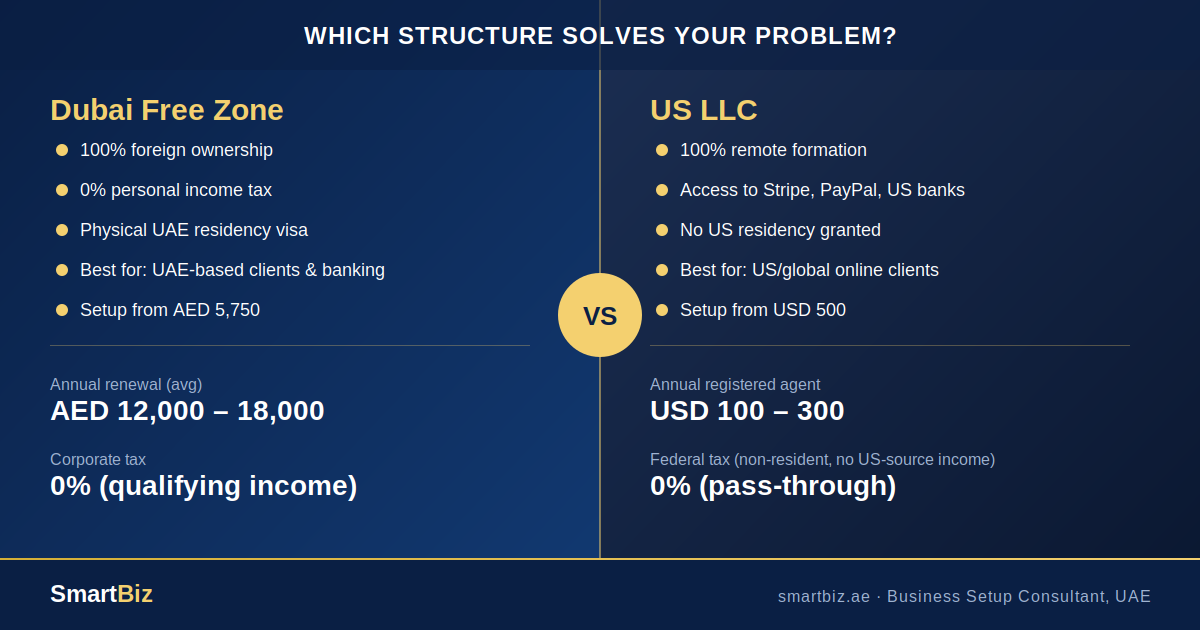
Side-by-Side: Dubai Free Zone vs US LLC
| Factor | Dubai Free Zone Company | US LLC (Non-Resident) |
|---|---|---|
| Primary purpose | Residency, tax position, life base | US payment and banking access |
| Personal income tax | 0% | Not applicable (commercial entity only) |
| Corporate tax | 0% on qualifying income; 9% above threshold otherwise | Generally 0% US federal tax for qualifying non-resident structures |
| Residency granted | Yes — 2-year renewable UAE visa + Emirates ID | No residency rights of any kind |
| Foreign ownership | 100% | 100% |
| Setup timeline | Typically 2–4 weeks | Typically 7–10 business days |
| Banking | UAE corporate banking, SWIFT network | US banking, Stripe/PayPal domestic merchant status |
| Annual compliance | UAE corporate tax filing (where applicable), licence renewal | Form 5472 + pro-forma 1120 mandatory every year |
| Best suited for | Founders wanting to relocate and restructure their tax base | Founders needing US payment rails without relocating |
The Permanent Establishment Trap Most Guides Ignore
This is worth its own section because it is the single most consequential detail in the entire Dubai Free Zone vs US LLC conversation — and it is the part most surface-level comparisons either skip entirely or mention in a single throwaway line.
If you are physically based in Dubai and you personally manage a US LLC’s operations — making the day-to-day decisions, directing the business, controlling its strategy — the UAE Federal Tax Authority may determine that the LLC has a permanent establishment in the UAE. In practical terms, this means the LLC’s income can become subject to UAE corporate tax, despite being a US-registered entity.
This does not make a US LLC a bad idea. It means the structure needs to be set up correctly from the outset, with proper attention to:
- Where management and control genuinely sits — and how this is documented
- The ownership structure — generally, having the US LLC owned by your UAE company rather than by you personally produces a cleaner, more defensible structure
- How profits flow between the two entities, and ensuring this is properly recorded and compliant on both sides
This is exactly the kind of structural decision that benefits from proper advisory input before you set anything up — not a retrofit after a tax authority raises a question.
When a Dubai Free Zone Company Alone Is the Right Answer
For a substantial proportion of entrepreneurs, a Dubai Free Zone company on its own is the complete answer — no US LLC required at all. This is typically the case when:
- Your clients and customers are based outside the United States, or your business does not depend on US-specific platforms like Amazon US, US-restricted affiliate networks, or Stripe’s domestic merchant categorisation
- You invoice clients directly and are not encountering payment processing friction
- You want UAE residency as a genuine life decision, not purely a tax optimisation exercise
- You are a consultant, agency owner, service provider, or international trader whose payment flows work perfectly well through UAE corporate banking
If this describes your situation, adding a US LLC introduces additional annual compliance obligations (the mandatory Form 5472 filings) and structural complexity without solving any actual problem you currently have. The right move is the simpler one: a clean Free Zone Company Setup, supported by proper Bank Account Support and ongoing Financial Management.
When You Might Need Both Structures
There is a specific, recognisable profile of founder for whom running both structures together genuinely makes sense:
You relocate to Dubai — or are planning to. Your business sells primarily to US or international online customers. The Dubai Free Zone company handles your residency, your UAE banking, and your tax-efficient base. But your business relies on Stripe, sells through Amazon, or works with US affiliate networks that only pay out to US accounts — and a UAE entity alone runs into friction at exactly that commercial layer.
In this scenario, a properly structured US LLC sits underneath the UAE company as the payment-facing entity, with the recommended ownership flow looking like this:
You (UAE resident) → own → UAE Free Zone Company → owns → US LLC
Payments from US customers flow into the US LLC. Profits then distribute upward to the UAE company, where they are taxed under UAE rules. Done correctly, this avoids double taxation and gives you both the tax-efficient home base and frictionless US payment access simultaneously.
A few non-negotiables for this to function correctly:
- The US LLC should be owned by the UAE entity, not by the founder personally — this produces a cleaner ownership chain and clearer tax treatment on both sides
- The annual US compliance filings cannot be skipped, even when zero US tax is owed
- Where management and control of the LLC actually sits needs to be clearly established and properly advised on, given the permanent establishment risk outlined above
If this is your profile — UAE-based, internationally focused revenue, hitting friction on US platforms — it is worth having a proper conversation about structuring this correctly from the outset, rather than retrofitting it after the friction becomes a genuine bottleneck. SmartBiz can advise on the UAE side of this structure and coordinate with appropriate US-side specialists where a US LLC genuinely becomes necessary for your business.
How Ownership and Profit Flow Should Be Structured
Getting the structural mechanics right matters as much as the decision itself. Here is what a properly structured dual arrangement looks like in practice:
Ownership layer: Your UAE Free Zone company sits as the parent entity. If a US LLC is genuinely needed for payment access, it should generally be owned by the UAE company rather than directly by you as an individual. This produces a defensible, properly documented corporate structure rather than a personal-ownership arrangement that blurs the lines between the two jurisdictions.
Banking layer: Your UAE corporate bank account receives distributed profits from the US LLC. Your personal banking, residency, and day-to-day financial life operate through the UAE structure, supported by our Bank Account Support service.
Tax layer: Profits earned by the US LLC from US-facing commercial activity (Stripe transactions, Amazon sales, affiliate payouts) flow up to the UAE parent company. Taxation is then assessed under UAE rules — and where the UAE company qualifies for 0% corporate tax on its qualifying income, this is where the overall tax efficiency of the dual structure is realised.
Compliance layer: Both sides require ongoing attention. The US side needs annual Form 5472 and pro-forma 1120 filings regardless of tax owed. The UAE side needs proper VAT Registration and VAT Filing where applicable, Corporate Tax Registration and Corporate Tax Filing, and accurate Financial Management across both entities to keep the structure clean and defensible.
Setting Up Your Dubai Free Zone Company: The Process
Whichever way you ultimately structure your business internationally, the Dubai Free Zone company is almost always the foundation. Here is the standard process:
Step 1 — Choose your free zone. Dubai has over 30 free zones, each with its own focus, fee structure, and permitted activities. The right choice depends on your business activity, your visa requirements, and your budget.
Step 2 — Select your legal structure. Most single-founder businesses register as an FZE (Free Zone Establishment); businesses with two or more shareholders typically register as an FZCO (Free Zone Company).
Step 3 — Reserve your trade name and apply for initial approval. This confirms the free zone authority’s no-objection to your proposed company name and business activity.
Step 4 — Submit your incorporation documents. Passport copies, passport photographs, and (for corporate shareholders) parent company incorporation documents.
Step 5 — Secure your office or flexi-desk. Most free zones offer flexible, cost-effective workspace packages suited to remote and digitally focused businesses.
Step 6 — Receive your trade licence. Once approvals and payments are complete, your licence is issued — typically within a few business days for most free zones.
Step 7 — Apply for your residency visa and Emirates ID. This includes a medical fitness test, biometrics appointment, and visa stamping — generally completed within 2–4 weeks of licence issuance.
Step 8 — Open your UAE corporate bank account. With your trade licence and residency visa in hand, our Bank Account Support team manages bank selection, documentation, and the account opening process.
For a full breakdown of free zone options and costs, visit our Free Zone Company Setup page. If your business model is better suited to direct UAE market access, our Mainland Company Formation page covers that alternative, and our Dubai Offshore Licence page covers holding structures for international assets.
How SmartBiz Supports Your Dubai Structure (and Coordinates the Rest)
At SmartBiz, our focus is building a properly structured, compliant UAE business foundation — the part of this comparison that genuinely determines your residency, your tax position, and your long-term base. We then work alongside your wider advisory team (accountants, US-side specialists where relevant) to ensure your full international structure functions correctly end to end.
Here is what we manage directly:
Business Formation:
- Free Zone Company Setup — full setup across Dubai’s leading free zones, matched to your business activity and budget
- Mainland Company Formation — for businesses requiring direct UAE market access
- Dubai Offshore Licence — holding structures for international assets and parent-company arrangements
- Trader Registration & Licence — specialist support for commercial traders
Visa and Residency:
- Employment Visa UAE and Residency Visa UAE — full visa processing and renewals
- Golden Visa UAE — 10-year residency through qualifying investment routes
Banking and Compliance:
- Bank Account Support Dubai — UAE corporate and personal account opening support
- VAT Registration and VAT Filing — full UAE VAT compliance
- Corporate Tax Registration and Corporate Tax Filing — ensuring your structure correctly qualifies for available exemptions
- Company Audit Reports and Financial Management — ongoing bookkeeping and compliance across your UAE entity
Get in touch with our team at smartbiz.ae to discuss your specific situation, and we will help you build the right UAE foundation for whatever broader structure your business needs.
Frequently Asked Questions (FAQs)
What is the difference between a Dubai Free Zone company and a US LLC?
A Dubai Free Zone company is a residency and tax-position decision — it gives you a UAE trade licence, 100% foreign ownership, a renewable UAE residency visa, and access to 0% personal income tax. A US LLC formed by a non-US resident is a commercial infrastructure decision — it gives access to US banking, Stripe and PayPal as a domestic merchant, and US platforms like Amazon, without granting any residency rights or tax benefits in itself.
Do I need a US LLC if I already have a Dubai Free Zone company?
Not necessarily. If your business does not depend on US-specific payment platforms, US affiliate networks, or US clients requiring a domestic invoicing entity, a Dubai Free Zone company alone is typically the complete and correct answer. A US LLC becomes worth considering specifically when you encounter payment processing friction tied to US infrastructure.
Can a UAE company own a US LLC?
Yes. This is generally the recommended ownership structure when both entities are genuinely needed — your UAE Free Zone company owns the US LLC, rather than you owning the LLC personally. This produces a cleaner ownership chain, with profits distributing from the LLC up to the UAE parent company, where they are taxed under UAE rules.
Does a US LLC reduce my UAE tax obligations?
No. This is one of the most important points to understand: a US LLC does not sit outside UAE tax rules simply because it is a US-registered entity. If the LLC is managed and controlled from Dubai, UAE tax authorities can treat it as having a permanent establishment in the UAE, bringing its income back into the UAE tax framework. A US LLC is a commercial tool for payment access, not a tax-reduction strategy.
Can I get UAE residency through a US LLC?
No. A US LLC grants no residency rights of any kind, in the UAE or anywhere else. UAE residency is obtained specifically through setting up a UAE company — whether free zone, mainland, or through other qualifying routes such as the Golden Visa — which grants a renewable UAE residency visa as part of the setup.
Which is faster to set up: a Dubai Free Zone company or a US LLC?
A US LLC can typically be formed within 7–10 business days. A Dubai Free Zone company, including trade licence issuance, typically takes 2–4 weeks when factoring in the residency visa and Emirates ID process. If you only need the trade licence itself without the full residency process, free zone licence issuance alone can be completed in a few business days.
Do I need both a Dubai company and a US LLC?
Both structures together tend to make sense when you are based in Dubai, your revenue comes primarily from US or international digital customers, and your business is running into payment processing friction specifically tied to US platforms (Stripe declines, Amazon US restrictions, US-only affiliate payouts). If none of those frictions currently apply to your business, a Dubai Free Zone company alone is generally sufficient.
What is the permanent establishment risk with a US LLC managed from Dubai?
If you are physically based in the UAE and personally direct the day-to-day operations and strategic decisions of a US LLC, the UAE Federal Tax Authority may determine the LLC has a permanent establishment in the UAE — meaning its income becomes subject to UAE corporate tax rules despite the entity being US-registered. Proper structuring around ownership, management, and documentation reduces this risk, and is best addressed with qualified advice before setup rather than after.
Is a Dubai Free Zone company better than a US LLC for tax purposes?
They are not really comparable on tax in the way this question implies, because they answer different questions. A Dubai Free Zone company is the structure that determines your personal tax residency and offers 0% personal income tax plus potential 0% corporate tax on qualifying income. A US LLC generally generates no US federal tax for qualifying non-resident structures, but it has no bearing on your personal tax position — that is determined entirely by where you are tax resident, which for most founders considering this comparison means the UAE structure.
What annual compliance does each structure require?
A US LLC with non-resident ownership must file Form 5472 alongside a pro-forma Form 1120 every year, regardless of whether any US tax is owed — penalties for missing this are substantial. A UAE Free Zone company requires trade licence renewal, VAT compliance where applicable (via our VAT Registration and VAT Filing services), and corporate tax registration and filing (via our Corporate Tax Registration and Corporate Tax Filing services) where the company exceeds the relevant thresholds or does not qualify for the 0% exemption.