
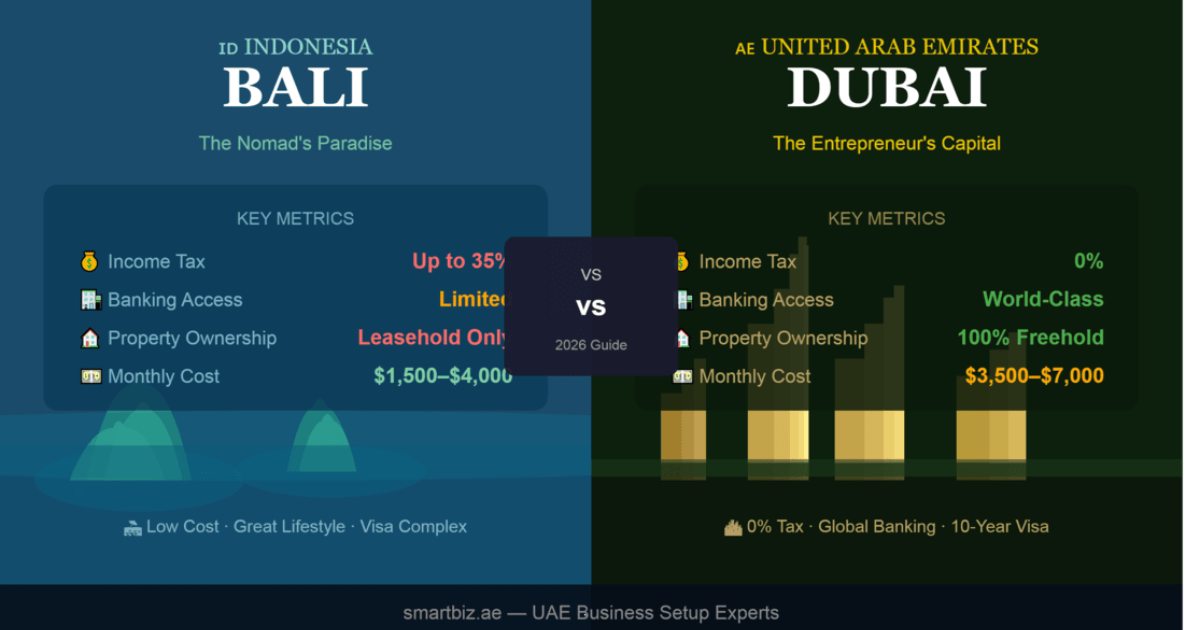
Bali vs Dubai for Entrepreneurs: Which Is the Better Business Hub in 2026?
Every year, thousands of entrepreneurs ask the same question: should I base my business in Bali or Dubai?
Bali looks incredible on Instagram. The cost of living is a fraction of what you’d pay in your home country. The digital nomad scene is booming. And the food, the nature, the yoga studios it all seems perfect.
Dubai, on the other hand, is serious. Structured. Tax-free. It’s the city that serious founders are talking about the one that made them rethink everything about where they run their business and where they park their money.
We’ve helped hundreds of entrepreneurs through this exact decision at Smart Biz. This guide gives you the honest, number-driven answer to the Bali vs Dubai question so you can make the right call for your income, your lifestyle, and your long-term financial future.
The Big Picture: Bali vs Dubai at a Glance
Before we go deep, here’s a side-by-side snapshot of the two destinations across the most important categories for entrepreneurs:
| Category | 🇮🇩 Bali | 🇦🇪 Dubai | Winner |
|---|---|---|---|
| Personal Income Tax | Up to 35% | 0% | Dubai |
| Corporate Tax | 22% | 0–9% (Free Zone/Mainland) | Dubai |
| Tax Residency Certificate | ❌ Not globally recognized | ✅ Internationally accepted TRC | Dubai |
| Residency Visa | 60–180 days (extendable) | 2-year or 10-year Golden Visa | Dubai |
| Freehold Property | ❌ Foreigners cannot own | ✅ 100% ownership in freehold zones | Dubai |
| Banking | Limited multi-currency | USD, EUR, GBP, AED accounts | Dubai |
| Monthly Living Cost | $1,500–$4,000 | $3,500–$7,000 | Bali (sticker) |
| Internet Speed | Moderate, inconsistent | Among world’s fastest | Dubai |
| Safety | Safe (petty crime present) | Top 5 globally | Dubai |
| Networking Quality | Nomad/lifestyle-focused | High-earning founders & investors | Dubai |
The numbers are clear. But let’s go deeper because the real story is in the details.
1. Taxes: The Number That Changes Everything
For most Western entrepreneurs, taxes are the #1 reason they start exploring alternatives to their home country. And this is where Dubai and Bali are worlds apart.
What Indonesia’s Tax System Actually Looks Like
Indonesia uses a progressive personal income tax system with rates climbing all the way to 35% for high earners. Corporate tax sits at 22%. If you’re considered an Indonesian tax resident which kicks in after 183 days of physical presence in any rolling 12-month period these rates apply to your worldwide income.
Here’s the critical detail most people miss: even holding an Indonesian residence permit can trigger tax residency, regardless of whether you’ve spent 183 days in the country. This catches many digital nomads off guard.
Indonesia introduced its E33G Remote Worker Visa to attract location-independent professionals. It does offer an exemption from Indonesian tax on foreign-sourced income but it has serious limitations:
- Requires proof of at least $60,000 in annual income
- Capped at 2 years with one renewal (maximum 4 years total)
- Not internationally recognized banks and foreign tax authorities won’t accept it as proof of changed tax residency
That last point is crucial. If you’re leaving a high-tax country, you need your new tax residency to be formally accepted by your home country’s tax authority and by international banks. Bali’s visa options simply don’t provide that.
What the UAE’s Tax System Looks Like
The UAE has 0% personal income tax full stop. No exceptions. No income thresholds. No excluded income types. Dividends, capital gains, crypto profits, freelance income, salary all received tax-free by UAE tax residents.
UAE corporate tax was introduced in 2023:
- 0% on profits up to AED 375,000 (~$102,000/year)
- 9% above that threshold for mainland companies
- 0% for qualifying Free Zone businesses (subject to economic substance requirements)
To qualify as a UAE tax resident, you need:
- A valid UAE residency visa
- A minimum of 90 days of physical presence in the UAE per year
- A Tax Residency Certificate (TRC) issued by the Federal Tax Authority
This TRC is recognized by governments and banks worldwide making it a genuine, legally accepted proof of tax residency change. Smart Biz has a 100% TRC approval rate for all clients we’ve supported.
The Math That Makes the Decision Easy
Let’s say you earn $200,000 per year. Here’s what each destination actually costs you:
In Bali:
- Indonesian income tax (~35%): -$70,000
- Monthly living costs (~$2,500/month): -$30,000
- Annual surplus: ~$100,000
In Dubai:
- UAE personal income tax: $0
- Monthly living costs (~$4,500/month): -$54,000
- Annual surplus: ~$146,000
Dubai leaves you with $46,000 more per year despite having higher living costs. Over five years, that’s potentially $230,000+ that stays in your pocket instead of going to a government.
At higher income levels, the gap grows even more dramatically.
2. Visas and Residency: Stability vs Complexity
Bali’s Visa Landscape in 2026
Bali’s visa situation has improved in recent years, but it remains significantly more complex and less stable than Dubai’s.
The most commonly used option is the B211A social/cultural visa, valid for 60 days and extendable to 180 days. It technically doesn’t permit working, but most remote workers use it in practice. Indonesian authorities have been tightening enforcement on this throughout 2025 and 2026.
The E33G Remote Work KITAS is Indonesia’s formal remote work visa. It legally permits working remotely for foreign companies, costs around $600, and is valid for one year with one renewal. But it:
- Does not provide a path to permanent residency
- Does not resolve formal tax residency
- Caps out at a maximum of 4 years total
The Second Home Visa offers up to 10 years of residency but requires $130,000+ in savings or a qualifying property investment and still doesn’t provide internationally recognized tax residency.
In practice, most people in Bali cycle through tourist visas and manage extensions. It works as a lifestyle setup. But it’s not a business infrastructure.
Dubai’s Residency Options in 2026
UAE residency through a free zone or mainland company is a formal, internationally recognized legal status.
From first contact to Emirates ID in hand: 7 to 14 days with Smart Biz.
Your options:
- Standard 2-year company visa renewable, straightforward
- 10-year Golden Visa available through a property purchase of AED 2,000,000+ or qualifying investment; a decade of secure residency, no annual renewal required
- Emirates ID functions as a primary identity document for banking, contracts, healthcare, and government services
- UAE residency can sponsor family members
- Provides the foundation for the internationally accepted Tax Residency Certificate
The contrast is sharp. Bali offers lifestyle. Dubai offers infrastructure.
3. Banking: Where Serious Business Happens
This is one of the most practically important differences for entrepreneurs running international businesses.
In Bali: Opening a legitimate foreign business bank account in Indonesia is genuinely difficult. International transfers are slower and more expensive. While Stripe and PayPal operate in Indonesia, payouts into Indonesian bank accounts involve significantly more friction than most founders want.
In Dubai:
- Multi-currency accounts: USD, EUR, GBP, AED all available
- Clean international payment rails with fast, low-cost transfers
- No friction with European and North American clients
- Regulated crypto exchanges for compliant digital asset transactions
- The UAE was recently removed from the EU’s financial grey list, making UAE banking even more accessible for international business
Smart Biz assists all clients with corporate bank account setup, including introductions to the best banks for your specific business type. We also support you through the entire approval process so you’re not navigating it alone.
4. Property Ownership: A Fundamental Legal Difference
If you’re thinking about long-term wealth building not just short-term living this section matters enormously.
Bali: Leasehold Only
Foreigners in Indonesia cannot own freehold residential property directly. Your options are:
- Long-term leases (typically 30 years with possible renewal)
- Nominee structures using local Indonesian partners
- Indonesian corporate entities
All of these carry legal risk, require ongoing management, and provide no guarantee of continuation after the lease period. After 30 years, you may or may not be able to renew and you have no legal recourse if you can’t.
Dubai: Full Freehold Ownership
In Dubai’s designated freehold zones, foreigners can buy property with full legal title no nominees, no leasehold cliff, no corporate wrappers needed.
Key benefits:
- Dubai Land Department maintains a transparent, publicly verifiable register
- The market is highly liquid
- Rental yields of 5–8% gross among the highest of any major global city
- A purchase of AED 2,000,000+ qualifies for the 10-year Golden Visa
- Property can be rented, sold, or passed on without restriction
For an entrepreneur thinking about where to build long-term assets, the legal security difference between Dubai freehold and Bali leasehold is not a minor detail. It’s a fundamental structural distinction.
Smart Biz works with trusted real estate partners to help clients identify the right property, manage the purchase process, and secure their Golden Visa through property investment.
5. Infrastructure and Connectivity
For entrepreneurs who run businesses online which is most of the people considering this choice infrastructure is the practical environment in which you work every single day.
Bali
Internet in Bali has improved significantly. Fiber connections delivering 50–100 Mbps are now standard in Canggu and Seminyak. But reliability still varies villa to villa and building to building. Many serious digital workers add Starlink as a backup ($40–60/month), which adds an extra layer of cost and setup.
Power cuts, while less frequent than a decade ago, still occur during wet season storms. Mobile data can be slow in more rural areas.
Dubai
Dubai consistently ranks among the world’s fastest and most reliable internet destinations. Fiber is available across virtually all residential and commercial areas. Mobile connectivity is excellent. Power is 100% stable. The infrastructure is simply in a different league.
Dubai International Airport connects directly to almost every major global city, making it one of the best-positioned hubs for founders who travel frequently for business.
6. Lifestyle: Where Bali Actually Has the Edge
Let’s be honest Bali has real lifestyle advantages that Dubai can’t replicate.
Bali wins on:
- Cost of day-to-day living ($1,500–$4,000/month is genuinely comfortable)
- Food quality, especially healthy and vegan options
- Natural beauty rice terraces, beaches, volcanos
- The wellness community yoga, meditation, retreats
- A slower pace that many founders find restorative
- The nomad community creative, diverse, international
Dubai wins on:
- Ambition and energy a city of builders and founders
- World-class restaurants, events, and lifestyle infrastructure
- High-caliber networking the people you meet in Dubai tend to be operating at a higher business level
- Safety Dubai is consistently ranked top 5 globally for safety
- Better weather October to April (and the heat of June–September is when you can be in Bali)
The key insight: these two places serve completely different needs. Dubai gives you the foundation. Bali gives you the reset.
Many Smart Biz clients use exactly this combination Dubai as their primary tax home (90–120 days/year to satisfy UAE residency requirements), and Bali as one of their favorite destinations during Dubai’s summer months.
7. The Hidden Reason Bali and Dubai Work Perfectly Together
One thing most comparison articles miss: the climates of Bali and Dubai are almost perfectly complementary.
Dubai is exceptional from October through April beautiful weather, ideal for networking, events, and productivity.
Dubai’s summers (June–September) are extreme heat that most people find difficult.
Bali’s dry season runs from May through September exactly the months when Dubai is at its most challenging.
The result: a founder who spends October–April in Dubai (meeting the 90-day UAE residency requirement easily) can then spend May–September in Bali without any tax residency conflict as long as they:
- Stay under 183 days in Indonesia
- Do not hold an Indonesian residence permit (to avoid triggering Indonesian tax residency)
This is the smart entrepreneur’s dual-destination strategy, and it’s exactly what many of our clients already practice.
8. The Real Cost Comparison (After Taxes)
Bali is cheaper on paper. But paper doesn’t pay taxes.
Here’s the true comparison at different income levels:
At $100,000/year income:
| Bali | Dubai | |
|---|---|---|
| Tax paid | ~$30,000 | $0 |
| Annual living costs | ~$24,000 | ~$42,000 |
| Annual surplus | ~$46,000 | ~$58,000 |
At $200,000/year income:
| Bali | Dubai | |
|---|---|---|
| Tax paid | ~$70,000 | $0 |
| Annual living costs | ~$30,000 | ~$54,000 |
| Annual surplus | ~$100,000 | ~$146,000 |
At $500,000/year income:
| Bali | Dubai | |
|---|---|---|
| Tax paid | ~$175,000 | $0 |
| Annual living costs | ~$36,000 | ~$72,000 |
| Annual surplus | ~$289,000 | ~$428,000 |
The higher your income, the more dramatic the Dubai advantage. Bali’s cheaper cost of living is entirely wiped out by Indonesia’s tax rates at any meaningful income level.
9. Who Should Choose Bali (At Least Part-Time)
We’re not here to dismiss Bali. It genuinely suits certain situations:
- Entrepreneurs earning below $50,000/year where tax savings don’t significantly offset Dubai’s higher costs
- Founders in a creative or reset phase who need space to think, not hustle
- People who want to test location independence before committing to a full relocation
- Those who have already established Dubai residency and want Bali as a seasonal base
If you fall into any of these categories especially the last one Bali makes a lot of sense for parts of the year.
10. Who Should Choose Dubai
Dubai is the clear choice if you:
✅ Earn more than $100,000/year (the tax savings alone justify the move)
✅ Need internationally recognized tax residency for banking and home-country tax exit
✅ Want multi-currency corporate banking with clean international payment rails
✅ Plan to build long-term assets through property ownership
✅ Want to build a serious network of high-caliber entrepreneurs and investors
✅ Need business infrastructure that’s stable, recognized, and scalable
✅ Can commit to 90+ days/year in the UAE
How Smart Biz Makes Your Dubai Setup Easy
At Smart Biz, we handle the entire process of getting your business established in Dubai from company registration to bank account opening and Tax Residency Certificate application.
What we set up for you:
- 🏢 Company registration Free Zone, Mainland, or Offshore based on your business needs
- 🪪 UAE Residency Visa processed efficiently with Emirates ID issued in 7–14 days
- 🏦 Corporate bank account we introduce you to the right bank for your business type and guide you through approval
- 📄 Tax Residency Certificate the globally recognized document that formally establishes your UAE tax residency
- 💼 PRO Services all government paperwork, visa renewals, and documentation handled for you
- 🧾 Accounting & VAT compliance ongoing support so you stay compliant
We offer Free Zone licenses from AED 5,750, with Mainland and Offshore options available depending on your requirements. Most clients complete the full setup company, visa, and Emirates ID within two weeks of starting.
Our team works across Dubai, Sharjah, and Abu Dhabi and has established relationships with all major Free Zones, UAE government authorities, and leading banks.
Frequently Asked Questions
Can I live in Bali and use Dubai for tax purposes?
Yes but it requires careful planning. UAE tax residency requires a minimum of 90 days of physical presence in the UAE per year plus a valid residency visa. You can spend the remaining time in Bali or anywhere else.
The key watch-out for Bali: stay under 183 days and do not hold an Indonesian residence permit, or you risk triggering Indonesian tax residency on top of your UAE residency.
Do I have to choose between Bali and Dubai?
No. The most effective arrangement used by many Smart Biz clients is Dubai as the primary base for 90–150 days per year, then travelling freely. Bali, Europe, Southeast Asia wherever you prefer. Dubai provides the structure. Everything else is lifestyle.
Is Bali’s E33G visa a real alternative to UAE residency?
Not for someone who wants internationally recognized tax residency. The E33G permits legal remote work in Bali, but it:
- Does not resolve home-country tax obligations
- Is not accepted as proof of changed tax residency by most foreign banks or tax authorities
- Caps out at 4 years total
UAE residency with a Tax Residency Certificate is a structurally different and far more robust solution.
How much does it cost to set up in Dubai?
At Smart Biz, Free Zone company packages start from AED 5,750. Packages including a visa, Emirates ID, and corporate bank account support start from AED 12,000. Mainland licenses are available from AED 13,500.
For most entrepreneurs earning above $100,000/year, the first year’s tax saving alone covers the setup cost multiple times over.
Is Dubai safe?
Yes Dubai consistently ranks among the top 5 safest cities globally for crime rate. It offers an extremely high quality of life, world-class healthcare, and outstanding stability for residents and their families.
How long does the Dubai setup process take?
With Smart Biz, most clients receive their company registration, visa, and Emirates ID within 7–14 days of starting the process. We handle everything end-to-end so there are no delays caused by paperwork errors or missing documentation.
The Bottom Line: Bali vs Dubai for Entrepreneurs
Bali is beautiful, affordable, and genuinely appealing. It’s a wonderful place to spend weeks or months of the year.
But it cannot replace Dubai as a business base.
Dubai offers the structural foundation that serious entrepreneurs need: zero personal income tax, internationally recognized tax residency, world-class banking infrastructure, freehold property ownership, and long-term visa stability.
The smart play in 2026 is not Bali or Dubai. It’s Dubai as your foundation, with Bali (and anywhere else you love) as part of your lifestyle once that foundation is in place.
Ready to build your Dubai structure? Smart Biz handles company setup, visas, banking, and Tax Residency Certificates all in 7 to 14 days.