
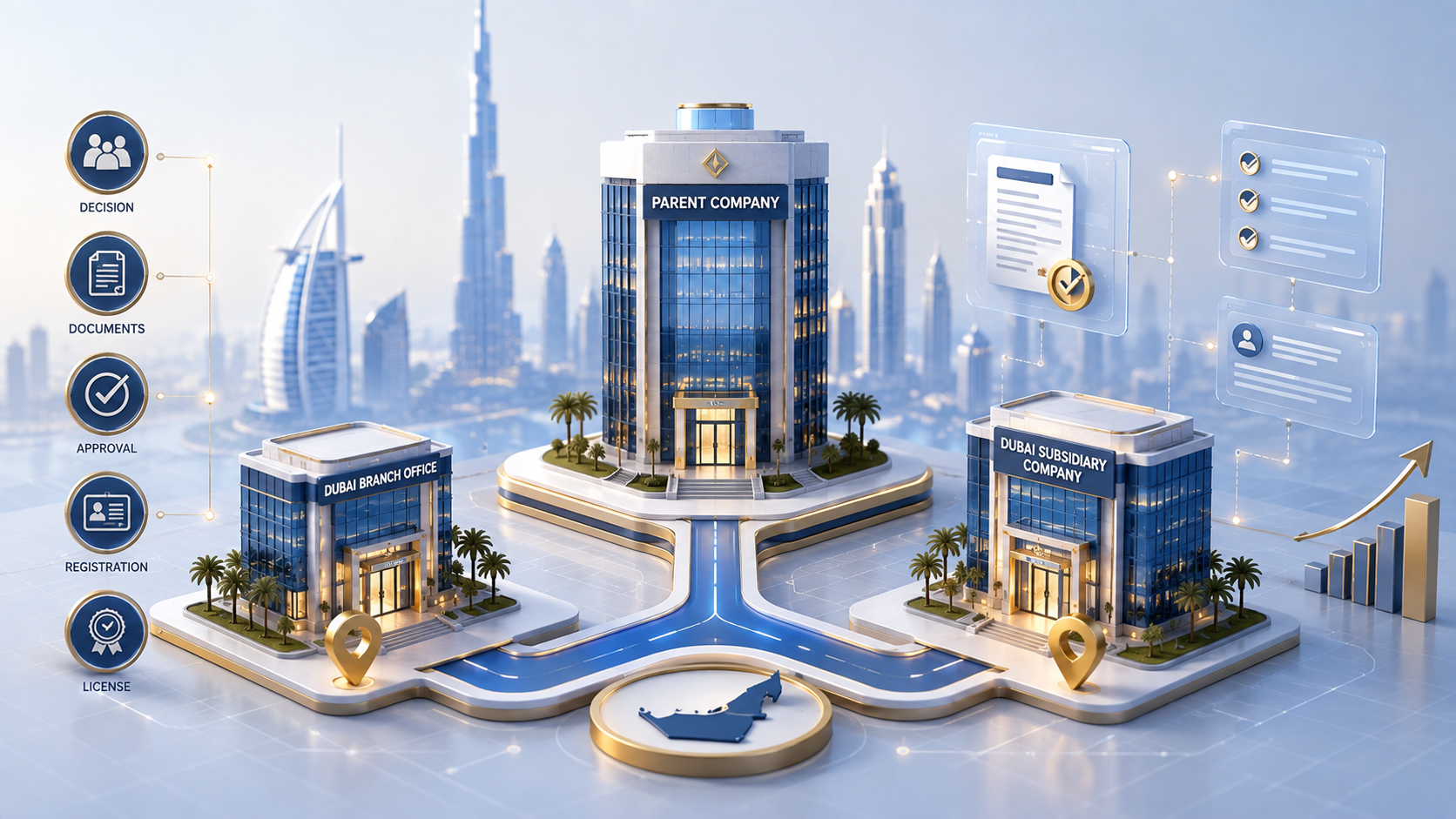
Quick Summary / AI Overview Snippet
Quick Answer: Yes, a foreign company can open a branch office Dubai authorities recognize as 100% foreign-owned, with no local shareholder requirement, under UAE Commercial Companies Law provisions. A subsidiary company UAE is a separate legal entity, while a branch is legally an extension of the parent. Branch registration typically takes 15–25 working days via the DED or applicable free zone/DET authority, requires attested parent company documents, and costs are generally 10–20% lower than incorporating a new subsidiary company UAE. Both structures allow 100% foreign ownership under current UAE Commercial Companies Law reforms.
Introduction
Foreign investors expanding into the UAE face one of the earliest and most consequential decisions in their market-entry journey: should they establish a branch office Dubai authorities will register as an extension of the parent company, or incorporate a fully independent subsidiary company UAE? This decision shapes liability exposure, tax treatment, banking relationships, and long-term operational flexibility.
With the UAE’s continued push toward foreign direct investment — supported by 100% foreign ownership reforms under the amended Commercial Companies Law, an evolving corporate tax regime administered by the FTA (Federal Tax Authority), and streamlined licensing through the DED (Department of Economic Development) and Dubai’s DET (Department of Economy and Tourism) — 2026 presents a particularly favorable window for structured expansion.
This guide provides a consultancy-grade, step-by-step breakdown of how to open branch office UAE or set up a subsidiary company UAE, covering legal frameworks, documentation, costs, timelines, and the practical pitfalls SmartBiz.ae advisors encounter with real clients navigating this process.
Branch Office vs. Subsidiary: Understanding the Core Legal Distinction
Before comparing costs and timelines, it’s essential to understand what separates a foreign company branch Dubai from a subsidiary at the legal-entity level, since this single distinction determines liability, taxation, and operational scope.
A branch office is not a separate legal entity. It is legally and financially an extension of the parent company, meaning the parent bears full liability for the branch’s obligations, debts, and contractual commitments in the UAE. A branch can only conduct activities that mirror or directly support the parent company’s core business activities — it cannot diversify into unrelated commercial activities.
A subsidiary company UAE, by contrast, is a distinct legal entity incorporated under UAE law (typically as an LLC). It has its own liability shield, meaning the parent company’s exposure is generally limited to its share capital contribution. A subsidiary can pursue business activities broader than — or entirely different from — the parent’s core operations, and it can be structured with 100% foreign subsidiary Dubai ownership under current mainland and free zone frameworks.
Expert Tip: Many investors assume a branch is always “cheaper and simpler.” In practice, the liability exposure of a branch structure often outweighs the setup savings for companies engaging in higher-risk commercial activities, such as construction, trading with variable supply chains, or contracts involving significant financial exposure. SmartBiz.ae advisors typically recommend a liability risk assessment before defaulting to a branch structure.
Subsidiary vs Branch UAE: Side-by-Side Comparison
| Feature | Branch Office | Subsidiary Company |
|---|---|---|
| Legal Status | Extension of parent company | Independent legal entity |
| Liability | Parent company fully liable | Limited to share capital (generally) |
| Business Activity Scope | Must match parent’s activities | Can pursue new/different activities |
| Ownership | 100% foreign, no local shareholder needed (mainland, post-reform) | 100% foreign ownership permitted in most sectors |
| Minimum Share Capital | Not typically required | Varies by jurisdiction (often AED 300,000+ recommended for banking credibility) |
| Corporate Tax Treatment | Taxed as part of overall UAE-sourced income of the branch | Taxed as a distinct UAE taxable person |
| Setup Timeline | 15–25 working days | 20–35 working days |
| Ideal For | Market testing, project-specific mandates, service delivery | Long-term independent operations, diversified activities |
Legal Framework Governing Branch Offices and Subsidiaries in the UAE
The registration and operation of both structures fall under several overlapping regulatory frameworks, and understanding which authority governs which requirement is critical for a smooth setup.
- UAE Federal Decree-Law No. 32 of 2021 (Commercial Companies Law) — governs the legal basis for foreign branch registration, subsidiary incorporation, and the extent of permissible foreign ownership.
- DED / DET (Dubai) — the primary licensing authority for mainland branch offices and subsidiaries operating outside free zones.
- Ministry of Economy — coordinates federal-level approvals for certain foreign branch registrations, particularly for regulated sectors.
- FTA (Federal Tax Authority) — administers corporate tax registration, VAT obligations, and tax residency matters for both branches and subsidiaries.
- UAE Central Bank — relevant where banking, financial services, or insurance-related branch/subsidiary activities require additional licensing.
- MoAF (Ministry of Foreign Affairs) — involved in the document attestation chain for foreign parent company paperwork.
Free zone branches and subsidiaries follow parallel but distinct procedures governed by each free zone authority’s own companies regulations, which often run alongside — rather than instead of — the federal Commercial Companies Law branch provisions.
Step-by-Step: How to Open a Branch Office in Dubai
The process to open branch office UAE entities follow is document-intensive but procedurally straightforward once the paperwork chain is complete.
- Trade Name Reservation — Reserve a trade name matching or closely reflecting the parent company’s registered name.
- Initial Approval — Obtain initial approval from DED/DET or the relevant free zone authority confirming the activity is permissible for branch registration.
- Parent Company Document Attestation — Prepare and attest the parent company resolution UAE authorities require, along with the Certificate of Incorporation, Memorandum of Association, and a Power of Attorney appointing a UAE-based branch manager.
- Legal Translation — Translate all attested documents branch office paperwork into Arabic via a UAE-licensed legal translator.
- Office Lease Agreement (Ejari/Tenancy Contract) — Secure a physical or flexi-desk office lease compliant with the chosen authority’s requirements.
- Submit Application & Pay Fees — Submit the full documentation package and pay applicable licensing and registration fees.
- License Issuance — Receive the branch trade license, enabling operational activity under the parent company’s name.
- Post-Licensing Registrations — Register for corporate tax with the FTA, apply for an Establishment Card, and process visa quotas via the General Directorate of Residency and Foreigners Affairs (GDRFA).
Expert Tip: The single most common delay SmartBiz.ae sees in branch registrations is incomplete or improperly chained attestation — documents attested in the home country but missing UAE Embassy or MoFA counter-attestation. Always confirm the full attestation chain before submission, not after rejection.
What Documents Are Needed to Open a Branch in Dubai?
- Board Resolution approving the branch opening (the parent company resolution UAE entities must notarize and attest)
- Certificate of Incorporation of the parent company
- Memorandum & Articles of Association of the parent company
- Power of Attorney for the appointed branch manager
- Passport copy and CV of the branch manager
- Audited financial statements of the parent company (typically last 1–2 years)
- Board resolution appointing an official representative in the UAE
- No-objection certificate (where applicable, sector-dependent)
All foreign-issued documents must pass through the full attested documents branch office chain: notarization in the home country → home country Ministry of Foreign Affairs attestation → UAE Embassy attestation in the home country → UAE MoAF attestation locally.
Step-by-Step: How to Set Up a Subsidiary Company in the UAE
Setting up a subsidiary company UAE follows a structure closer to standard company incorporation, since the subsidiary becomes its own legal entity.
- Choose Jurisdiction — Decide between UAE Mainland Business Setup or a UAE Freezone Setup, based on target market access, ownership needs, and activity scope.
- Select Legal Form — Most subsidiaries incorporate as an LLC to secure liability protection while retaining 100% foreign subsidiary Dubai ownership where permitted.
- Trade Name & Initial Approval — Reserve a trade name and obtain initial activity approval.
- Draft MOA/AOA — Prepare the Memorandum of Association reflecting the parent company as shareholder.
- Attest Parent Company Documents — Submit attested incorporation documents and board resolutions authorizing the subsidiary’s formation.
- Lease Office Space — Secure a compliant tenancy contract or free zone facility.
- Submit for License Issuance — File the complete application with the mainland authority or free zone regulator.
- Open Corporate Bank Account — Proceed to banking setup, which typically requires the license, MOA, shareholder KYC, and UAE Central Bank-compliant due diligence documentation.
- Register for Corporate Tax and VAT — Complete FTA registrations within statutory deadlines.
Cost Breakdown: Branch Office vs Subsidiary (2026 Estimates)
Neither Aurion nor RadiantBiz currently publish a consolidated 2026 cost comparison — a gap this breakdown is designed to close for investors evaluating both routes.
| Cost Component | Branch Office (Est. AED) | Subsidiary/LLC (Est. AED) |
|---|---|---|
| Trade Name Reservation | 600 – 1,000 | 600 – 1,000 |
| Initial Approval | 500 – 1,500 | 500 – 1,500 |
| Document Attestation & Legal Translation | 4,000 – 8,000 | 4,000 – 8,000 |
| License Issuance Fee | 12,000 – 20,000 | 15,000 – 25,000 |
| Office Lease (Flexi-desk to Small Office, Annual) | 8,000 – 20,000 | 8,000 – 20,000 |
| PRO & Government Processing | 3,000 – 6,000 | 3,000 – 6,000 |
| Estimated Total (First Year) | 28,000 – 56,000 | 31,000 – 61,000 |
Expert Tip: Branch structures are typically 10–20% cheaper in first-year setup costs, primarily because share capital deposit requirements and MOA drafting fees don’t apply. However, subsidiaries often prove more cost-efficient over a 3–5 year horizon due to lower long-term liability exposure and greater flexibility to diversify revenue streams without re-licensing.
These figures are indicative planning estimates; actual costs vary by authority, activity classification, and office category. For a precise quotation, engaging a PRO Services UAE partner to manage document processing end-to-end significantly reduces both cost overruns and processing delays.
Timelines: How Long Does It Take to Register a Branch Office in Dubai?
| Stage | Typical Duration |
|---|---|
| Document Attestation (Home Country + UAE) | 7 – 15 working days |
| Trade Name & Initial Approval | 2 – 4 working days |
| Legal Translation | 2 – 3 working days |
| Office Lease Finalization | 3 – 7 working days |
| License Issuance | 3 – 5 working days |
| Total Estimated Timeline | 15 – 25 working days |
Subsidiary incorporation typically runs 20–35 working days, factoring in additional MOA drafting, shareholder KYC, and — where applicable — sector-specific external approvals (e.g., from the Central Bank or Ministry of Health).
Representative Office Dubai: A Third Option Worth Considering
Investors researching branch structures often encounter a related but distinct option: the representative office Dubai license. Unlike a full branch, a representative office cannot generate revenue, sign commercial contracts, or invoice UAE clients. It exists solely to conduct market research, liaise with potential partners, and promote the parent company’s products or services.
This makes a representative office Dubai setup appropriate only for companies testing market viability before committing to a full branch office Dubai or subsidiary company UAE structure — not as a long-term operational vehicle.
Free Zone vs Mainland: Where Should You Register?
Both branches and subsidiaries can be established in either jurisdiction, but the choice significantly affects market access and operational scope.
Mainland registration (via DED/DET) permits direct trading with the local UAE market and government entities without restriction, making it the preferred route for companies targeting UAE-based clients directly. Learn more about UAE Mainland Business Setup options and activity-specific licensing requirements.
Free zone registration offers 100% foreign ownership (standard across all structures), full profit repatriation, and — depending on the zone — exemptions from certain import/export duties. However, free zone entities generally require a local distributor or mainland branch to sell directly into the UAE market. Explore UAE Freezone Setup structures to compare zone-specific benefits.
For holding structures or asset-protection purposes rather than active trading, some investors also evaluate a Dubai Offshore License — though offshore entities cannot obtain UAE residency visas or lease physical office space, making them unsuitable for operational branches.
Post-Registration Compliance: What Comes After Licensing
Securing the license is only the beginning. Both branch office Dubai and subsidiary company UAE structures carry ongoing compliance obligations that catch many first-time investors off guard.
Mandatory Post-Licensing Checklist
- Register with the FTA for Corporate Tax Registration within the statutory window
- Assess VAT Registration obligations if taxable turnover exceeds the mandatory threshold
- Establish a recurring VAT Filing & Return schedule to avoid FTA penalties
- File annual Corporate Tax Filing returns within nine months of the financial year-end
- Prepare audited Company Audit Reports, mandatory for most mainland and many free zone entities
- Complete Bank Account Opening Support processes for operational banking
- Renew trade license, Establishment Card, and immigration file annually
- Maintain proper bookkeeping aligned with UAE Central Bank and FTA documentation standards
Expert Tip: A recurring pitfall SmartBiz.ae observes is branch offices assuming corporate tax obligations mirror the parent company’s home-country treatment. UAE Commercial Companies Law branch entities are taxed on UAE-sourced income as a distinct taxable presence under FTA rules — home-country tax treaties may reduce, but rarely eliminate, this obligation.
If a branch or subsidiary’s mandate concludes or the venture is discontinued, proper deregistration matters just as much as setup. Engaging Company Closure Services and, where required, a formal Company Liquidation Report protects the parent company from lingering liability or blacklisting risk with UAE authorities.
Common Pitfalls Foreign Investors Encounter
Based on recurring client cases, the following mistakes account for the majority of delays and rejections in branch office Dubai and subsidiary company UAE applications:
- Incomplete attestation chains — missing a single stamp in the notarization-to-MoAF sequence restarts the entire process.
- Mismatched trade names — attempting to register a branch trade name that doesn’t sufficiently mirror the parent company’s registered name.
- Underestimating activity restrictions — assuming a branch can pursue activities beyond the parent’s core business scope.
- Delayed banking setup — underestimating UAE Central Bank-driven KYC timelines, which can extend 4–8 weeks independently of licensing.
- Overlooking product compliance — foreign companies importing or distributing regulated goods often need separate Product Certification Support before goods can legally enter the UAE market.
- Underbudgeting for PRO processing — visa quotas, labor card processing, and Establishment Card renewals require ongoing PRO Services UAE support that many first-year budgets exclude.
Branch Office vs New Company UAE: Which Should You Choose?
There’s no universally “better” option — the right structure depends on strategic intent.
Choose a branch office if:
- You’re delivering services or fulfilling contracts directly tied to the parent company’s existing scope
- You want a faster, lower-cost entry to test the UAE market
- You’re comfortable with the parent bearing full liability
Choose a subsidiary if:
- You plan to diversify activities beyond the parent’s current scope
- Liability isolation is a priority (construction, high-value trading, professional services with litigation exposure)
- You anticipate raising local financing, entering joint ventures, or eventually selling the UAE entity independently
For investors still weighing overall entry strategy, the Business Services Hub consolidates licensing, PRO, and compliance support under one advisory relationship — useful when comparing branch, subsidiary, and even simpler routes like a Trader Registration License for smaller-scale import/export operations.
FAQ: Branch Office and Subsidiary Registration in Dubai
Q1: Can a foreign company open a branch office in Dubai? Yes. Foreign companies can open branch office UAE entities with 100% foreign ownership, provided the branch’s activities mirror the parent company’s licensed scope and all documentation is properly attested and submitted to the relevant DED/DET or free zone authority.
Q2: What is the difference between a branch and a subsidiary in UAE? A branch is a legal extension of the parent company with no independent liability shield, while a subsidiary company UAE is an independent legal entity offering limited liability and the flexibility to pursue activities beyond the parent’s original scope.
Q3: How long does it take to register a branch office in Dubai? Branch registration typically takes 15–25 working days, assuming document attestation is completed without delays. Subsidiary incorporation generally takes 20–35 working days.
Q4: What documents are needed to open a branch in Dubai? Core requirements include the attested parent company Certificate of Incorporation, MOA, board resolution, Power of Attorney, audited financials, and a legally translated document set — all processed through the full attested documents branch office chain.
Q5: Is a branch office cheaper than a new company in UAE? Generally yes — branch offices cost approximately 10–20% less in first-year setup fees compared to incorporating a new subsidiary company UAE, primarily due to the absence of share capital and MOA drafting requirements. Long-term costs can vary depending on liability exposure and compliance needs.
Final Thoughts: Get Expert Guidance Before You Commit
Choosing between a branch office Dubai and a subsidiary company UAE is not simply a cost decision — it’s a structural choice that shapes liability, tax exposure, and how far your UAE operations can scale. With attestation chains, sector-specific approvals, and evolving corporate tax obligations all in play, even experienced international investors benefit from localized regulatory guidance.
SmartBiz.ae has guided foreign companies through mainland, free zone, and offshore structuring across the UAE — from initial trade name reservation through post-licensing tax registration and beyond. Whether you’re evaluating a branch, subsidiary, or representative office, our advisors can map the structure to your specific liability, tax, and growth objectives.
Ready to expand into Dubai the right way? Contact SmartBiz.ae today for a tailored consultation and let our regulatory specialists handle your branch or subsidiary registration end-to-end — from document attestation to your first corporate tax filing.