
Quick Summary (AI Overview Snippet)
A cloud kitchen Dubai licence requires registration through DED (mainland) or a relevant free zone, plus mandatory Dubai Municipality food approval covering kitchen design, food safety systems, and staff food handler certificate Dubai requirements. Also known as a dark kitchen Dubai or ghost kitchen UAE model, cloud kitchens skip dine-in space but still require full food safety compliance, HACCP-aligned procedures, and a valid food safety permit DM. Running a food business from home in Dubai is generally not permitted for commercial delivery operations — a licensed commercial kitchen facility is required.
Introduction
The cloud kitchen model has reshaped Dubai’s food and beverage sector, letting entrepreneurs launch delivery-only concepts without the capital burden of a full dine-in restaurant. But “no dining room” doesn’t mean “no regulation” — a cloud kitchen Dubai licence still requires the same core regulatory foundation as any commercial food operation: trade licensing, Dubai Municipality food safety approval, and ongoing compliance monitoring.
Whether you’re launching a single delivery-only concept or building a multi-brand dark kitchen Dubai operation running several virtual restaurant brands from one facility, this guide walks through exactly what licensing, approvals, and costs to expect.
Advisor Note: In our experience advising F&B entrepreneurs, the most common misconception is that a cloud kitchen is a “lighter” regulatory category because there’s no dine-in service. In practice, Dubai Municipality applies the same core food safety framework regardless of service format — the kitchen itself is what’s regulated, not the dining room.
What Is a Cloud Kitchen and How Is It Regulated?
A cloud kitchen — also referred to as a dark kitchen Dubai facility or ghost kitchen UAE concept — is a commercial food preparation facility that operates exclusively for delivery and takeaway, without a public dining area. Despite the absence of a storefront, it remains fully subject to UAE food business regulation, primarily overseen by Dubai Municipality’s Food Safety Department.
Key Regulatory Bodies Involved
- Department of Economy and Tourism / DED — issues the underlying commercial trade licence for mainland operations
- Dubai Municipality (Food Safety Department) — issues the food safety permit DM and conducts kitchen design and hygiene approvals
- Relevant free zone authority — for entrepreneurs choosing a cloud kitchen free zone Dubai structure instead of mainland licensing
Cloud Kitchen Dubai Licence: Mainland vs. Free Zone
Choosing the right jurisdiction is one of the first — and most consequential — decisions for a new food business.
| Factor | Mainland Licence | Free Zone Licence |
|---|---|---|
| Delivery across all of Dubai/UAE | Generally unrestricted | May require additional approval depending on zone |
| Ownership | 100% foreign ownership permitted under current rules | 100% foreign ownership standard |
| Office/kitchen location flexibility | Can locate kitchen in DM-approved commercial areas across the city | Must operate within designated free zone facility, unless dual-licensed |
| Dubai Municipality approval | Still required | Still required (DM approval applies regardless of jurisdiction) |
| Best suited for | Multi-location delivery brands, aggregator-heavy models | Single-facility cloud kitchen operators, cost-conscious startups |
Expert Tip: A cloud kitchen free zone Dubai setup can reduce certain setup costs, but entrepreneurs should confirm delivery-radius and aggregator-platform compatibility before committing — some free zone structures create friction with citywide delivery logistics that a mainland licence avoids entirely. Our UAE Freezone Setup and UAE Mainland Business Setup advisors typically run this comparison against your specific delivery footprint before recommending a structure.
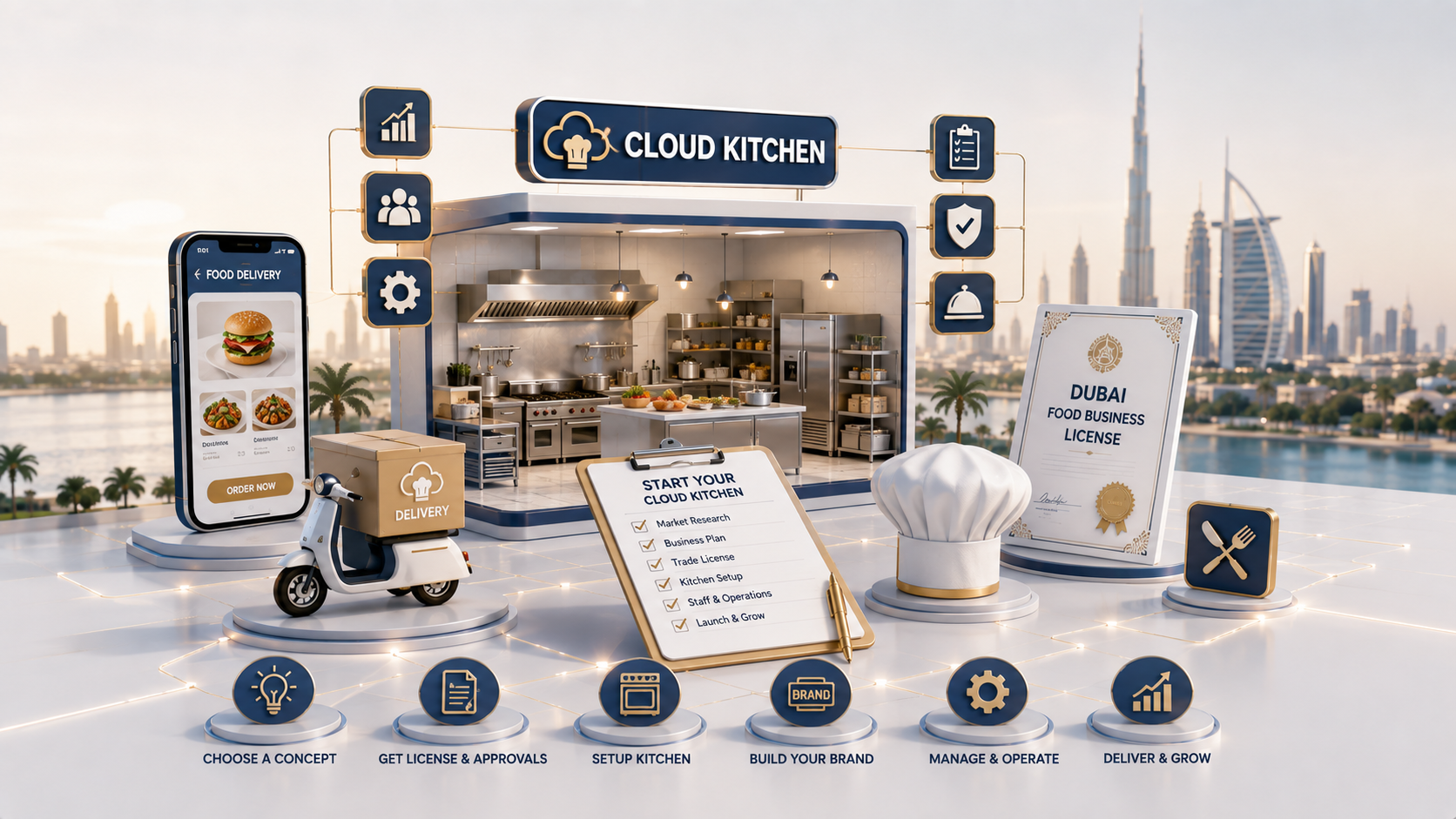
Step-by-Step: How Do I Start a Cloud Kitchen in Dubai?
Step 1: Choose Your Business Activity and Licence Type
Confirm the correct food trading licence UAE or food preparation/catering activity classification matching your concept — packaged food trading, restaurant/catering activity, and cloud kitchen operations may fall under different activity codes.
Step 2: Select Your Jurisdiction
Decide between mainland DED registration or a cloud kitchen free zone Dubai structure based on your delivery footprint, budget, and target aggregator partnerships.
Step 3: Reserve Trade Name and Initial Approval
Register your trade name and secure initial activity approval before proceeding to facility-specific requirements.
Step 4: Secure a DM-Compliant Kitchen Facility
Your kitchen space must meet Dubai Municipality’s physical design standards — this includes ventilation, food-grade surfaces, waste management systems, and layout separating raw and cooked food preparation zones.
Step 5: Submit for Dubai Municipality Food Approval
This is the core regulatory checkpoint. Dubai Municipality food approval covers kitchen design review, equipment inspection, and food safety system documentation before operational approval is granted.
Step 6: Obtain Staff Food Handler Certification
Every kitchen staff member involved in food handling must hold a valid food handler certificate Dubai authorities recognize, obtained through DM-approved training providers.
Step 7: Implement HACCP-Aligned Food Safety Procedures
While not always a standalone certificate requirement for every operator size, HACCP certification UAE principles — Hazard Analysis and Critical Control Points — form the backbone of the food safety documentation DM expects to see during inspection.
Step 8: Finalize Trade Licence Issuance
Once DM approval and all supporting documentation are complete, your trade licence is issued, authorizing commercial operation.
Step 9: Register with Delivery Aggregators
With your licence and DM approval active, you can formally onboard with delivery platforms, which typically require proof of valid trade licence and food safety approval before activation.
Common Pitfall: Some entrepreneurs attempt to onboard with delivery aggregators using only a pending licence application. Most major platforms require fully issued licensing and active DM approval before activation — building this into your launch timeline avoids a costly delay between kitchen readiness and actual revenue generation.
Cloud Kitchen Licence Cost in Dubai: Fee Breakdown
Costs vary meaningfully based on jurisdiction, kitchen size, and number of brands operated from one facility. The table below offers an illustrative framework.
| Cost Component | Estimated Range |
|---|---|
| Trade licence (mainland or free zone) | AED 12,000–25,000+ |
| Initial approval and name reservation | AED 1,000–3,000 |
| Dubai Municipality food approval/inspection fees | AED 2,000–6,000 |
| Kitchen fit-out (DM-compliant design) | AED 50,000–200,000+ (highly variable) |
| Food handler certification (per staff member) | AED 200–500 |
| PRO and government processing fees | AED 2,000–5,000 |
Figures shown are indicative estimates only and vary significantly based on kitchen size, jurisdiction, and current DED/DM fee schedules. Always confirm current costs directly with the relevant authority or a licensed advisory partner.
Expert Tip: Fit-out cost is consistently the most underestimated line item. Entrepreneurs frequently budget for licensing and approval fees in detail but treat kitchen fit-out as a rough estimate — this is usually the single largest cost component and the one most likely to derail a launch budget if not scoped properly with a DM-compliant kitchen designer from the outset.
Can I Run a Food Business From Home in Dubai?
Generally, no — not for commercial delivery or aggregator-based operations. Dubai Municipality’s food safety framework requires commercial food preparation to occur in a licensed, DM-approved facility meeting specific design and hygiene standards that a typical residential kitchen from home Dubai setup does not meet. Home-based food preparation for commercial sale, including via delivery apps, generally falls outside permitted activity without a licensed commercial facility behind it.
Entrepreneurs looking to start small and scale should instead consider:
- Shared/rentable cloud kitchen facilities — several operators in Dubai offer licensed kitchen space specifically for delivery-only brands, reducing the upfront fit-out burden
- Cloud kitchen free zone Dubai packages — some free zones bundle facility access with licensing for lower-cost entry
- Co-packing or commissary arrangements — producing under an already-licensed facility’s approval while building your brand before investing in a dedicated space
Advisor Note: We regularly see aspiring food entrepreneurs try to “test the concept” from a home kitchen before formalizing licensing. Beyond the legal exposure, this approach also means missing the aggregator partnerships that typically drive the bulk of cloud kitchen revenue — since most platforms require verified commercial licensing before onboarding.
What Approvals Do I Need to Sell Food in the UAE?
Beyond the cloud kitchen-specific requirements above, several approvals apply broadly to any UAE food business:
Core Food Business Approval Checklist
- Valid trade licence covering the correct food business activity classification
- Dubai Municipality food approval for the physical kitchen facility
- Food safety permit DM confirming ongoing compliance status
- Valid food handler certificate Dubai for all food-handling staff
- HACCP-aligned documented food safety procedures
- Packaging and labeling compliance for any pre-packaged food items
- Import approval (where applicable) for any imported food ingredients or products
If your concept includes branded packaged products intended for retail beyond direct delivery, our Product Certification Support team can guide you through the additional labeling and certification requirements that apply to packaged food products specifically.
Pros and Cons of the Cloud Kitchen Model
Advantages
- Significantly lower upfront capital requirement compared to a full dine-in restaurant
- Ability to run multiple virtual brands from a single licensed facility
- Faster market testing and concept iteration without storefront lease commitments
- Strong alignment with UAE’s high delivery-app adoption and aggregator ecosystem
Challenges to Plan For
- Full regulatory compliance still applies despite the “lighter” delivery-only format
- Heavy reliance on third-party delivery platforms means commission costs directly affect margins
- Kitchen fit-out and DM approval can take longer than entrepreneurs initially budget for
- Brand differentiation is harder without a physical storefront presence
Financial and Tax Compliance for Cloud Kitchen Operators
Cloud kitchen businesses are subject to the same core UAE tax and financial obligations as any commercial entity:
- VAT Registration — mandatory once turnover crosses the applicable threshold, relevant even for delivery-only revenue models
- Corporate Tax Registration — required for the underlying licensed entity regardless of dine-in versus delivery-only format
- VAT Filing & Return Services and Corporate Tax Filing — ongoing reporting obligations as the business generates revenue
- Bank Account Opening Support — cloud kitchens managing multiple aggregator payout streams benefit from a properly structured business account set up early, rather than retrofitted after revenue begins flowing through several platforms
- Financial Management & Advisory — particularly useful for multi-brand operators reconciling revenue across several virtual concepts and delivery platforms simultaneously
Common Pitfall: Multi-brand cloud kitchen operators sometimes run several virtual restaurant concepts under one licence without clean financial separation between brands. While this is generally permitted from a licensing perspective, it creates real challenges for accurate performance tracking and tax reporting — a structured chart of accounts from day one avoids reconciliation headaches later.
Common Mistakes First-Time Cloud Kitchen Operators Make
- Underestimating kitchen fit-out costs relative to licensing fees
- Assuming free zone licensing automatically permits citywide delivery without checking aggregator and logistics compatibility
- Attempting to launch from an unlicensed home kitchen setup
- Delaying food handler certification for staff, causing launch-day compliance gaps
- Treating Dubai Municipality approval as a formality rather than a substantive design and process review
- Skipping structured financial separation when running multiple brands from one facility
- Delaying VAT and corporate tax registration under the assumption that delivery-only revenue is treated differently from dine-in revenue
Building a Compliant, Scalable Food Business
Cloud kitchen success in Dubai depends as much on getting the regulatory and financial foundation right as it does on the food concept itself. Entrepreneurs planning multi-brand or multi-location growth should build compliance infrastructure early:
- Structure licensing correctly for your specific growth model — single-brand versus multi-brand, mainland versus free zone
- Get Dubai Municipality food approval right the first time by working with an experienced kitchen designer familiar with DM’s specific standards
- Keep financial records audit-ready from launch — our Company Audit Reports service supports operators as they scale toward institutional investment or franchise expansion
- If restructuring or closing a food business entity, coordinate proper deregistration through Company Closure Services or a Company Liquidation Report to avoid lingering DM or licensing obligations
FAQs
1. How do I start a cloud kitchen in Dubai? You select a jurisdiction (mainland or free zone), register the correct food business activity, secure a Dubai Municipality-compliant kitchen facility, pass DM food safety approval, certify staff with food handler credentials, and finalize your trade licence before onboarding with delivery platforms.
2. What approvals do I need to sell food in the UAE? At minimum: a valid trade licence for the correct food activity, Dubai Municipality food approval for your kitchen facility, a food safety permit, food handler certification for staff, and HACCP-aligned food safety documentation.
3. Can I run a food business from home in Dubai? Generally no for commercial delivery operations — Dubai Municipality requires food preparation for commercial sale to occur in a licensed, DM-approved facility, which a standard residential kitchen does not meet.
4. What is the cost of a food licence in Dubai? Costs vary by jurisdiction and kitchen size, but typically range from licensing and approval fees in the low tens of thousands of dirhams up to significantly more once kitchen fit-out — usually the largest cost component — is factored in.
5. Do I need a Dubai Municipality approval for a cloud kitchen? Yes. Dubai Municipality food approval applies to any commercial food preparation facility in Dubai, including delivery-only cloud kitchens, regardless of whether the business has a public dining area.