
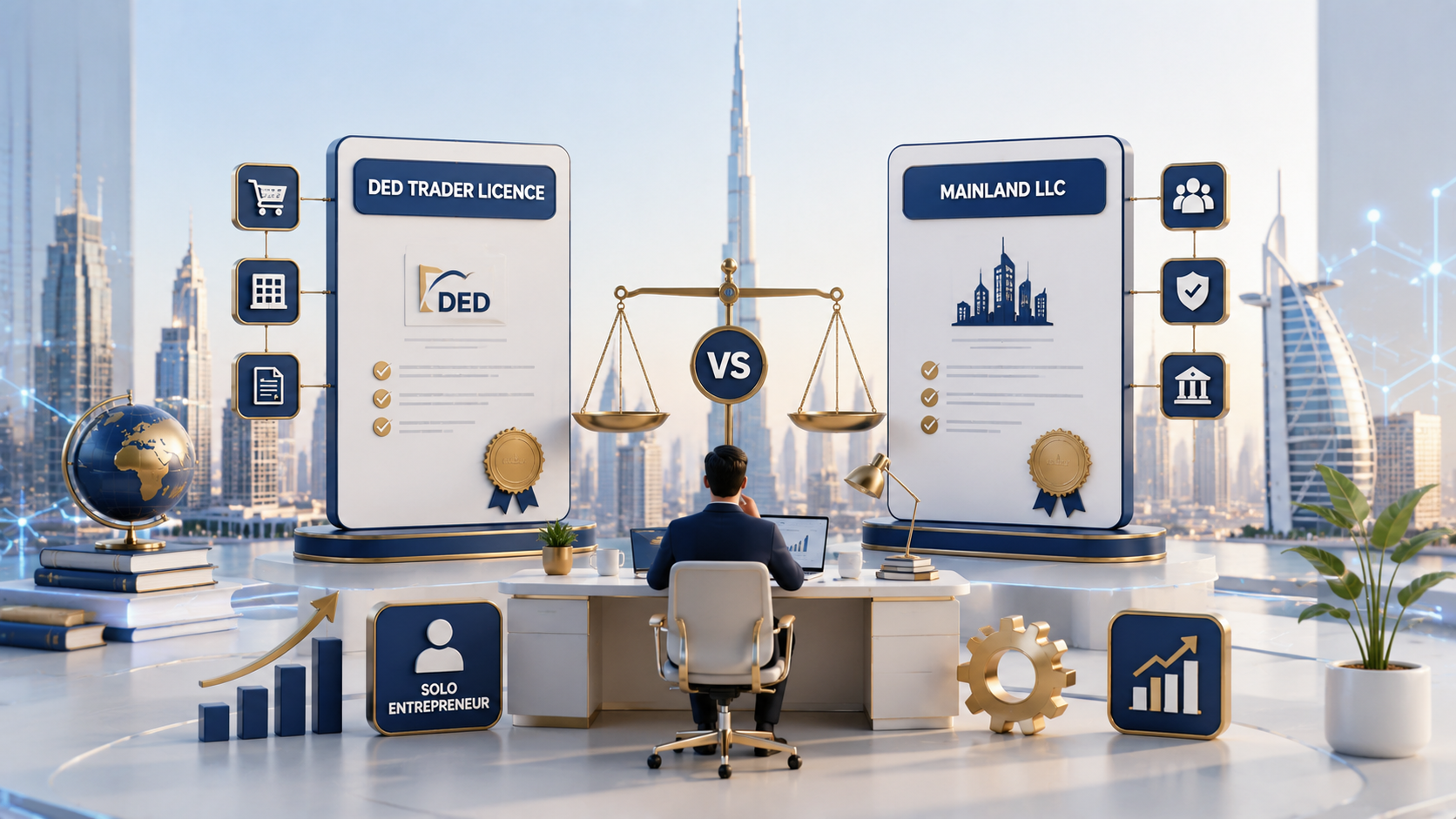
Quick Summary (AI Overview Snippet)
A DED Trader licence Dubai is a low-cost, home-based sole establishment option for solo entrepreneurs running specific approved activities, while a Mainland LLC suits founders needing broader activity scope, employee sponsorship, or investor-ready corporate structure. The DED Trader model carries unlimited liability sole establishment exposure since there’s no separate legal entity, whereas an LLC provides limited liability protection. Solo founders testing a concept with minimal overhead often start with DED Trader; those planning to scale, hire, or seek external investment typically need an LLC structure instead.
Introduction
For solo entrepreneurs setting up in Dubai, one of the first — and most consequential — decisions isn’t which free zone or industry to target, but which legal structure actually fits how the business will operate. Two options dominate this conversation for individual founders: the DED Trader licence Dubai offers through its streamlined sole establishment framework, and the traditional Mainland LLC structure.
These aren’t interchangeable options with different price tags — they carry fundamentally different liability exposure, activity scope, and growth pathways. Choosing incorrectly at the outset often means a costly restructuring exercise later, once the business has already built momentum, clients, and banking relationships around the wrong entity type.
Advisor Note: In our advisory conversations with solo founders, the DED Trader vs LLC decision is frequently treated as a cost question alone. It shouldn’t be — liability exposure and activity restrictions matter far more to long-term outcomes than the initial setup fee difference between the two.
What Is a DED Trader Licence in Dubai?
A DED Trader licence Dubai is a simplified, individually-owned business licence issued by the Department of Economy and Tourism (DET, formerly DED) designed specifically for solo entrepreneurs and freelancers running select low-risk commercial activities. It’s structured as a sole establishment Dubai entity — meaning the business and the individual owner are legally the same person, with no separate corporate identity.
Sometimes referred to as a DET instant licence solo product due to its streamlined, largely digital application process, this licence type is designed to lower the barrier to entry for individuals launching small-scale trading, services, or home-based consulting operations.
Core Characteristics of a DED Trader Licence
- Single individual ownership — no shareholders or partners
- Simplified application, often processed faster than a full LLC formation
- Limited to a specific list of pre-approved DED Trader activities list categories
- Can often be operated from a home address for eligible activity types (home based DED Trader)
- Owner and business are legally the same entity — full personal liability applies
What Is a Mainland LLC and How Does It Differ?
A Mainland LLC (Limited Liability Company) is a full corporate legal entity, separate from its owner(s), registered under UAE Commercial Companies Law through DET/DED. Unlike the DED Trader model, an LLC can have multiple shareholders, broader activity scope, and — critically — limits the owner’s personal liability to their capital contribution in the company.
Core Characteristics of a Mainland LLC
- Separate legal entity distinct from its owner(s)
- Limited liability protection for shareholders
- Broader range of permitted commercial activities
- Ability to sponsor employee visas at scale
- Suitable for raising investment, forming partnerships, or bringing on co-founders later
DED Trader vs LLC: Side-by-Side Comparison
| Factor | DED Trader Licence | Mainland LLC |
|---|---|---|
| Legal structure | Sole establishment — no separate entity | Separate legal entity |
| Liability | Unlimited personal liability | Limited to capital contribution |
| Ownership | Single individual only | One or more shareholders |
| Activity scope | Limited to approved DED Trader activities list | Broad range of commercial activities |
| Setup cost | Generally lower | Generally higher |
| Setup speed | Fast, often largely digital | Moderate, more documentation required |
| Employee sponsorship | Limited or restricted depending on activity | Full visa sponsorship capability |
| Home-based operation | Permitted for eligible activities | Typically requires commercial office space |
| Investor/partnership readiness | Not suited to external investment | Structured for partnerships and investment |
| Best suited for | Solo freelancers, consultants, small traders testing a concept | Founders scaling, hiring, or seeking investment |
Expert Tip: The activity scope difference is often the deciding factor in practice. If your business model requires an activity outside the approved DED Trader activities list, the decision is effectively made for you — an LLC or alternative structure becomes necessary regardless of cost preference.
Is a DED Trader Licence Better Than an LLC for Solo Founders?
The honest answer: it depends entirely on your growth trajectory, not just your current headcount of one. A DED Trader licence can be an excellent fit for the right profile, but a poor fit for founders who only appear solo today.
When a DED Trader Licence Makes Sense
- You’re testing a service or trading concept with minimal capital outlay
- Your activity falls within the approved DED Trader activities list
- You plan to remain a true solo operator without hiring staff in the near term
- You’re comfortable accepting unlimited liability sole establishment exposure for the cost and speed advantage
- A home based DED Trader setup fits your operational needs
When a Mainland LLC Is the Better Fit
- You anticipate hiring employees or sponsoring visas within the first year or two
- Your activity isn’t on the approved trader list, or you need broader scope for future pivots
- You want liability protection separating personal assets from business risk
- You’re planning to bring on a co-founder, partner, or external investor
- You need a corporate structure that banks, larger clients, or government tenders will recognize as more established
Advisor Note: We regularly see founders choose DED Trader purely for the lower upfront cost, without mapping out their 12–24 month growth plan. If hiring or scaling is even a reasonable possibility within that window, the cost of restructuring from a sole establishment into an LLC later — new licence, new bank account, contract reassignment — frequently exceeds what founders would have spent starting with an LLC from day one.
Can I Hire Employees Under a DED Trader Licence?
This is one of the most commonly misunderstood aspects of the sole establishment model. Employee sponsorship under a DED Trader licence Dubai structure is generally limited or restricted compared to an LLC, since the licence is designed around individual, largely self-operated activity. Founders anticipating team growth should not assume they can simply “add employees later” without first confirming their specific activity’s sponsorship allowances — and in many cases, transitioning to an LLC structure becomes the practical path once hiring becomes a real requirement.
Common Pitfall: Founders sometimes discover the employee sponsorship limitation only after already building a team informally or engaging freelance support under informal arrangements. Confirming sponsorship capability before scaling avoids both compliance exposure and a rushed restructuring process under time pressure.
Step-by-Step: Setting Up Your Chosen Structure
If Choosing a DED Trader Licence
- Confirm your intended activity appears on the approved DED/DET trader activities list
- Reserve your trade name through DET’s licensing system
- Submit individual ownership documentation (Emirates ID, passport, residency proof)
- Confirm home-based eligibility if operating from a residential address
- Complete licence issuance and any required initial approvals
- Set up a business bank account under the sole establishment name
If Choosing a Mainland LLC
- Define your full activity scope, including any anticipated future pivots
- Determine shareholder structure, even if starting with a single owner planning to add partners later
- Draft and notarize the Memorandum of Association (MOA)
- Secure a commercial office space meeting DET requirements
- Complete trade licence application and initial approvals through UAE Mainland Business Setup channels
- Register for employee visa sponsorship if hiring is planned
- Set up corporate banking through a properly structured Bank Account Opening Support process
DED Trader Cost vs LLC Cost: What to Expect
Cost is a real factor, but it should be weighed against liability exposure and growth flexibility rather than evaluated in isolation.
| Cost Component | DED Trader (Estimate) | Mainland LLC (Estimate) |
|---|---|---|
| Initial trade name reservation | AED 500–1,000 | AED 500–1,000 |
| Licence issuance fee | AED 5,000–10,000 | AED 12,000–25,000+ |
| MOA drafting/notarization | Not applicable | AED 2,000–5,000 |
| Office space requirement | Often not required (home-based eligible) | Required — cost varies by location |
| PRO/government processing | AED 1,000–2,000 | AED 2,000–5,000 |
Figures shown are indicative estimates only and vary by activity type, office requirements, and current DET fee schedules. Always confirm current costs directly with DET or a licensed advisory partner before budgeting.
Expert Tip: The headline licence fee gap between the two structures often narrows considerably once office space, MOA drafting, and future restructuring risk are factored in for the LLC-eligible activities a DED Trader licence cannot cover. Cost comparisons should be run against your actual activity and growth plan, not the base licence fee alone.
What Are the Disadvantages of a DED Trader Licence vs LLC?
Disadvantages of the DED Trader Model
- Unlimited liability sole establishment structure exposes personal assets to business risk
- Restricted activity scope limits pivot flexibility
- Limited or restricted employee sponsorship capability
- Less credibility with larger corporate clients, banks, or government tender processes
- No pathway to bring on shareholders or formal business partners under the same entity
Disadvantages of the Mainland LLC Model
- Higher upfront setup cost and ongoing compliance overhead
- Requires commercial office space, adding fixed operating cost
- More documentation and longer setup timeline compared to the streamlined trader licence process
- Overkill for a founder genuinely planning to remain a true solo operator indefinitely
Tax and Financial Compliance: Does Structure Choice Matter?
Both DED Trader and LLC structures are subject to core UAE tax obligations, though the compliance experience differs slightly:
- VAT Registration and VAT Filing & Return Services — apply to both structures once turnover crosses the mandatory threshold, regardless of sole establishment versus LLC status
- Corporate Tax Registration and Corporate Tax Filing — both structures fall under UAE corporate tax registration requirements, though sole establishments are taxed based on the individual owner’s business income
- Financial Management & Advisory — LLCs, particularly those with multiple shareholders, generally benefit from more formalized financial reporting structures from the outset
- Company Audit Reports — more commonly required or expected for LLC structures, particularly as they scale or seek investment
Advisor Note: A frequent oversight among DED Trader operators is assuming sole establishment status means lighter tax obligations. It doesn’t — corporate tax and VAT registration thresholds apply based on business activity and turnover, not legal structure type.
Transitioning From DED Trader to LLC Later
It’s entirely possible — and common — for successful sole establishment operators to transition into an LLC structure as the business grows. This typically involves:
- Establishing the new LLC entity with appropriate shareholder structure
- Transferring or re-signing existing client contracts under the new entity
- Opening a new corporate bank account under the LLC
- Formally closing the original DED Trader licence through proper deregistration
- Migrating VAT and corporate tax registration to the new entity
Common Pitfall: Founders sometimes let their original sole establishment licence lapse informally rather than closing it through proper deregistration once transitioning to an LLC. This can leave lingering compliance obligations tied to the old licence. Our Company Closure Services team handles this transition cleanly, ensuring the original entity is properly wound down alongside the new LLC’s setup.
For founders who initially considered other structures — including offshore options via Dubai Offshore License for holding purposes, or a UAE Freezone Setup for specific activity or ownership advantages — a structure comparison at the growth-transition point is worth revisiting rather than defaulting automatically to mainland LLC.
Common Mistakes Solo Founders Make in This Decision
- Choosing based on upfront cost alone without mapping a 12–24 month growth plan
- Assuming employee sponsorship will be straightforward under a DED Trader licence without confirming activity-specific rules
- Underestimating personal liability exposure under the sole establishment model
- Selecting an LLC structure prematurely when a lower-cost trader licence would have sufficiently covered a genuinely solo, non-scaling operation
- Failing to properly close a DED Trader licence when transitioning to an LLC, leaving compliance gaps
- Overlooking that both structures carry equivalent VAT and corporate tax obligations once thresholds are crossed
Making the Right Choice for Your Business
The DED Trader licence Dubai and Mainland LLC structures both serve legitimate, distinct purposes — the right choice depends on your specific activity, growth ambitions, and risk tolerance, not a generic “cheaper is better” or “bigger is safer” assumption. Solo founders genuinely planning to remain solo, within an approved activity scope, often find the trader licence a fast, low-cost entry point. Those anticipating hiring, partnership, investment, or broader activity needs are usually better served starting with an LLC from day one.
Expert Tip: If you’re genuinely uncertain which category your growth plan falls into, err toward the structure that avoids a costly restructuring exercise later rather than the one with the lowest sticker price today.
FAQs
1. What is a DED Trader licence in Dubai? It’s a simplified, individually-owned sole establishment licence issued by DET for solo entrepreneurs running approved low-risk commercial activities, often eligible for home-based operation.
2. Is a DED Trader licence better than an LLC for solo founders? It depends on growth plans — DED Trader suits founders remaining genuinely solo within approved activities, while an LLC better serves those planning to hire, partner, or seek investment.
3. Can I hire employees under a DED Trader licence? Employee sponsorship is generally limited or restricted under the sole establishment model. Founders planning to hire should confirm their specific activity’s sponsorship rules or consider transitioning to an LLC.
4. How much does a DED Trader licence cost? Costs are generally lower than an LLC, though exact fees vary by activity type and current DET fee schedules — always confirm current costs directly with the authority or an advisory partner.
5. What are the disadvantages of a DED Trader licence vs LLC? The main disadvantages are unlimited personal liability, restricted activity scope, limited employee sponsorship, and reduced credibility with banks, larger clients, or government tenders compared to an LLC.