
Quick Summary (AI Overview Snippet)
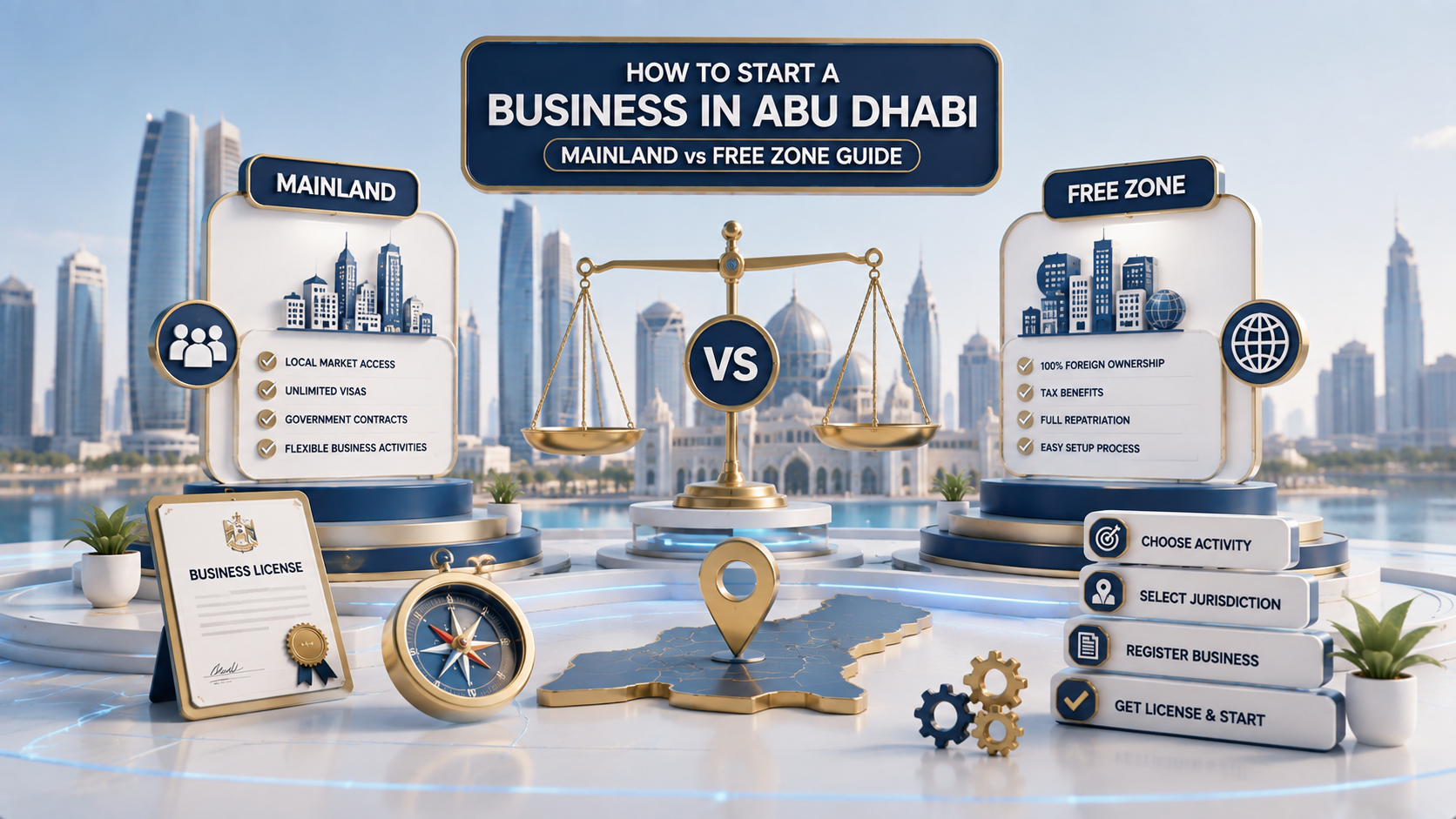
Business setup Abu Dhabi ventures generally follow two paths: an Abu Dhabi mainland company licensed through ADDED (Abu Dhabi Department of Economic Development), or an Abu Dhabi free zone setup through zones like Abu Dhabi Global Market, twofour54, Masdar City, or KIZAD. Both structures permit 100% foreign ownership under current UAE commercial company rules. Mainland companies offer unrestricted access to the local Abu Dhabi and wider UAE market, while free zones offer sector-specific ecosystems, streamlined licensing, and — depending on the zone — full repatriation of profits and capital.
Introduction
Abu Dhabi has steadily built its own distinct value proposition for entrepreneurs and investors, separate from Dubai’s more globally recognized commercial brand. Backed by structured government investment promotion through the Abu Dhabi Investment Office (ADIO), a growing set of specialized free zones, and a business-friendly mainland licensing framework via ADDED, business setup Abu Dhabi has become a genuine alternative — and in some sectors, a preferred choice — for founders evaluating where to establish their UAE presence.
This guide walks through the core decision every founder faces when entering the Abu Dhabi market: mainland versus free zone, what each path actually involves, what it costs, and how ADIO registration and support programs fit into the picture.
Advisor Note: In our advisory conversations with founders comparing Abu Dhabi and Dubai, the most common misconception is that the two emirates’ setup processes are functionally identical with only cosmetic differences. They’re not — Abu Dhabi’s regulatory bodies, free zone ecosystem, and sector incentive structures operate independently and require their own dedicated assessment.
Abu Dhabi Mainland Company: The ADDED Framework
An Abu Dhabi mainland company is registered and licensed through the Abu Dhabi Department of Economic Development (ADDED), the emirate’s primary commercial licensing authority. Mainland companies operate under standard UAE Commercial Companies Law and can conduct business anywhere in Abu Dhabi and across the wider UAE market without the geographic restrictions that apply to most free zone entities.
Key Features of an ADDED Licence Abu Dhabi
- 100% foreign ownership permitted under current UAE commercial ownership rules for the vast majority of business activities
- Ability to trade directly with the local Abu Dhabi market and across other emirates without additional cross-jurisdiction registration
- Broader activity scope compared to many specialized free zones
- Requirement for physical office space compliant with ADDED regulations
- Full access to government tenders and contracts that often require mainland licensing
Expert Tip: While 100% foreign ownership is now standard for most activities, certain strategic sectors may still carry specific ownership or Emirati participation requirements. Confirming your exact activity classification with ADDED before assuming unrestricted ownership avoids a structuring surprise mid-application.
Abu Dhabi Free Zone Setup: The Ecosystem Approach
Abu Dhabi has developed one of the UAE’s more diverse free zone ecosystems, each built around specific industry clusters rather than a one-size-fits-all model.
Major Abu Dhabi Free Zones
| Free Zone | Primary Focus | Notable Feature |
|---|---|---|
| Abu Dhabi Global Market (ADGM) | Financial services, fintech, holding companies | Common law jurisdiction, independent courts |
| twofour54 Abu Dhabi | Media, gaming, content production | Sector-specific incentives for creative industries |
| Masdar City free zone | Clean energy, sustainability, innovation | Positioned around renewable energy and sustainability sector growth |
| Khalifa Industrial Zone (KIZAD) | Manufacturing, logistics, industrial activity | Strategic port and industrial infrastructure access |
Advisor Note: Choosing among Abu Dhabi’s free zones isn’t just about cost comparison — it’s about ecosystem fit. A fintech startup registering in KIZAD, for instance, would miss the regulatory framework and investor network that ADGM specifically offers for financial services activity. Matching your sector to the right zone often matters more than the headline setup fee.
Key Features of Abu Dhabi Free Zone Companies
- 100% foreign ownership as standard across virtually all free zone structures
- Streamlined, often faster licensing process compared to mainland registration
- Full repatriation of profits and capital, depending on the specific zone’s framework
- Sector-specific regulatory environments tailored to the zone’s target industries
- Generally restricted from direct trading within the UAE mainland market without additional arrangements (such as a distributor or dual-licence structure)
Abu Dhabi Mainland vs Free Zone: Side-by-Side Comparison
| Factor | Abu Dhabi Mainland (ADDED) | Abu Dhabi Free Zone |
|---|---|---|
| Foreign ownership | 100% for most activities | 100% standard |
| Local UAE market access | Full, unrestricted | Generally restricted without additional setup |
| Office requirement | Physical office required | Varies by zone; flexi-desk options often available |
| Government tender eligibility | Full eligibility | Often limited or requires additional registration |
| Setup speed | Moderate | Often faster, especially digital-first zones |
| Best suited for | Businesses trading directly with local Abu Dhabi/UAE market | Businesses in specific sectors (finance, media, industrial, sustainability) or those not needing direct mainland market access |
What Is the Difference Between Abu Dhabi Mainland and Free Zone Company?
Beyond the comparison table, the core distinction comes down to market access and regulatory environment. A mainland company under ADDED functions as a standard UAE commercial entity with full access to the local market, government contracts, and no jurisdictional trading restrictions. A free zone company operates within a defined regulatory ecosystem — often with its own courts, incentives, and sector focus (as with ADGM’s common law framework) — but generally cannot trade directly within the UAE mainland market without structuring around that limitation.
Common Pitfall: Founders sometimes register in a free zone assuming they can freely sell products or services to mainland Abu Dhabi clients without restriction. In most cases, direct mainland trading requires either a mainland licence, a local distributor arrangement, or a dual-licence structure — this should be planned for during initial setup, not discovered after signing a client contract.
The Role of ADIO: Abu Dhabi Investment Office
ADIO registration and engagement isn’t a licensing requirement in the same sense as ADDED or a free zone authority — rather, ADIO functions as Abu Dhabi’s investment promotion arm, supporting qualifying businesses (particularly in priority sectors) with incentive programs, funding support, and streamlined government facilitation.
How ADIO Supports New Businesses
- Sector-specific incentive programs for priority industries identified in Abu Dhabi’s economic diversification strategy
- Facilitation support connecting investors with the right regulatory bodies and free zone authorities
- Potential funding or partnership opportunities for qualifying strategic investments
- Streamlined government liaison for larger-scale or strategically significant investments
Expert Tip: ADIO engagement is most valuable for businesses in Abu Dhabi’s identified priority sectors — technology, advanced manufacturing, sustainability, and similar strategic industries. A standard small trading or services business may not see the same level of ADIO-facilitated support as a qualifying strategic investment would.
Step-by-Step: How Do I Set Up a Company in Abu Dhabi?
For a Mainland Company (ADDED)
- Determine your business activity and confirm ADDED’s classification and ownership rules for that activity
- Reserve your trade name through ADDED’s licensing system
- Draft and notarize your Memorandum of Association (for LLC structures)
- Secure a physical office space compliant with ADDED requirements
- Submit your licence application with all required documentation
- Obtain initial approval and finalize licence issuance
- Register for VAT and corporate tax as applicable, and open your corporate bank account
For a Free Zone Company
- Select the free zone aligned with your business sector (ADGM, twofour54, Masdar City, KIZAD, or others)
- Confirm the specific zone’s activity list and ownership structure
- Choose your office/facility option — flexi-desk, shared office, or dedicated space depending on the zone
- Submit your application with required documentation through the zone’s licensing authority
- Obtain your free zone trade licence and establishment card
- Set up banking and complete VAT/corporate tax registration as applicable
Advisor Note: Regardless of mainland or free zone choice, we consistently recommend confirming your banking strategy before finalizing your licence application. Certain banks have specific requirements or preferences tied to jurisdiction and activity type — securing this alignment early through proper Bank Account Opening Support avoids delays after your licence is already issued.
Business Setup Abu Dhabi Cost Breakdown
Costs vary significantly based on structure, activity, and office requirements. The table below offers an illustrative cost framework.
| Cost Component | Mainland (ADDED) Estimate | Free Zone Estimate |
|---|---|---|
| Trade name reservation | AED 500–1,000 | AED 500–1,000 |
| Initial approval | AED 500–1,500 | AED 1,000–2,000 |
| Licence issuance fee | AED 10,000–20,000+ | AED 12,000–25,000+ (varies significantly by zone) |
| Office/facility cost | Required — varies by location and size | Flexi-desk options often lower cost; dedicated space varies by zone |
| MOA drafting/notarization | AED 2,000–5,000 (LLC structures) | Often included or reduced, depending on zone |
| PRO and government processing | AED 2,000–5,000 | AED 2,000–5,000 |
Figures shown are indicative estimates only and vary meaningfully by activity, chosen free zone, and office requirements. Always confirm current fees directly with ADDED, the relevant free zone authority, or a licensed advisory partner.
Is Business Setup Cheaper in Abu Dhabi or Dubai?
There’s no universal answer — costs are highly comparable between the two emirates for equivalent structures, with the real cost differentiator typically being office/facility costs (which vary by specific location within each emirate) and the specific free zone chosen, rather than a blanket “cheaper emirate” difference. Businesses should compare based on their specific activity, target market, and preferred zone rather than assuming either emirate carries an inherent cost advantage.
Pros and Cons: Abu Dhabi Mainland vs Free Zone
Mainland Advantages
- Unrestricted access to the local Abu Dhabi and broader UAE market
- Full eligibility for government tenders and contracts
- Broader activity scope across most commercial sectors
Mainland Challenges
- Mandatory physical office requirement adds fixed cost
- Generally more documentation-intensive setup process
Free Zone Advantages
- Sector-specific ecosystem and regulatory alignment (particularly valuable for finance, media, and industrial activities)
- Often faster, more streamlined licensing process
- Flexible office options, including lower-cost flexi-desk arrangements
Free Zone Challenges
- Restricted direct access to the UAE mainland market without additional structuring
- Limited government tender eligibility in most cases
- Activity scope tied specifically to the chosen zone’s licensed categories
Financial and Tax Compliance in Abu Dhabi
Regardless of mainland or free zone structure, businesses in Abu Dhabi are subject to the same core UAE federal tax framework:
- VAT Registration and VAT Filing & Return Services — apply once turnover crosses the mandatory federal threshold, regardless of emirate or free zone status
- Corporate Tax Registration and Corporate Tax Filing — required for the licensed entity, with certain free zone entities potentially qualifying for specific tax treatment depending on their activity and compliance with relevant free zone tax rules
- Company Audit Reports — often required for free zone entities as part of annual compliance, and increasingly relevant for mainland companies as they scale
- Financial Management & Advisory — particularly valuable for companies operating across both Abu Dhabi and Dubai structures, ensuring consistent financial reporting across jurisdictions
Common Pitfall: Some free zone entrepreneurs assume free zone status automatically exempts their business from corporate tax obligations entirely. Qualifying for specific free zone corporate tax treatment depends on meeting defined conditions — it isn’t an automatic blanket exemption, and assuming otherwise creates real compliance risk.
Choosing Between Abu Dhabi and Dubai (or Both)
Many growing businesses eventually operate across both emirates rather than choosing exclusively. Entrepreneurs evaluating business setup Abu Dhabi against a Dubai-based structure should consider:
- Target client base — is your primary market Abu Dhabi-based government and enterprise clients, or Dubai’s broader commercial and tourism-driven economy?
- Sector alignment — does your industry map more naturally to an Abu Dhabi free zone like ADGM or twofour54, or to Dubai’s broader free zone and mainland ecosystem via UAE Freezone Setup or UAE Mainland Business Setup?
- Long-term expansion plans — some founders establish a primary entity in one emirate and a branch or dual structure in the other as they scale
Expert Tip: Businesses genuinely uncertain which emirate fits best should get a structured comparison against their specific activity and client base rather than defaulting to whichever emirate is simply more familiar or commonly discussed online.
Common Mistakes When Setting Up in Abu Dhabi
- Assuming Dubai and Abu Dhabi setup processes are functionally interchangeable
- Registering in a free zone without confirming mainland trading restrictions apply to the target client base
- Overlooking ADIO engagement opportunities for businesses in genuinely qualifying priority sectors
- Assuming free zone status provides an automatic corporate tax exemption without confirming qualifying conditions
- Underbudgeting for office/facility costs relative to the licensing fee itself
- Choosing a free zone based on cost alone rather than sector and ecosystem fit
Structuring Your Abu Dhabi Business for Long-Term Success
Whether choosing mainland or free zone, building a compliant foundation from day one supports smoother long-term operations:
- Confirm your activity classification and ownership structure with ADDED or your chosen free zone before finalizing your business plan
- Set up proper banking and financial systems early through structured Bank Account Opening Support
- Build your VAT and corporate tax compliance calendar from the outset, rather than treating it as a later-stage task
- If restructuring, merging, or winding down an Abu Dhabi entity, coordinate proper deregistration through Company Closure Services or a Company Liquidation Report to avoid lingering obligations with ADDED or your free zone authority
FAQs
1. How do I set up a company in Abu Dhabi? You choose between mainland licensing through ADDED or registration with an Abu Dhabi free zone like ADGM, twofour54, Masdar City, or KIZAD, then complete activity classification, documentation, office setup, and licence issuance specific to your chosen path.
2. Is business setup cheaper in Abu Dhabi or Dubai? Costs are broadly comparable between the two emirates for equivalent structures — the main cost differences come from specific office location and free zone choice rather than an inherent emirate-wide cost advantage.
3. What free zones are available in Abu Dhabi? Major options include Abu Dhabi Global Market (ADGM) for financial services, twofour54 for media and content, Masdar City for clean energy and sustainability, and KIZAD for industrial and manufacturing activity.
4. Can a foreign investor own 100% of an Abu Dhabi company? Yes, 100% foreign ownership is standard for the vast majority of business activities across both mainland ADDED-licensed companies and Abu Dhabi free zone entities.
5. What is the difference between Abu Dhabi mainland and free zone company? Mainland companies have unrestricted access to the local Abu Dhabi and UAE market and full government tender eligibility, while free zone companies operate within a specific regulatory ecosystem with generally restricted direct mainland trading access.