
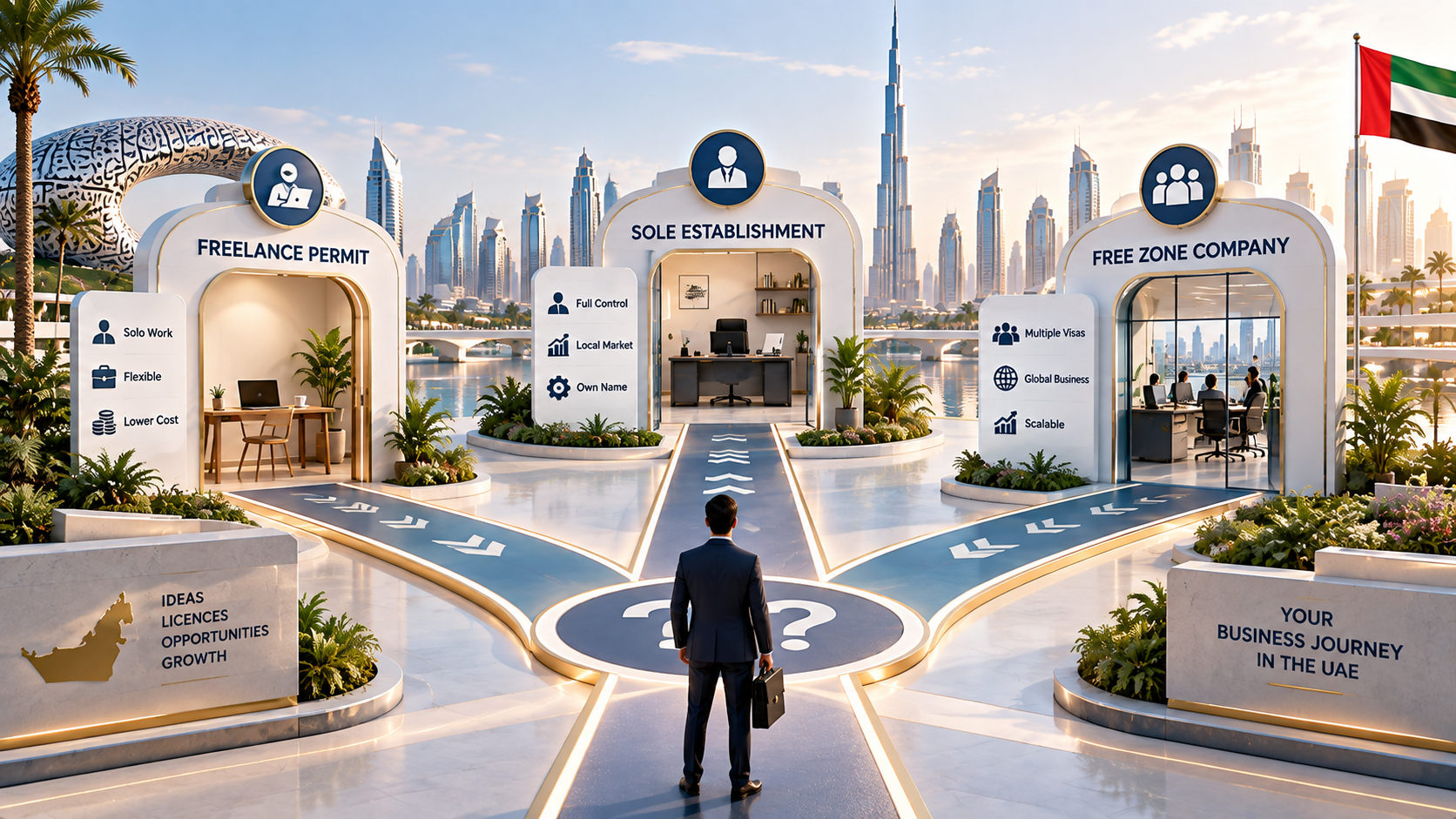
Quick Summary / AI Overview Snippet
Quick Answer: The freelance permit vs company uae decision comes down to three factors: liability, hiring rights, and banking credibility. A freelance permit suits a solo professional working alone under one activity, with no employee-sponsorship rights and unlimited personal exposure. A sole establishment uae structure carries full unlimited personal liability and, for most non-GCC professional activities, still requires a Local Service Agent. A free zone company is a separate legal entity offering limited liability, staff-visa sponsorship, and stronger bank account approval odds — at a higher first-year cost. Most solo professionals outgrow a freelance permit once they need to hire, sign larger contracts, or open a fully functional corporate bank account.
Introduction
Almost every solo professional exploring UAE relocation runs into the same wall of conflicting advice: some content says “just get a freelance permit,” others push straight to “form an LLC,” and a handful mention sole establishment uae structures without explaining why that’s meaningfully different from either. The result is a decision made on vibes rather than the three factors that actually determine which structure fits — liability exposure, visa/hiring rights, and how a bank will treat your application.
This isn’t a two-option decision, and it isn’t a one-size-fits-all answer either. A freelance permit, a sole establishment, and a free zone company each solve a different problem, and the wrong choice typically costs a founder a wasted year of licensing fees before they end up migrating to the structure they needed in the first place.
This guide leads with the comparison itself — liability, visa eligibility, bank acceptance, upgrade path, and real Year-1 cost — rather than burying the decision in prose, because that’s the actual question people are asking.
The Decision Table: Freelance Permit vs Sole Establishment vs Free Zone Company
| Factor | Freelance Permit | Sole Establishment | Free Zone Company |
|---|---|---|---|
| Legal Structure | Individual permit, not a company | Individual owner, no legal separation from the business | Separate legal entity (FZE/FZ-LLC) |
| Liability | Personal, unlimited | Unlimited personal liability — no distinction between personal and business assets | Limited to share capital |
| Can Hire Employees? | No | Yes, with visa quota | Yes, with visa quota |
| Can Sponsor Own Residence Visa? | Yes (self-sponsored, tied to permit) | Yes | Yes |
| Can Sponsor Staff Visas? | No | Yes | Yes |
| Local Service Agent Needed? | No | Yes, for most non-GCC professional/consultancy activities | No |
| Bank Account Approval Odds | Lower — banks often treat freelance permits cautiously | Moderate — individual liability raises scrutiny | Higher — recognised corporate structure |
| Typical Year-1 All-In Cost | AED 7,500 – 26,000 | AED 30,000 – 45,000 | AED 15,000 – 35,000+ (activity/zone dependent) |
| Upgrade Path | Migrate to sole establishment or free zone company as activity grows | Migrate to LLC or free zone company for liability protection | Can add activities, hire, or convert entity type as needed |
| Best Suited For | True solo operators with one activity, low contract risk | Licensed professionals wanting 100% ownership without a full company structure, accepting liability exposure | Founders planning to hire, scale, or need stronger banking credibility |
Expert Tip: The single biggest misread in this comparison is assuming “freelance” and “sole establishment” are the same thing with different names. They’re not. A freelance permit is a permit to work under your own name with no employees; a sole establishment is a licensed mainland business — still carrying unlimited personal liability, but capable of hiring staff and operating more like a real company.
What Is a Freelance Permit in the UAE?
A freelance permit authorizes one individual to invoice clients, sign contracts, and market services under their own name, but strictly within the activity category listed on the permit. It is the lightest-weight option of the three, issued through freelancer permit free zones such as GoFreelance (TECOM zones including Dubai Media City and Internet City), Shams, RAKEZ, IFZA, twofour54, and Fujairah Creative City, or via the separate federal MOHRE freelance permit route for existing UAE residents.
What a freelance permit allows:
- Working and invoicing under your own name for one permitted activity
- Self-sponsoring your own residence visa (in most free zone freelance packages)
- Sponsoring eligible family members once your residence visa is issued, subject to income and housing conditions
What a freelance permit does not allow:
- Hiring employees under any circumstances
- Sponsoring staff visas
- Operating under a commercial trade name separate from your own
- Expanding into activities beyond what’s listed on the permit without an additional application
Expert Tip: Freelance permit holders are frequently surprised that adding a second activity later costs extra and requires a fresh application — get the activity wording right on day one rather than assuming it can be casually expanded once you’re operational.
What Is a Sole Establishment in the UAE?
A sole establishment uae authorities recognise — sometimes called a sole proprietorship dubai structure — is a mainland licence issued in the name of one individual who owns and personally runs the business. Unlike a freelance permit, a sole establishment is a genuine business licence: it can hire employees, sponsor staff visas, and operate under a commercial or professional trade name.
The defining characteristic — and the one most competitor content underplays — is unlimited personal liability. There is no legal separation between the owner’s personal assets and the business’s liabilities. If the business faces a debt, lawsuit, or contractual claim it cannot satisfy, the owner’s personal assets are directly exposed.
Who Can Set Up a Sole Establishment?
- UAE and GCC nationals can establish a sole establishment for virtually any licensed activity.
- Foreign nationals are generally restricted to professional or consultancy activities — IT consulting, management consulting, marketing, engineering, design, medical, legal, and similar fields — and must appoint a local service agent.
The Local Service Agent Requirement
A local service agent (LSA) is a UAE national appointed on the trade licence for a fixed annual fee (typically AED 5,000–15,000), acting purely as an administrative liaison with government departments. The LSA holds no equity, no profit share, and no operational control over the business.
Expert Tip: A critical nuance most generic guides skip: the LSA requirement was not removed by the 2021 Commercial Companies Law reforms. Those reforms eliminated the 51% Emirati shareholder requirement for most commercial/trading activities, but the LSA requirement for foreign-owned professional-category sole establishments — consulting, IT, medical, legal, engineering — remains in place in 2026. An LSA does not shield you from liability, tax exposure, or regulatory action; it is purely a compliance formality, not a risk-sharing arrangement.
Many solo professionals evaluating this route ultimately compare it against a single-shareholder LLC, which has been available since 2017 and avoids the LSA requirement entirely while also providing limited liability — a structural upgrade some founders choose from the outset rather than starting with a sole establishment and migrating later.
What Is a Free Zone Company?
A free zone company — typically structured as a Free Zone Establishment (FZE) or Free Zone LLC (FZ-LLC) — is a fully separate legal entity, distinct from its owner in every legally meaningful sense. This is the structural difference that resolves the liability problem inherent to both the freelance permit and the sole establishment: the company, not the individual, bears business liability, limited to the company’s share capital.
Key characteristics:
- 100% foreign ownership across virtually all free zone activities
- Limited liability protection for the owner(s)
- Ability to hire employees and sponsor staff visas, subject to visa quota tied to office/facility package
- No local service agent requirement
- Recognised corporate structure that banks, larger clients, and government counterparties treat more consistently than an individual permit or sole establishment
This structural credibility is precisely why free zone companies tend to see materially better outcomes during Bank Account Opening Support processes compared to freelance permits or sole establishments — banks generally view a properly incorporated entity with its own MOA as a lower-friction KYC case than an individual liability structure.
Expert Tip: Don’t assume every free zone company package is identical in cost or visa capacity. Package tiers directly determine how many staff visas you can sponsor and whether you get a dedicated office or flexi-desk arrangement — this is often the real driver behind the wide Year-1 cost range for free zone companies.
Can a Freelancer Sponsor a Visa in the UAE?
Yes, but only their own — and, where eligible, their family’s. A freelance permit holder can self-sponsor a residence visa tied directly to their permit, typically valid for 1–3 years depending on the route (standard freelance permit visa, or the longer-validity Green Visa for established earners meeting income thresholds).
What a freelance permit cannot do is sponsor employee visas, because there is no legal entity behind it capable of acting as an employer-sponsor. This single limitation is usually the deciding factor that pushes a growing freelancer toward a sole establishment or free zone company: the moment you need to hire even one employee, the freelance permit structure has hit its ceiling.
Family sponsorship note: Most free zone freelance permits now allow spouse and child sponsorship once the residence visa is stamped, subject to a minimum income threshold (commonly AED 4,000–5,000/month, varying by emirate). This removed an older restriction that previously limited family sponsorship for some freelance visa holders.
Is a Freelance Permit Cheaper Than a Free Zone Company?
Generally, yes — but the gap is narrower than headline pricing suggests once visa, establishment card, and add-on costs are factored in on both sides.
Realistic Year-1 Cost Comparison
| Cost Component | Freelance Permit | Sole Establishment | Free Zone Company |
|---|---|---|---|
| Permit/Licence Fee | AED 5,500 – 25,000 | AED 15,000 – 25,000 | AED 8,000 – 25,000 |
| Establishment/Immigration Card | AED 2,000 – 2,800 | AED 2,000 – 3,500 | AED 2,000 – 3,500 |
| Residence Visa (self) | AED 3,300 – 6,340 | AED 3,300 – 6,340 | AED 3,300 – 6,340 |
| Local Service Agent Fee (if applicable) | Not applicable | AED 5,000 – 15,000 | Not applicable |
| Office/Facility Requirement | Often included in permit package | Physical office typically required | Flexi-desk to dedicated office, package-dependent |
| Estimated Year-1 Total | AED 7,500 – 26,000 | AED 30,000 – 45,000 | AED 15,000 – 35,000+ |
Expert Tip: The sole establishment’s higher cost isn’t just licensing — it typically requires physical office space (rather than a flexi-desk) and carries the LSA fee for most foreign-owned professional activities, which is why it often lands as the most expensive of the three despite being a single-owner structure.
Upgrade Paths: What Happens When You Outgrow Your Structure
None of these three options is meant to be permanent for a growing business, and understanding the realistic upgrade path to LLC or free zone company matters as much as the initial choice.
- Freelance Permit → Sole Establishment or Free Zone Company: Triggered by the need to hire staff, expand into additional activities, or improve bank account credibility. This is typically a fresh licensing process rather than a simple conversion.
- Sole Establishment → LLC or Free Zone Company: Triggered primarily by liability concerns — once contract values, client risk, or operational complexity increase, the unlimited personal liability of a sole establishment becomes a genuine business risk rather than a theoretical one.
- Free Zone Company → Mainland Structure: Some free zone companies later add or migrate toward mainland presence when direct UAE market access (beyond what free zone qualifying-income rules permit) becomes commercially necessary.
Expert Tip: SmartBiz.ae generally advises founders to model their expected trajectory 18–24 months out before choosing a starting structure. A solo consultant confident they’ll want to hire within a year is often better served starting directly with a free zone company, even at a higher Year-1 cost, rather than paying twice — once for a freelance permit, then again for the eventual upgrade.
Do I Need a Company or a Freelance Permit in Dubai?
A practical way to decide:
Choose a freelance permit if:
- You’re a true solo operator with no plans to hire
- Your activity fits cleanly into a single permitted category
- Contract risk and liability exposure in your field are genuinely low
- You want the fastest, lowest-cost route to legal residency and invoicing capability
Choose a sole establishment if:
- You’re a licensed professional (consulting, IT, medical, legal, engineering) wanting 100% ownership without full company overhead
- You’re comfortable accepting unlimited personal liability in exchange for lower structural complexity than an LLC
- You may need to hire occasionally, but aren’t planning significant scale
Choose a free zone company if:
- You plan to hire employees or scale beyond solo operation
- Liability protection matters given your industry or contract exposure
- You need stronger banking credibility for larger client relationships or funding conversations
- You want the clearest long-term structural runway without an early migration
Tax Treatment Across the Three Structures
All three structures interact with UAE corporate tax, but not identically. Pure freelance income from professional services generally follows individual/natural-person taxpayer treatment, while freelancers structured as sole establishments or free zone entities fall under the standard Corporate Tax framework — meaning the 0% rate up to AED 375,000 of taxable income, 9% above that applies, subject to registration obligations via Corporate Tax Registration and ongoing Corporate Tax Filing.
Sole establishment owners should note their Corporate Tax registration trigger is generally tied to turnover exceeding a specified threshold as a natural person conducting business, which differs mechanically from how a free zone company’s taxable income is assessed — including potential Qualifying Free Zone Person eligibility for properly structured free zone entities, which a sole establishment or freelance permit cannot access at all.
Regardless of structure, once operations generate meaningful revenue, proper bookkeeping becomes essential — an area where Financial Management & Advisory support helps founders stay ahead of both Corporate Tax and, where applicable, VAT Registration obligations from the outset rather than scrambling once thresholds are crossed.
A Note on Mainland Trading Structures
This comparison deliberately covers freelance permits, sole establishments, and free zone companies — the three structures relevant to solo professionals and consultants deciding how to formalize independent work in the UAE. If your activity is commercial trading rather than professional/consultancy services, a different mainland route — the Trader Registration License — may be the more relevant comparison point for smaller-scale import/export or trading activity, and is worth reviewing separately rather than folding into this professional-services decision.
Setting Up Successfully, Whichever Structure You Choose
Regardless of which of the three routes fits, the setup process benefits from proper groundwork. Founders establishing a UAE Freezone Setup company should confirm activity classification and visa quota needs before committing to a package tier, since upgrading later often costs more than getting the right tier from the start.
For founders who anticipate needing ongoing government-liaison support — license renewals, visa processing, or establishment card management — regardless of which structure they choose, PRO Services UAE support keeps these recurring administrative tasks from becoming a distraction from actual client work. And for solo professionals managing multiple moving pieces across licensing, banking, and compliance simultaneously, a consolidated Business Services Hub relationship often proves more efficient than coordinating separate providers for each function.
If a freelancer, sole establishment owner, or free zone company founder eventually winds down UAE operations, proper Company Closure Services — including a formal Company Liquidation Report where applicable — protects against lingering liability or compliance flags, particularly important for sole establishment owners given their personal liability exposure extends beyond the business itself.
Common Mistakes in the Freelance vs Company Decision
- Treating “freelance permit” and “sole establishment” as interchangeable — they carry meaningfully different liability and hiring implications.
- Underestimating the Local Service Agent requirement for sole establishments — assuming the 2021 ownership reforms eliminated it entirely, when it remains mandatory for most foreign-owned professional activities.
- Choosing a freelance permit while already planning to hire within the year — leading to an avoidable, costly migration soon after setup.
- Ignoring liability exposure until it becomes a real problem — sole establishment owners sometimes only recognize the personal liability risk after a contractual dispute arises.
- Assuming all free zone company packages carry identical visa capacity — package tier directly determines staff-sponsorship ability, and this needs confirming before licensing, not after.
- Underbudgeting for the true Year-1 cost of a sole establishment — the LSA fee and physical office requirement are frequently left out of headline cost comparisons.
FAQ: Freelance Permit vs Sole Establishment vs Free Zone Company
Q1: Do I need a company or a freelance permit in Dubai? It depends on whether you plan to hire. A freelance permit works for solo operators with no employees and low contract risk. The moment you need to hire staff or want liability protection, a sole establishment or free zone company becomes necessary.
Q2: What is the difference between a sole establishment and an LLC in the UAE? A sole establishment carries unlimited personal liability with no legal separation between owner and business, and generally requires a Local Service Agent for foreign-owned professional activities. An LLC is a separate legal entity offering limited liability, with no LSA requirement.
Q3: Can a freelancer sponsor a visa in the UAE? A freelancer can self-sponsor their own residence visa and, subject to income conditions, sponsor eligible family members. A freelance permit cannot sponsor employee visas, since there’s no legal entity behind it to act as an employer-sponsor.
Q4: Is a freelance permit cheaper than a free zone company? Generally yes on a like-for-like basis — freelance permits typically run AED 7,500–26,000 in Year 1 versus AED 15,000–35,000+ for a free zone company — though the gap narrows once visa quota, office requirements, and hiring needs are factored in for growing businesses.
Q5: What is the sole establishment vs freelance permit vs free zone company summary? A freelance permit suits solo work with no employees. A sole establishment allows hiring but carries unlimited personal liability and usually an LSA requirement. A free zone company offers limited liability, staff-sponsorship capability, and stronger banking credibility, at a comparatively higher setup cost.