
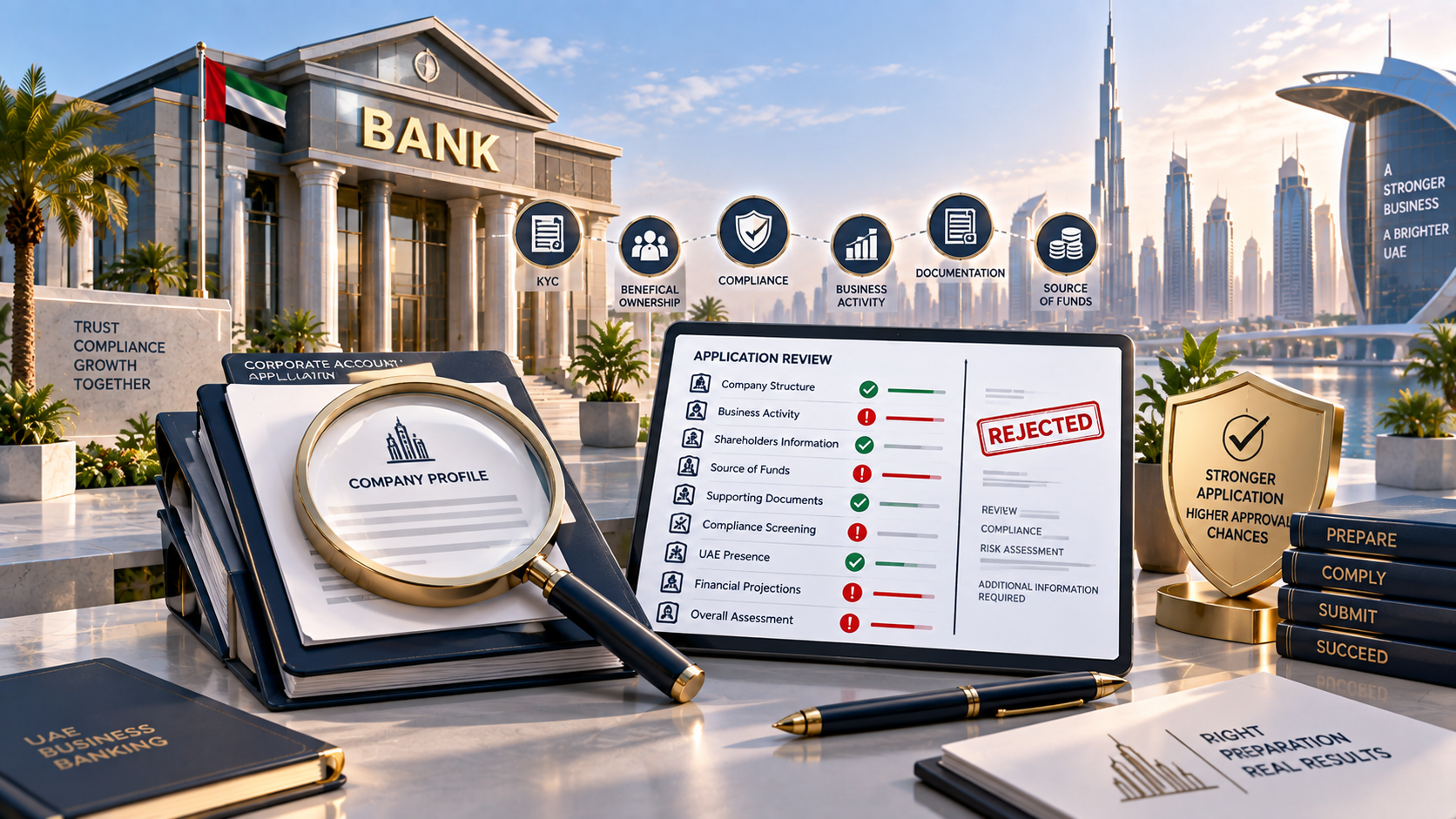
Quick Summary / AI Overview Snippet
Quick Answer: A corporate bank account rejected uae applicant almost always fails on one of nine recurring compliance triggers: nationality-based risk screening, weak business substance, licence-activity mismatch, unclear source of funds, incomplete KYC documentation, a thin or inconsistent business narrative, applying to the wrong bank for your free zone, prior banking history issues, or an opaque ownership structure. Industry estimates suggest 30–50% of free zone corporate applications face initial rejection or delay. Most rejections are fixable — but only once the specific root cause is identified, since reapplying with the same file typically produces the same result.
Introduction
Getting a trade licence in the UAE feels like the hard part is over. Then the corporate bank account application comes back declined — often with no explanation beyond “documentation incomplete” or a vague compliance note — and founders are left guessing what actually went wrong. This isn’t a rare edge case. Industry estimates put free zone corporate account rejection or delay rates at 30–50% or higher at some institutions, driven by tightened AML/KYC enforcement since the UAE’s 2023–2024 push to exit the FATF grey list.
Most consultancy content on this topic stays deliberately vague — a soft list of “common issues” that reads more like a sales pitch than an actual diagnostic. That vagueness doesn’t help anyone fix the real problem. So this guide names the nine specific reasons UAE banks actually decline corporate accounts, based on the patterns SmartBiz.ae sees repeatedly across mainland and free zone applications — and, for each one, exactly what fixes it.
Why This Happens: The Compliance Logic Behind Every Rejection
Before the nine reasons, it’s worth understanding the institutional logic driving all of them. UAE banks operate under a layered compliance framework set by the Central Bank of the UAE (CBUAE), reinforced by FATF-aligned AML obligations and the UAE Financial Intelligence Unit. Every corporate account a bank opens creates ongoing regulatory exposure for that bank — so the application isn’t really being assessed on “is this a legitimate business,” it’s being assessed on “can we clearly explain this business to a regulator if asked.”
A file that leaves any ambiguity in beneficial ownership, business substance, or the source and destination of funds typically fails that test — not because the business is illegitimate, but because the bank’s compliance file doesn’t tell one clean, internally consistent story.
Expert Tip: Banks generally do not request missing documents multiple times. A weak initial submission often fails silently, without a clear explanation of which specific element triggered the decline. This is exactly why founders reapply with the same file and get the same result — they’re fixing the wrong thing, or nothing at all.
The 9 Real Reasons UAE Banks Reject Corporate Accounts
1. Nationality and Jurisdiction Risk Screening
Banks run every shareholder and beneficial owner through jurisdiction-risk screening. If any shareholder holds a passport from a country on the FATF grey list, an EU high-risk third-country list, or a jurisdiction the bank’s internal risk policy flags, the application faces significantly elevated scrutiny — sometimes an automatic decline regardless of how strong the rest of the file is.
The Fix: This factor can’t be eliminated, but it can be managed. Choose a bank with a track record of onboarding clients from your shareholders’ nationalities, be transparent about jurisdiction risk from the first meeting rather than letting it surface mid-review, and where possible, structure ownership so higher-risk-jurisdiction shareholders aren’t the sole or majority beneficial owner without additional supporting documentation.
2. No Genuine Business Substance
This is one of the most common — and most preventable — rejection triggers. Banks want evidence of substance and office proof: a real operating presence, not just a licence and an address. A flexi-desk arrangement with no other evidence of activity is a red flag, particularly for free zone companies, because compliance teams have seen this pattern used to mask shell structures.
The Fix: Bring evidence beyond the trade licence — signed contracts, client invoices, a functioning company website, correspondence with suppliers or customers, and where possible, a dedicated office rather than a bare flexi-desk. Over 60% of UAE free zone companies reportedly launch with a virtual office address, which means substance evidence is precisely what differentiates an approved application from a declined one in this bracket.
Expert Tip: “Substance” doesn’t necessarily mean a large office. A small, genuinely used dedicated desk with visible operational activity outperforms a large flexi-desk address with nothing behind it. Banks are pattern-matching against known shell-company structures, not measuring square footage.
3. Business Activity–Licence Mismatch
If your trade licence lists a generic or broad activity category — or an activity the bank considers high-risk (crypto-related services, forex, certain trading categories, or activities involving cross-border payment flows) — the application faces a steeper compliance review, and some banks decline these categories outright regardless of documentation quality.
The Fix: Confirm your licensed activity accurately reflects what your business actually does, and check the bank’s internal risk appetite for your specific sector before applying. Not every bank accepts every activity category — a bank that readily approves consultancy accounts may routinely decline crypto-adjacent or high-cross-border-volume businesses, and applying to the wrong bank for your activity wastes a compliance cycle you can’t easily recover.
4. Unclear Source of Funds Declaration
Banks need a coherent, verifiable answer to a simple question: where is the initial capital and expected transaction volume actually coming from? A vague or unsupported source of funds declaration — “personal savings” with no supporting evidence, or capital origin that doesn’t match the shareholder’s declared profile — is one of the fastest routes to rejection.
The Fix: Prepare clear, documented evidence of fund origin — bank statements, prior business sale documentation, salary history, or investment proceeds — that logically matches the amount being declared. The story needs to be internally consistent: a shareholder declaring AED 2 million in capital from “consulting income” should be able to show consulting income at roughly that scale, not a mismatch that raises more questions than it answers.
5. Incomplete or Inconsistent KYC Documentation
This is the single most frequently cited cause across nearly every source on this topic, and it’s often simpler than founders assume: name mismatches across the passport, trade licence, MOA, and Emirates ID; missing certified translations; unsigned or undated forms; expired document pages. A board resolution authorizing account opening that’s signed but not dated is a specific, real example of a file that gets automatically flagged and returned with nothing more than “documentation incomplete.”
The Fix: Build the complete document pack before approaching any bank, and cross-check every name, date, and reference number across every document for exact consistency. This is mechanical, tedious work — and exactly the kind of review that’s easy to skip when founders are eager to submit quickly, which is precisely why it remains the most common rejection trigger.
Standard KYC Document Checklist
- Valid trade licence (mainland or free zone)
- MOA/AOA with consistent shareholder details
- Passport and Emirates ID copies for all shareholders, directors, and authorized signatories
- Proof of registered address (tenancy contract or facility agreement)
- Board resolution authorizing account opening — signed and dated
- Source of funds supporting documentation
- Company organizational chart showing full beneficial ownership (UBO)
- Business plan or activity narrative (see reason #6)
6. Weak or Missing Business Plan / Inconsistent Transaction Narrative
Some banks explicitly request a business plan for bank submission purposes — not a polished investor pitch deck, but a clear explanation of what the company does, who its customers and suppliers are, and what transaction volumes and patterns to expect. Without this, the bank has no baseline to judge whether future account activity looks normal or suspicious.
The Fix: Prepare a concise, realistic operating narrative: business model, target clients, expected monthly transaction volume and geography, and how revenue flows in and out. This document does double duty — it satisfies the bank’s onboarding requirement, and it becomes the reference point against which future account activity gets judged as consistent or anomalous.
Expert Tip: If actual account activity later diverges significantly from this declared narrative — sudden large inflows, transaction patterns with countries never mentioned, activity in a different sector entirely — compliance concerns escalate quickly, even post-approval. The business plan isn’t just an onboarding hurdle; it’s the reference story your account gets judged against going forward.
7. Applying to the Wrong Bank for Your Free Zone
Not every bank has an active, comfortable relationship with every free zone. Some banks maintain preferred introductions with specific free zone authorities and process those applications more smoothly; others have limited familiarity with a given zone’s structure and treat it with more caution by default — sometimes declining purely because the compliance team isn’t confident assessing that zone’s typical company profile.
The Fix: Research which banks actively and successfully onboard companies from your specific free zone before applying — this single factor can be the difference between a fast approval and an unexplained decline that has nothing to do with your actual business quality. Bank Account Opening Support guidance that tracks real, current bank-by-zone approval patterns is significantly more useful here than a generic “these banks are good” list, since bank appetite for specific free zones shifts over time.
8. Prior Banking History or Credit Issues
Banks review AECB (Al Etihad Credit Bureau) history for company directors and shareholders, and a history of prior account closures, unresolved compliance flags from another bank, or poor personal credit standing for a majority shareholder can weigh against an otherwise clean application — even when the current business itself presents no obvious risk.
The Fix: Review your own and key shareholders’ AECB standing before applying, and be prepared to proactively explain any prior account closure rather than letting the bank discover it independently during their own screening. A previous account closure isn’t automatically disqualifying, but an undisclosed one that surfaces during compliance review reads as far worse than a disclosed one with a clear explanation.
9. Opaque or Complex Ownership Structure
Multi-layered ownership — holding companies, offshore shareholders, or beneficial ownership structures that take several steps to trace back to an actual individual — significantly increases compliance review complexity. Banks need to identify the ultimate beneficial owner (UBO) clearly and confidently; structures that obscure this, even unintentionally through legitimate international holding arrangements, frequently stall or fail review.
The Fix: Where possible, simplify ownership structure before applying, or be prepared with a clear organizational chart and full supporting documentation tracing ownership to the ultimate individual beneficial owners. If a complex structure is genuinely necessary for legitimate business reasons, proactively provide the full documentation trail rather than waiting for the bank to request it piecemeal — incomplete disclosure of a complex structure reads as evasiveness even when there’s a legitimate explanation.
Rejection Reasons at a Glance
| # | Rejection Reason | Core Fix |
|---|---|---|
| 1 | Nationality/jurisdiction risk screening | Choose a bank experienced with your shareholders’ nationalities; be upfront early |
| 2 | No genuine business substance | Provide contracts, invoices, website, and real office evidence |
| 3 | Activity-licence mismatch | Confirm licensed activity matches actual operations; check bank sector appetite |
| 4 | Unclear source of funds | Provide documented, consistent evidence matching declared capital |
| 5 | Incomplete/inconsistent KYC documents | Cross-check names, dates, and signatures across every document |
| 6 | Weak business plan/narrative | Prepare a clear, realistic operating and transaction narrative |
| 7 | Wrong bank for your free zone | Research bank-zone fit before applying |
| 8 | Prior banking/credit history issues | Review AECB standing; disclose prior issues proactively |
| 9 | Opaque ownership structure | Simplify structure or provide a full UBO documentation trail |
How Long Does It Take to Open a Corporate Bank Account in Dubai?
Timelines vary significantly by bank, company structure, and how complete the initial application is, but realistic ranges based on current market patterns:
| Scenario | Typical Timeline |
|---|---|
| Well-prepared mainland LLC, clean ownership | 2 – 4 weeks |
| Free zone company, standard activity, complete documentation | 3 – 6 weeks |
| Free zone company, higher-risk activity or complex ownership | 6 – 10+ weeks, with possible rejection cycles |
| Foreign branch/subsidiary with offshore parent structure | 4 – 8 weeks, often requiring additional parent-company documentation |
| Reapplication after a rejection, root cause properly addressed | 2 – 4 weeks (faster than initial application, if the file is genuinely fixed) |
Expert Tip: The single biggest lever over your own timeline isn’t the bank — it’s submission completeness. A file with every one of the nine risk factors above proactively addressed typically moves through review meaningfully faster than a file the compliance team has to chase for clarifications across multiple rounds.
What Documents Do UAE Banks Need for a Company Account?
Beyond the standard KYC checklist above, most banks additionally request, depending on structure:
- Certificate of incorporation or trade licence (attested, where the entity involves a foreign parent)
- Audited financial statements or, for newer companies, projected financials
- Proof of registered UAE address (tenancy/Ejari for mainland, facility agreement for free zone)
- VAT registration certificate, where applicable
- Corporate tax registration confirmation, increasingly requested during onboarding as standard practice since the corporate tax regime took effect
- Details of expected relationship-manager contact and ongoing account usage pattern
Expert Tip: Many banks now specifically request corporate tax registration confirmation as part of standard onboarding, even for newly formed companies. Completing Corporate Tax Registration before applying for a bank account — rather than treating it as a separate, later task — removes one more potential delay point from the banking process.
Can a Free Zone Company Open a Bank Account in Dubai?
Yes — free zone companies open corporate accounts in the UAE routinely, and free zone status itself is not a rejection factor. What matters is whether the company meets the same core KYC and AML standards mainland companies face: banks apply consistent compliance requirements regardless of where the company is licensed, though some free zones do carry stronger or weaker banking relationships and reputations that can influence how smoothly a given bank processes the application.
The nine reasons above apply identically to free zone and mainland applicants — free zone companies simply face reasons #2 (substance) and #7 (bank-zone fit) somewhat more often in practice, since flexi-desk arrangements and less-familiar zone names are more common in the free zone segment.
What to Do After a Rejection
A rejection is not automatically disqualifying, and reapplying is generally possible — but only after the specific root cause is identified and genuinely addressed, not simply resubmitted with the same file.
- Request clarity where possible. Some banks provide limited feedback; even a general compliance category can help narrow which of the nine reasons applies.
- Audit the file against all nine reasons, not just the one you suspect — rejections sometimes stem from a combination of smaller issues rather than one dominant cause.
- Rebuild the weak elements specifically — don’t resubmit identical documentation hoping for a different outcome.
- Consider a different bank if the issue was bank-specific fit (reason #7), rather than assuming every bank will respond the same way to your profile.
- Allow a reasonable interval before reapplying to the same institution, since immediate resubmission with minor changes rarely changes the outcome.
Building Banking Readiness From the Start
The strongest position is avoiding rejection entirely by building a banking-ready file before the first application, rather than treating account opening as an afterthought once licensing is complete. This connects directly to broader financial and compliance readiness: companies with clean, consistent Company Audit Reports, up-to-date VAT Registration and VAT Filing & Return Services compliance, and completed Corporate Tax Registration present a materially stronger compliance narrative than companies treating these as separate, unrelated administrative tasks.
Businesses still finalizing entity structure should factor banking readiness into that decision directly — a UAE Mainland Business Setup entity with a clear, single-activity licence and genuine office presence typically faces a smoother banking path than a multi-layered offshore structure, while a properly documented UAE Freezone Setup company with real operational substance avoids the most common free zone-specific rejection triggers described above. For businesses evaluating simpler structures, confirming banking implications is equally relevant when considering a Trader Registration License versus a full company formation.
Businesses juggling account opening alongside licensing, PRO transactions, and tax registration often find it more efficient to coordinate through a single Business Services Hub relationship rather than treating banking as a disconnected final step — since, as this guide has shown, banking approval depends heavily on how well-aligned every other part of the company’s compliance file already is. And for growing companies managing ongoing financial complexity, Financial Management & Advisory support helps maintain the consistent, audit-ready financial story that keeps both banks and regulators satisfied well beyond the initial account opening.
FAQ: UAE Corporate Bank Account Rejection
Q1: Why do UAE banks reject business account applications? Nine recurring reasons account for the vast majority of rejections: nationality/jurisdiction risk, weak business substance, activity-licence mismatch, unclear source of funds, incomplete KYC documentation, a weak business narrative, wrong bank-zone fit, prior banking history issues, and opaque ownership structure.
Q2: How long does it take to open a corporate bank account in Dubai? A well-prepared mainland application typically takes 2–4 weeks; free zone applications generally take 3–6 weeks with complete documentation, extending to 6–10+ weeks for higher-risk activities or complex ownership structures.
Q3: What documents do UAE banks need for a company account? Core requirements include the trade licence, MOA, shareholder passport/Emirates ID copies, proof of registered address, a signed and dated board resolution, source of funds documentation, and increasingly, corporate tax registration confirmation.
Q4: Can a free zone company open a bank account in Dubai? Yes — free zone status is not itself a rejection factor. Free zone companies face the same core KYC/AML standards as mainland companies, though weak business substance and unfamiliar bank-zone relationships are somewhat more common triggers in this segment.
Q5: Can I reapply after a UAE bank rejects my corporate account? Yes, but only after identifying and genuinely fixing the specific root cause. Reapplying to the same bank with the same documentation typically produces the same rejection.