
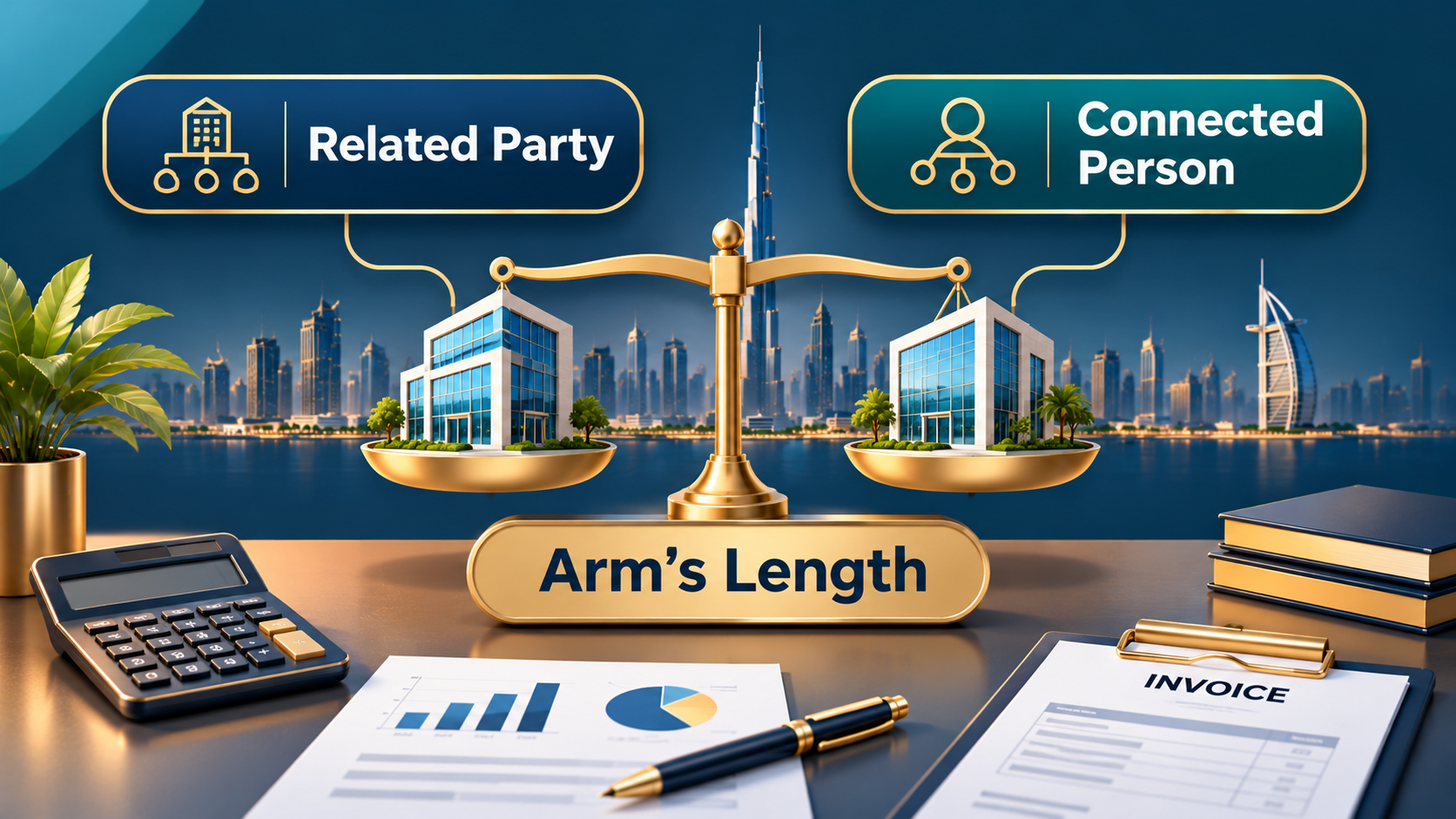
Transfer pricing in the UAE applies to every business subject to Corporate Tax, including SMEs. Any transaction with a related party (such as a sister company or a 50%+ owner) or a connected person (such as an owner, director or their relatives) must be priced at arm’s length, meaning the price unrelated parties would agree. Most SMEs do not need a Master File or Local File, because these apply only above AED 200 million revenue or within groups of AED 3.15 billion+. However, SMEs must still keep evidence of pricing, and may need to file a Transfer Pricing Disclosure Form with their Corporate Tax return if related-party transactions exceed AED 40 million or connected-person payments exceed AED 500,000.
Many SME owners in the UAE assume transfer pricing is a concern only for multinationals. That is a costly assumption. Under the UAE Corporate Tax Law, the arm’s length principle applies to all taxable persons, regardless of size. If you pay yourself a director’s salary, rent an office from a family member, lend money to a sister company or share staff between two businesses you own, transfer pricing rules already apply to you.
This guide explains transfer pricing from an SME’s point of view: which transactions are covered, which thresholds trigger formal documentation, and what records a smaller business should keep.
UAE Transfer Pricing at a Glance: Key Thresholds
| Threshold | What it triggers |
|---|---|
| 50% | Ownership or control level that generally makes two parties “related” |
| AED 500,000 | Connected-person payments above this must be reported in the TP Disclosure Form |
| AED 4 million | Per-category related-party value that requires disclosure (when the AED 40m test is also met) |
| AED 40 million | Total related-party transactions that trigger the Related Party schedule of the TP Disclosure Form |
| AED 200 million | Revenue that requires a Master File and Local File |
| AED 3.15 billion | Multinational group revenue that requires a Master File and Local File for UAE members |
| 30 days | Time to submit TP documentation after an FTA request |
What Is Transfer Pricing in the UAE?
Transfer pricing refers to the prices charged in transactions between parties that are not independent of each other, such as two companies owned by the same person or a company and its owner. The UAE rules are found in Articles 34 to 36 and Article 55 of Federal Decree-Law No. 47 of 2022 (the Corporate Tax Law), with documentation rules in Ministerial Decision No. 97 of 2023.
The core rule is the arm’s length principle: the price in a controlled transaction must match what independent parties would agree in comparable circumstances. If it does not, the FTA can adjust taxable income to the arm’s length amount.
Why it matters for SMEs: The UAE has no personal income tax. That creates a natural incentive to shift business profits to owners through inflated salaries, rent or fees. The transfer pricing and connected person rules exist specifically to prevent this.
Who Counts as a Related Party in the UAE?
Under Article 35 of the Corporate Tax Law, related parties include:
- Individuals related by kinship or marriage up to the fourth degree, including through adoption or guardianship.
- An individual and a company where the individual, alone or with related parties, owns 50% or more of the company or controls it.
- Two or more companies where one owns 50% or more of the other, or the same person owns 50% or more of (or controls) both.
- A business and its permanent establishment or foreign branch.
- Partners in the same unincorporated partnership.
- Trustees, founders and beneficiaries of a trust or foundation and its related parties.
Control includes holding 50% or more of voting rights, the ability to appoint 50% or more of the board, entitlement to 50% or more of profits, or the ability to significantly influence the business.
What Is a Connected Person, and Why Does It Matter More for SMEs?
A connected person (Article 36) is someone who is close to the business itself:
- An owner who directly or indirectly holds 50% or more of the business
- A director or officer of the business
- A related party of the owner, director or officer (for example, a spouse or sibling)
Payments or benefits to a connected person are deductible only to the extent they reflect market value and are incurred wholly and exclusively for the business. If an owner-director pays himself AED 150,000 a month, but the market rate for that role is AED 60,000, the excess may be disallowed for Corporate Tax.
SME reality check: For most owner-managed businesses, the connected person rule is the transfer pricing issue that matters most day to day. It covers salaries, bonuses, rent, consultancy fees and benefits paid to owners, directors and their families.
Exceptions apply to businesses such as companies listed on a recognised stock exchange and entities regulated by a competent UAE authority, but most private SMEs are fully within scope.
Common SME Transactions That Fall Under Transfer Pricing
| Transaction | Who is involved | Transfer pricing question |
|---|---|---|
| Owner-director salary and bonus | Connected person | Is the pay in line with market rates for the role? |
| Office or warehouse rented from the owner or a relative | Connected person | Is the rent equal to market rent for similar space? |
| Loan from a shareholder or sister company | Related party | Is the interest rate (or zero interest) arm’s length? |
| Management or admin fees charged between sister companies | Related party | Were the services actually provided, and is the fee reasonable? |
| Goods sold to a sister company | Related party | Is the price comparable to sales to unrelated customers? |
| Shared staff or premises across two companies | Related party | Are costs split on a reasonable, documented basis? |
| Use of a brand or trademark owned by another group entity | Related party | Is a royalty charged, and is it arm’s length? |
Which Transfer Pricing Methods Can Be Used?
Article 34 recognises five OECD-aligned methods. The business should use the most appropriate method for each transaction:
| Method | Best suited for | Simple SME example |
|---|---|---|
| Comparable Uncontrolled Price (CUP) | Goods or services also sold to third parties | Price charged to sister company vs price charged to outside customers |
| Resale Price Method | Distributors buying from a related party and reselling | Trading company buying from a related supplier |
| Cost Plus Method | Routine services or manufacturing | Shared admin services charged at cost + a mark-up |
| Transactional Net Margin Method (TNMM) | Most common where direct price comparisons are unavailable | Comparing a company’s profit margin with similar independent companies |
| Transactional Profit Split | Highly integrated operations | Two related companies jointly developing a product |
Another method may be used if none of the five can reasonably be applied, provided the choice is justified.
Do SMEs Need a Master File and Local File?
Most do not. Under Ministerial Decision No. 97 of 2023, a Master File and Local File are required only if:
- The business’s revenue in the tax period is AED 200 million or more, or
- The business is part of a multinational group with consolidated revenue of AED 3.15 billion or more.
Even then, these files are not filed with the return. They must be submitted within 30 days of an FTA request.
Visual: Which documentation applies to your business?
| Business profile | Arm’s length pricing | Keep supporting records | TP Disclosure Form | Master File & Local File |
|---|---|---|---|---|
| SME, revenue under AED 200m, few related-party dealings | ✔ Required | ✔ Required | Only if thresholds met | ✘ Not required |
| SME paying owners/directors over AED 500,000 | ✔ Required | ✔ Required | ✔ Connected Person schedule | ✘ Not required |
| Group with related-party transactions over AED 40m | ✔ Required | ✔ Required | ✔ Related Party schedule | Only if AED 200m revenue / AED 3.15bn group |
| Business with revenue of AED 200m+ | ✔ Required | ✔ Required | ✔ If thresholds met | ✔ Required |
The Transfer Pricing Disclosure Form: When SMEs Must File It
The TP Disclosure Form is submitted with the Corporate Tax return, which is due within 9 months of the end of the tax period. It has two parts:
Related Party schedule. This is required when both conditions are met:
- Total related-party transactions exceed AED 40 million, and
- Transactions in a single category exceed AED 4 million.
The categories are goods, services, intellectual property, interest, assets, liabilities and others.
Connected Person schedule. This is required when total payments or benefits to connected persons (and their related parties) exceed AED 500,000. Each connected person above that amount is reported individually, with the gross value paid and its market value.
Watch this threshold: AED 500,000 a year is roughly AED 41,700 a month. An owner-director’s salary, plus rent paid to a family member, can cross this level quickly. Many SMEs that never think about transfer pricing will still need to complete this schedule.
Income and expenses must be reported separately, not netted. Downward adjustments that reduce taxable income generally need FTA approval.
What Records Should an SME Keep?
Even where no Master File or Local File is required, an SME should be able to show that its pricing is reasonable. A practical record-keeping checklist:
- Ownership chart showing owners, directors, sister companies and family connections
- List of all related-party and connected-person transactions with amounts for the tax period
- Written agreements: loan agreements, lease contracts, service agreements, employment contracts for owner-directors
- Invoices and payment records that match those agreements
- Market evidence: salary surveys, rental quotes for similar property, prices charged to outside customers, bank lending rates
- Cost allocation workings for shared staff, premises or overheads
- Board or owner approvals for significant related-party transactions
Under the Corporate Tax Law, records generally must be kept for 7 years after the end of the tax period they relate to. Failure to maintain required records can attract administrative penalties under Cabinet Decision No. 75 of 2023.
What About Small Business Relief?
SMEs with revenue of AED 3 million or less may elect Small Business Relief for tax periods ending on or before 31 December 2026. Businesses that elect it are relieved from formal transfer pricing documentation requirements. However:
- The arm’s length principle still applies to their transactions.
- 2026 is the final year the relief is currently available, so SMEs should prepare for full transfer pricing compliance in later periods.
Advance Pricing Agreements: An Option Mainly for Larger Businesses
In 2026, the FTA introduced an Advance Pricing Agreement (APA) framework, which lets businesses agree their transfer pricing method with the FTA in advance. Reported details include a minimum of AED 100 million in covered transactions per tax period, an AED 30,000 application fee and a typical term of 3 to 5 years. For most SMEs, APAs are not practical. Good documentation of everyday transactions is the more realistic protection.
Common Transfer Pricing Mistakes Made by UAE SMEs
- Assuming “too small for transfer pricing”. The arm’s length principle has no minimum size.
- Paying owners without a market benchmark. Excessive salaries or bonuses to owner-directors can be disallowed.
- Interest-free loans between sister companies with no documentation. The FTA may question whether the terms are arm’s length.
- No written agreements. Undocumented management fees and cost recharges are hard to defend.
- Ignoring the AED 500,000 connected-person threshold. Missing the disclosure schedule can lead to an incorrect tax return.
- Netting income and expenses. The disclosure form requires them to be reported separately.
If you own more than one UAE company, or pay yourself and family members through the business, a transfer pricing review before you file can prevent adjustments later. SmartBiz helps UAE SMEs with corporate tax registration and filing and accounting and bookkeeping.
Unsure whether your related-party transactions are compliant?
SmartBiz reviews owner payments, sister-company dealings and your TP disclosure obligations before you file your Corporate Tax return. Book a Consultation
Frequently Asked Questions
Does transfer pricing apply to small businesses in the UAE?
Yes. The arm’s length principle applies to all taxable persons under UAE Corporate Tax, regardless of size. Smaller businesses are mainly exempt from the Master File and Local File requirements, not from the pricing rules themselves.
What is the revenue threshold for transfer pricing documentation in the UAE?
A Master File and Local File are required if the business has revenue of AED 200 million or more in the tax period, or belongs to a multinational group with consolidated revenue of AED 3.15 billion or more.
What is the difference between a related party and a connected person in the UAE?
A related party is linked through family ties up to the fourth degree, or through 50%+ ownership or control. A connected person is an owner holding 50% or more, a director or officer of the business, or a related party of any of them. Payments to connected persons are deductible only up to market value.
When must the UAE Transfer Pricing Disclosure Form be filed?
It is filed with the Corporate Tax return. The Related Party schedule applies when related-party transactions exceed AED 40 million in total and AED 4 million in a category. The Connected Person schedule applies when connected-person payments exceed AED 500,000.
Can I pay myself a salary from my UAE company?
Yes, but if you are an owner or director, the salary is a payment to a connected person. It is deductible for Corporate Tax only to the extent it reflects market value for the work performed.
How long does a business have to submit transfer pricing documents to the FTA?
Where a Master File and Local File are required, they must be submitted within 30 days of an FTA request.
Are interest-free loans between sister companies allowed in the UAE?
They are not prohibited, but they are related-party transactions. The terms should be documented and justified as consistent with the arm’s length principle, or the FTA may adjust taxable income.
Sources and Legal References
- Federal Decree-Law No. 47 of 2022 on the Taxation of Corporations and Businesses: Articles 34 (Arm’s Length Principle), 35 (Related Parties and Control), 36 (Payments to Connected Persons) and 55 (Transfer Pricing Documentation)
- Ministerial Decision No. 97 of 2023 on Requirements for Maintaining Transfer Pricing Documentation
- Ministerial Decision No. 73 of 2023 on Small Business Relief
- Cabinet Decision No. 75 of 2023 on Administrative Penalties for Violations Related to the Application of Corporate Tax
- Federal Tax Authority: Transfer Pricing Guide and Advance Pricing Agreement Guide, available at tax.gov.ae
Disclaimer: This article provides general information based on UAE tax legislation and FTA guidance available at the time of writing. It is not tax or legal advice. Thresholds and FTA practice can change, so confirm your specific position with a qualified tax adviser.