
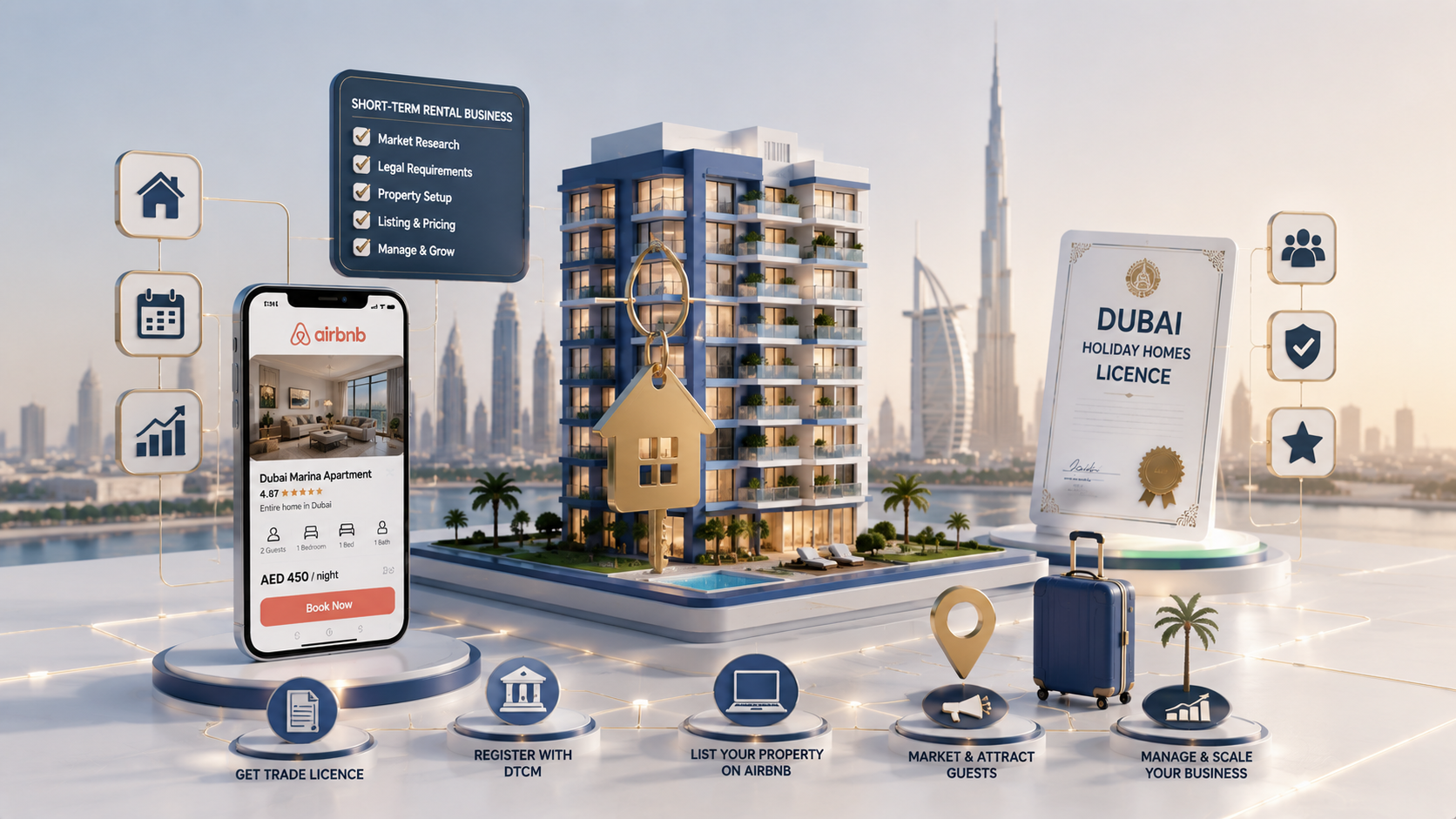
Quick Summary (AI Overview Snippet)
Yes, Airbnb business Dubai operations are legal — provided the property is licensed through the Department of Economy and Tourism (DET), formerly DTCM, under a DTCM holiday home licence. Hosts need a short term rental licence Dubai authorities issue per unit, along with owner consent, Ejari registration, and compliance with tourism dirham and safety standards. Free zone companies generally cannot operate short-term rentals directly, since the activity falls under mainland tourism licensing. Most hosts either self-manage under their own licence or partner with a licensed property management company Dubai operator.
Introduction
Dubai’s short-term rental market has grown into a genuine business category in its own right, driven by strong tourism numbers and a regulatory framework that — while structured — is far more accessible than many first-time hosts assume. Running an Airbnb business Dubai authorities recognize as legitimate isn’t a grey-area side hustle; it’s a licensed tourism activity regulated by the Department of Economy and Tourism (DET), the successor to the Dubai Department of Tourism and Commerce Marketing (DTCM).
For property owners and entrepreneurs exploring the holiday home business UAE model, this guide covers exactly what’s required — licensing, permits, costs, and the regulatory details that determine whether your rental operation is compliant or exposed to penalty risk.
Advisor Note: In our advisory work with property investors, the most common misconception is that a single Ejari-registered lease is enough to list a unit on Airbnb. It isn’t — short-term rental activity requires its own dedicated licensing layer entirely separate from standard tenancy registration.
Is Airbnb Legal in Dubai?
Yes — Airbnb business Dubai activity is fully legal when conducted through the proper regulatory channel. Dubai actively encourages the holiday home sector as part of its broader tourism strategy, but every unit listed for short-term stays must be individually licensed. Listing a property on Airbnb, Booking.com, or any similar platform without the required DTCM holiday home licence is a compliance violation that can result in fines, platform delisting, and legal exposure for the property owner.
Expert Tip: Licensing is issued per unit, not per owner. If you plan to operate multiple properties, each individual unit requires its own holiday home licence application — you cannot rely on a single company-level approval to cover an entire portfolio.
What Is a DTCM Permit and Do I Need One?
The DTCM permit — now issued under DET’s holiday home licensing framework — is the mandatory authorization required to legally rent out residential property on a short-term basis in Dubai. It functions similarly to a hotel or hospitality licence, reflecting the fact that short-term rental hosting is classified as a tourism activity, not standard residential leasing.
Who Needs a DTCM Holiday Home Licence?
- Individual property owners renting their own unit on a short-term basis
- Investors operating multiple units as a rental business
- Property management company Dubai operators managing units on behalf of owners
- Sub-lessees, where explicitly permitted by the landlord and building regulations
Without this tourist permit Dubai apartment authorization, the unit cannot legally be listed on any short-term booking platform, regardless of ownership status.
Short-Term Rental Regulations Dubai: Key Requirements
Dubai’s regulatory framework for holiday homes covers several layers beyond the core licence itself.
| Requirement | Detail |
|---|---|
| Licensing authority | Department of Economy and Tourism (DET), formerly DTCM |
| Licence type | DTCM/DET holiday home licence, issued per unit |
| Ownership documentation | Title deed or landlord’s No Objection Certificate (NOC) for tenants subletting |
| Building compliance | Property must be in a building/community that permits short-term rental use |
| Safety standards | Fire safety, smoke detectors, and general habitability compliance |
| Tourism dirham | Nightly tourism fee collected from guests, remitted to DET |
| Guest registration | Host must register guest details per DET/tourism reporting requirements |
| Insurance | Property and liability insurance coverage recommended, in some cases required |
Common Pitfall: Many owners assume a standalone villa or apartment automatically qualifies for short-term rental use. In practice, many residential communities and building management companies explicitly restrict or prohibit holiday home activity — checking building-level permissions before applying for your licence avoids a wasted application.
Step-by-Step: How Do I Get a Short-Term Rental Licence in Dubai?
Step 1: Confirm Property Eligibility
Verify that your building or community permits short-term rental use, and confirm you hold either full ownership or a landlord NOC if you’re a tenant planning to sublet.
Step 2: Gather Required Documentation
Typical documentation includes the title deed or tenancy contract, Emirates ID/passport copies, landlord NOC (if applicable), and building management approval where required.
Step 3: Apply for the DTCM Holiday Home Licence
Submit your application through DET’s licensing system, providing property details, ownership documentation, and unit specifications.
Step 4: Complete Safety and Compliance Inspection
Properties are typically required to meet basic safety standards — functioning smoke detectors, fire extinguishers, and general habitability requirements — before licence approval.
Step 5: Register for Tourism Dirham Collection
Licensed hosts must integrate with DET’s tourism dirham collection system, charging and remitting the nightly tourism fee per booking.
Step 6: List Your Property Legally
Once licensed, your unit can be listed on Airbnb, Booking.com, or other platforms, referencing your active holiday home licence where required by the platform.
Step 7: Maintain Ongoing Compliance
Annual licence renewal, continued building-level compliance, and accurate tourism dirham remittance are ongoing obligations, not one-time steps.
Expert Tip: Renewal timing matters. Letting a holiday home licence lapse — even briefly — while continuing to accept bookings is treated as unlicensed operation, exposing the host to the same penalties as never having been licensed at all.
Company Setup Path: Running Airbnb as a Business, Not Just a Side Rental
Individual hosts with one or two units often manage under a personal holiday home licence. But entrepreneurs building a genuine holiday home business UAE portfolio — managing multiple units, potentially for other owners — typically need a proper company structure.
When You Need a Company Licence, Not Just a Unit Permit
- You plan to manage short-term rental units on behalf of other property owners (third-party management)
- You’re scaling beyond a small number of self-owned units
- You want to formally brand and market a property management company Dubai service
- You intend to raise financing, hire staff, or build a scalable operating business around the activity
Setting Up Your Holiday Home Management Company
- Register a mainland trade licence covering holiday home management/tourism activity — this activity generally cannot be conducted under a free zone licence, since it requires direct DET mainland registration.
- Obtain the required UAE Mainland Business Setup licence structure suited to hospitality/property management activity.
- Apply for company-level DET approval to operate as a licensed holiday home management entity.
- Register each managed unit individually under the appropriate holiday home licence.
- Set up compliant banking and financial systems to handle owner payouts, tourism dirham remittance, and platform payment reconciliation.
Advisor Note: We frequently guide clients comparing UAE Freezone Setup against UAE Mainland Business Setup for hospitality-adjacent ventures. For direct short-term rental operation and management, mainland licensing is generally required — free zone structures are better suited to adjacent activities like marketing, booking-platform technology, or consulting services that don’t directly involve managing the licensed units themselves.
Airbnb Income Dubai: What Can You Realistically Earn?
Actual Airbnb income Dubai returns vary significantly based on location, property type, seasonality, and management quality. Rather than quoting a single figure, it’s more useful to understand the variables that drive returns:
Key Factors Affecting Short-Term Rental Income
- Location — proximity to tourism hubs, business districts, and major attractions materially affects occupancy and nightly rates
- Property type and size — studio and one-bedroom units in high-demand areas often see stronger occupancy than larger units
- Seasonality — occupancy and pricing typically peak during UAE’s cooler tourism months and dip during summer
- Management quality — professionally managed listings with strong photography, pricing optimization, and guest response times consistently outperform self-managed, passive listings
- Licensing and compliance costs — tourism dirham remittance, licence renewal, and management fees (where applicable) directly affect net returns
Expert Tip: Gross booking revenue is not the same as net income. Owners frequently underestimate the combined impact of platform commissions, management fees (typically a percentage of revenue for third-party operators), tourism dirham, licensing costs, and maintenance — all of which should be modeled before assuming a headline occupancy rate translates directly to profit.
Pros and Cons of the Dubai Short-Term Rental Model
Advantages
- Strong year-round tourism demand supporting consistent booking volume
- Regulatory framework that, while structured, is transparent and accessible compared to many international markets
- Potential for higher yield compared to standard long-term residential leasing in prime locations
- Established property management ecosystem for owners who prefer a hands-off model
Challenges to Plan For
- Licensing and compliance costs add administrative overhead compared to standard leasing
- Building-level restrictions can limit eligible properties
- Income is seasonal and platform-dependent, creating revenue variability
- Third-party management fees can meaningfully reduce net yield if not carefully negotiated
Short-Term Rental Tax and Financial Compliance in the UAE
Short-term rental income is not exempt from standard UAE tax and financial compliance obligations. Hosts and holiday home businesses should account for:
- VAT Registration — required once taxable turnover crosses the mandatory threshold, which applies to short-term rental income the same as any other taxable business activity
- Corporate Tax Registration — companies operating holiday home management businesses are subject to standard UAE corporate tax registration requirements
- VAT Filing & Return Services and Corporate Tax Filing — ongoing reporting obligations as rental income is recognized
- Financial Management & Advisory — particularly relevant for owners managing multiple units or third-party owner payouts, where clean financial separation and reporting matters for both compliance and owner trust
Common Pitfall: Some hosts treat short-term rental income as informal or personal earnings rather than business revenue subject to standard tax rules. Once activity scales past a hobby level — particularly for those managing units on behalf of others — proper corporate structuring and tax registration become non-negotiable.
Can a Free Zone Company Operate a Short-Term Rental Business?
Generally, no — not directly. Short-term rental and holiday home management is classified as a tourism activity requiring DET registration, which is tied to mainland licensing rather than free zone jurisdiction. Free zone companies can, however, operate adjacent services — such as PRO Services UAE-style government liaison support, booking technology platforms, marketing services, or consulting — without directly holding the property management licence themselves.
Entrepreneurs unsure which structure fits their specific business model should get a jurisdiction assessment before committing capital, since correcting a mismatched structure after the fact is more costly than planning correctly from the outset — a service our advisory team provides through both UAE Freezone Setup and UAE Mainland Business Setup consultations.
Common Mistakes New Hosts and Operators Make
- Listing a property on Airbnb before securing the DTCM/DET holiday home licence
- Assuming a standard Ejari tenancy registration is sufficient for short-term rental compliance
- Failing to confirm building-level restrictions before investing in a property for this purpose
- Letting the holiday home licence lapse while continuing to accept bookings
- Treating rental income as informal earnings rather than registering for VAT and corporate tax where thresholds apply
- Underestimating the combined cost of licensing, tourism dirham, and management fees when projecting returns
- Attempting to operate a multi-unit management business under a free zone licence rather than proper mainland registration
Building a Compliant, Scalable Holiday Home Business
For owners and entrepreneurs serious about building a genuine holiday home business UAE operation rather than a single side rental, the foundation matters as much as the licence itself:
- Structure your company correctly from the start, factoring in whether you’ll self-manage or manage on behalf of other owners
- Keep clean, auditable financial records — particularly important if you’re handling owner payouts as a management company; our Company Audit Reports service supports this as the business scales
- Build your tax compliance calendar around VAT and corporate tax obligations from day one, not after your first full year of revenue
- If you’re winding down or restructuring a rental portfolio business, coordinate proper deregistration through Company Closure Services or a Company Liquidation Report to avoid lingering DET or tax obligations
FAQs
1. Is Airbnb legal in Dubai? Yes, provided the property holds a valid DTCM/DET holiday home licence. Listing a unit without this licence is not legal, regardless of standard tenancy or ownership documentation.
2. How do I get a short-term rental licence in Dubai? You apply through the Department of Economy and Tourism (DET), confirming property eligibility, submitting ownership documentation, passing a safety compliance check, and registering for tourism dirham collection.
3. What is a DTCM permit and do I need one? The DTCM permit — now issued as a DET holiday home licence — is the mandatory authorization to legally rent a property short-term in Dubai. Any individual or company listing a unit on a short-term rental platform needs one.
4. How much can I earn from Airbnb in Dubai? Returns vary widely based on location, property type, seasonality, and management quality. Owners should model net income after platform commissions, licensing costs, tourism dirham, and management fees rather than relying on gross occupancy figures alone.
5. Can a free zone company operate a short-term rental business? Generally not directly — holiday home management requires mainland DET registration. Free zone companies can operate adjacent services like marketing or booking technology, but not the licensed rental management activity itself.