
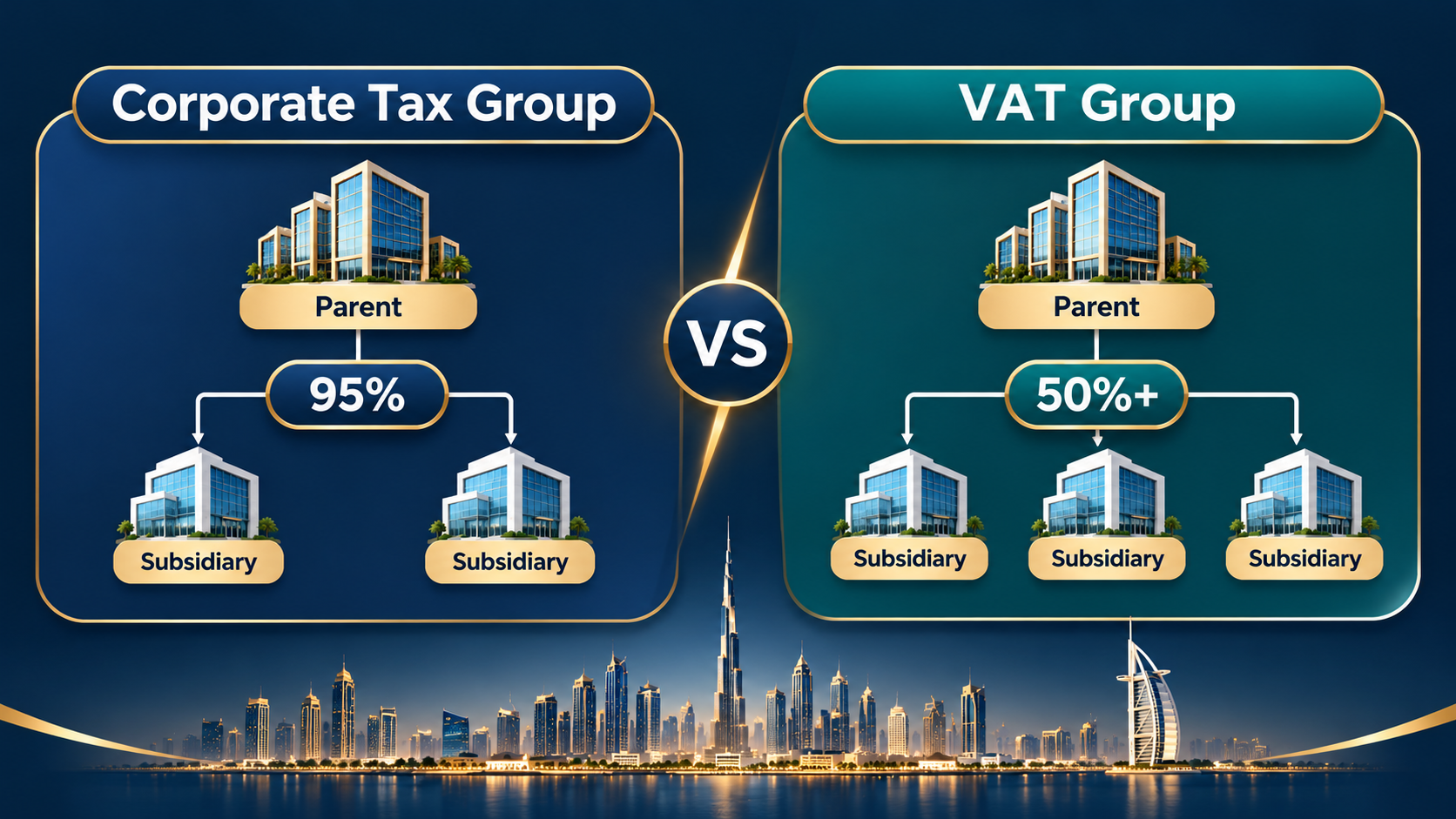
Quick Answer: A Corporate Tax Group and a VAT Group are two separate grouping regimes in the UAE with different legal tests. A Corporate Tax Group requires a UAE-resident parent to hold at least 95% of the share capital, voting rights, profits and net assets of each subsidiary, and it files one Corporate Tax return. A VAT Group requires UAE-established legal persons that are related parties under common control (typically more than 50%), and it registers under one VAT number (TRN) and files one VAT return. The same companies can belong to both groups, but only if they pass both tests separately.
Many UAE business owners with more than one company assume that “tax grouping” is a single decision. It is not. The UAE has two independent grouping systems: one under the Corporate Tax Law and one under the VAT Law. Each has its own eligibility rules, ownership thresholds, filing treatment and FTA application.
This guide compares the two side by side so you can see which group your entities qualify for, where the rules differ, and why a company that fits one group may not fit the other.
Corporate Tax Group vs VAT Group: The Key Numbers at a Glance
| Figure | What it means |
|---|---|
| 95% | Minimum parent ownership for a Corporate Tax Group |
| 50%+ | Typical control level for VAT Group related parties |
| 9% | Corporate Tax rate on taxable income above AED 375,000 |
| 5% | Standard UAE VAT rate |
| 1 | Return per group, under each regime |
What Is a Corporate Tax Group in the UAE?
A Corporate Tax Group is a parent company and one or more subsidiaries that the Federal Tax Authority (FTA) treats as a single taxable person for UAE Corporate Tax. The rules sit in Article 40 of Federal Decree-Law No. 47 of 2022 (the Corporate Tax Law) and Ministerial Decision No. 125 of 2023.
Once the group is approved, the parent company files one Corporate Tax return on behalf of the whole group, based on consolidated results. Transactions between group members are eliminated on consolidation, and the group’s taxable income is assessed as one figure.
Corporate Tax Group Eligibility: The 95% Ownership Rule
Each member must meet all of the following conditions:
- The parent and every subsidiary is a UAE-resident juridical person (a company, not an individual).
- The parent holds, directly or indirectly through group members, at least 95% of the subsidiary’s share capital.
- The parent holds at least 95% of the voting rights.
- The parent is entitled to at least 95% of the profits and net assets.
- No member is an Exempt Person or a Qualifying Free Zone Person (QFZP).
- All members have the same financial year and prepare accounts under the same accounting standards.
- Each member already holds a Corporate Tax Registration Number before the group application is filed.
What Is a VAT Group in the UAE?
A VAT Group (called a “Tax Group” under the VAT Law) is two or more legal persons registered together under one Tax Registration Number. The rules come from Article 14 of Federal Decree-Law No. 8 of 2017 on VAT and its Executive Regulation.
A representative member files one VAT return for the whole group. The key practical benefit is that supplies between group members are generally disregarded for VAT, so the companies do not charge each other VAT on intra-group invoices.
VAT Group Eligibility: Related Parties and Control
- Each member is a legal person with a place of establishment or fixed establishment in the UAE.
- The members are related parties, connected through ownership, economic, financial or regulatory ties.
- One or more members control the others, commonly by holding more than 50% of shares or voting rights, or by having the power to direct the business.
- Natural persons, government entities and charities are not eligible members.
Ownership Threshold Comparison: 95% vs 50%
The single biggest difference between the two groups is how much ownership the parent needs.
| Group type | Minimum parent ownership / control |
|---|---|
| Corporate Tax Group | 95% |
| VAT Group | 50%+ (typical control level) |
The gap that matters: A subsidiary owned 51% to 94% by the parent falls inside this gap. It can be eligible for VAT grouping but not for Corporate Tax grouping.
Corporate Tax Group vs VAT Group: Side-by-Side Comparison
| Factor | Corporate Tax Group | VAT Group |
|---|---|---|
| Governing law | Federal Decree-Law No. 47 of 2022, Article 40 | Federal Decree-Law No. 8 of 2017, Article 14 |
| Ownership test | At least 95% of capital, voting rights, profits and net assets | Related parties with control (commonly 50%+) |
| Who can be a member | UAE-resident juridical persons | Legal persons established in the UAE |
| Excluded entities | Exempt Persons, Qualifying Free Zone Persons | Natural persons, government entities, charities |
| Financial year | Must be the same for all members | Group follows a single VAT tax period |
| Who files | Parent company | Representative member |
| Registration number | Members keep their own TRNs; group files one return | One group TRN replaces individual VAT TRNs |
| Intra-group transactions | Eliminated on consolidation (arm’s length still expected) | Supplies between members generally disregarded for VAT |
| Liability | Parent and subsidiaries jointly and severally liable | All members jointly and severally liable |
| Application | Parent applies via EmaraTax before the end of the tax period it should apply to | Representative member applies via EmaraTax; FTA decides within 20 business days |
Practical Example: Same Group, Two Different Results
Consider a Dubai holding company with four subsidiaries:
| Entity | Parent ownership | Corporate Tax Group? | VAT Group? |
|---|---|---|---|
| Sub A: Mainland trading LLC | 100% | ✔ Yes | ✔ Yes |
| Sub B: Mainland services LLC | 80% | ✘ No (below 95%) | ✔ Yes |
| Sub C: Free zone company taxed as a QFZP | 100% | ✘ No (QFZP excluded) | Assessed under VAT rules |
| Sub D: Mainland LLC, different financial year | 100% | Only after aligning year | ✔ Yes |
The result: the holding company could form a Corporate Tax Group with only Sub A (and Sub D once its financial year is aligned with FTA approval), while a VAT Group could include A, B and D, and possibly C depending on its VAT position. The same corporate structure produces two groups with different memberships.
“Qualifying for a VAT Group says nothing about qualifying for a Corporate Tax Group. Each regime runs its own test, and the FTA assesses each application on its own conditions.”
Can the Same Companies Belong to Both a Corporate Tax Group and a VAT Group?
Yes. Nothing in UAE law stops the same entities from being in both groups. But membership of one does not give automatic membership of the other. You need:
- Two separate applications on EmaraTax, one for Corporate Tax grouping and one for VAT grouping.
- To pass each test independently: 95% ownership plus the other Corporate Tax conditions, and related-party control for VAT.
- To manage two different filers: the parent company for Corporate Tax and the representative member for VAT. These are often the same entity, but they don’t have to be.
Which Group Can Your Business Join? A 4-Step Check
- Are all entities UAE-resident or UAE-established companies? If an entity is an individual or sole establishment, it cannot join either group.
- Does the parent control each entity? If yes (typically 50%+), the VAT Group route is open.
- Does the parent hold 95%+ of capital, votes, profits and net assets? If no, the entity stays outside the Corporate Tax Group.
- Is any entity a QFZP or Exempt Person, or on a different financial year? If yes, it is excluded from the Corporate Tax Group until the issue is resolved.
How Do Filing Obligations Differ Between the Two Groups?
Corporate Tax Group filing
- One annual Corporate Tax return filed by the parent
- Based on consolidated financial statements
- Intra-group transactions eliminated
- The AED 375,000 0% band applies once to the group’s combined taxable income
- Members stop filing standalone Corporate Tax returns
VAT Group filing
- One VAT return per tax period (monthly or quarterly) filed by the representative member
- One group TRN on invoices to outside customers
- No VAT on supplies between members
- Output and input VAT of all members combined
- Members’ individual VAT registrations are replaced by the group registration
⚠ Joint and several liability applies to both. In both regimes, every group member can be held liable for the group’s tax. A filing error or unpaid liability caused by one company can become the responsibility of all members, so check each entity’s compliance history before adding it to either group.
Common Mistakes When Comparing Tax Groups
- Assuming one application covers both taxes. Corporate Tax and VAT grouping are separate EmaraTax applications.
- Using the VAT control test for Corporate Tax. An 80%-owned subsidiary may join a VAT Group but fails the 95% Corporate Tax test.
- Adding a Qualifying Free Zone Person to a Corporate Tax Group. QFZPs are excluded. To include one, it would first have to leave the QFZP regime and give up its 0% QFZP treatment.
- Ignoring financial-year mismatches. Corporate Tax Group members must share the same financial year.
- Missing the application window. A Corporate Tax Group application must be filed before the end of the tax period from which the group should apply.
If your structure includes mainland companies, free zone entities and partly owned subsidiaries, a professional eligibility review helps you avoid a rejected application. SmartBiz supports UAE businesses with corporate tax registration and filing and VAT registration services.
Not sure which tax group fits your company structure?
SmartBiz reviews your ownership, free zone status and financial year to confirm Corporate Tax and VAT grouping eligibility. Book a Consultation
Frequently Asked Questions
What is the difference between a Corporate Tax Group and a VAT Group in the UAE?
A Corporate Tax Group requires 95% common ownership and files one consolidated Corporate Tax return through the parent company. A VAT Group requires related parties under common control and registers under one VAT number, with supplies between members disregarded for VAT.
What is the minimum ownership to form a Corporate Tax Group in the UAE?
The parent company must hold at least 95% of each subsidiary’s share capital and voting rights, and be entitled to at least 95% of its profits and net assets, directly or indirectly through other group members.
Can a free zone company join a Corporate Tax Group?
A free zone company can join only if it is not a Qualifying Free Zone Person and meets every other condition. A QFZP enjoying the 0% rate on qualifying income is excluded from Corporate Tax grouping.
Can the same companies be in both a VAT Group and a Corporate Tax Group?
Yes. The same entities can be members of both, but each group needs its own EmaraTax application and each set of conditions must be met separately.
Who files the return for a tax group in the UAE?
For a Corporate Tax Group, the parent company files. For a VAT Group, the representative member files. Both are responsible for the group’s compliance with the FTA.
Is VAT charged on transactions between VAT Group members?
Generally no. Supplies between members of the same VAT Group are disregarded for VAT purposes, so no VAT invoice is needed for those intra-group supplies.
How long does the FTA take to approve a VAT Group application?
The FTA is expected to decide on a VAT Group application within 20 business days of receiving a complete application, though requests for further information can extend this.
Sources and Legal References
- Federal Decree-Law No. 47 of 2022 on the Taxation of Corporations and Businesses, Article 40 (Tax Group)
- Ministerial Decision No. 125 of 2023 on Tax Group for Corporate Tax
- Federal Decree-Law No. 8 of 2017 on Value Added Tax, Article 14 (Tax Group)
- Federal Tax Authority: Corporate Tax Guide on Tax Groups and VAT Tax Group guidance, available at tax.gov.ae
Disclaimer: This article provides general information based on UAE tax legislation and FTA guidance available at the time of writing. It is not tax or legal advice. Rules and FTA practice can change, so confirm your specific position with a qualified tax adviser before applying.