
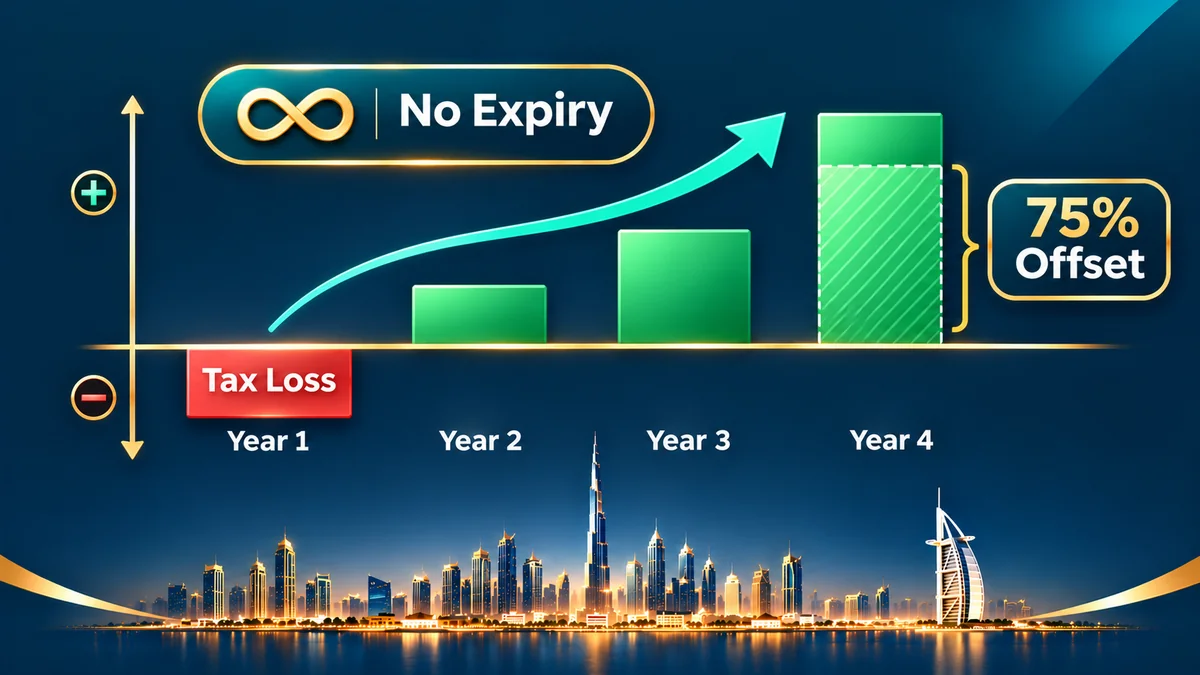
Quick Answer: Under corporate tax loss relief in the UAE, a business that makes a tax loss can carry it forward indefinitely and use it against future taxable income. There is no expiry date. However, the loss can offset only up to 75% of taxable income in any later tax period, so at least 25% of taxable income remains subject to tax. Losses are used oldest first, and must be used to the maximum extent allowed. Relief is lost if ownership changes by more than 50% and the same or a similar business is not continued, unless the company is listed. Losses can also be transferred to another UAE company where there is 75% common ownership and other conditions are met. Losses from before Corporate Tax applied to the business, or from exempt activities, cannot be used.
Many UAE businesses make losses in their early years. Startups invest before they earn, and established companies go through difficult periods. Under UAE Corporate Tax, those losses are not wasted. They become a valuable tax asset that can reduce tax in future profitable years, but only if the business understands the rules and keeps the conditions intact.
This guide explains UAE tax loss carry forward rules in detail: how tax losses arise, the 75% offset limit, which losses do not qualify, the ownership and business continuity tests, how losses can be transferred between group companies, and how Small Business Relief affects losses, with worked examples.
Corporate Tax Loss Relief UAE: Key Numbers at a Glance
| Figure | What it means |
|---|---|
| No time limit | Tax losses can be carried forward indefinitely |
| 75% | Maximum share of taxable income that can be offset by tax losses in a tax period |
| 25% | Minimum share of taxable income that remains taxable after loss relief |
| 50% | Ownership change threshold that can restrict loss carry forward |
| 75% | Common ownership needed to transfer tax losses between UAE companies |
| 9% | Corporate Tax rate on taxable income above AED 375,000 |
| AED 375,000 | Taxable income taxed at 0% |
What Is a Tax Loss Under UAE Corporate Tax?
A tax loss arises when a business’s deductible expenditure exceeds its taxable income in a tax period. In other words, it is negative taxable income.
Importantly, a tax loss is not the same as an accounting loss. It is calculated by starting with the accounting result in the financial statements and then making the adjustments required by the Corporate Tax Law, for example:
- adding back non-deductible expenses (such as 50% of client entertainment or fines and penalties)
- removing exempt income (such as qualifying dividends)
- applying interest limitation rules
- making transfer pricing adjustments for related-party and connected-person transactions
So a company can show an accounting loss but a smaller tax loss, or even taxable profit, once these adjustments are made.
The rules are set out in Articles 37 to 39 of Federal Decree-Law No. 47 of 2022 (the Corporate Tax Law), with practical guidance in the FTA’s Basic Tax Information Bulletin on Corporate Tax Losses.
How Long Can Tax Losses Be Carried Forward in the UAE?
Indefinitely. There is no expiry period for corporate tax losses in the UAE. A loss made in a business’s first tax period can still be used many years later, as long as:
- the business remains a Taxable Person (it has not deregistered), and
- the ownership and business continuity conditions below are met.
Compare this with other rules: Disallowed net interest expenditure under the General Interest Deduction Limitation Rule follows a different regime and can generally be carried forward for 10 years. Tax losses themselves have no time limit.
The 75% Rule: How Much Taxable Income Can Losses Offset?
The key restriction on tax loss offset in the UAE is the 75% cap:
Maximum loss relief in a period = 75% of taxable income for that period (before loss relief)
At least 25% of taxable income always remains subject to Corporate Tax, even if large losses are available. Any unused losses carry forward to the next period.
Additional FTA rules on using losses
| Rule | What it means |
|---|---|
| Oldest losses first (FIFO) | Losses are used in the order they arose |
| Use to the maximum extent | You cannot choose to use less than the allowable amount to “save” losses for later |
| Own losses before transferred losses | A company must use its own carried-forward losses before losses transferred from another company |
| Use own losses before transferring them | A company must offset its own losses against its own income before transferring any to another company |
Worked example: carrying forward a loss over three years
A mainland trading LLC (not electing Small Business Relief) has the following results:
| Tax period | Taxable income before loss relief (AED) | Maximum offset (75%) | Loss used | Taxable income after relief | Loss balance carried forward |
|---|---|---|---|---|---|
| Year 1 | (1,000,000) | — | — | 0 | 1,000,000 |
| Year 2 | 600,000 | 450,000 | 450,000 | 150,000 | 550,000 |
| Year 3 | 2,000,000 | 1,500,000 | 550,000 | 1,450,000 | 0 |
Corporate Tax payable:
| Tax period | Taxable income after relief | 0% band | Taxed at 9% | Corporate Tax (AED) |
|---|---|---|---|---|
| Year 2 | 150,000 | 150,000 | 0 | 0 |
| Year 3 | 1,450,000 | 375,000 | 1,075,000 | 96,750 |
Notice what happened in Year 2: Taxable income after relief (AED 150,000) fell entirely within the 0% band, so no tax would have been payable even without using losses. Because losses must be used to the maximum extent, AED 450,000 of losses was absorbed anyway. Understanding this rule helps with realistic tax forecasting.
Which Losses Cannot Be Carried Forward?
Not every loss qualifies for taxable income loss relief in the UAE. The following cannot be used:
| Loss type | Why it doesn’t qualify |
|---|---|
| Losses incurred before Corporate Tax came into effect | They arose before the Corporate Tax regime applied |
| Losses incurred before the business became a Taxable Person | The business was not yet within the Corporate Tax system |
| Losses from activities that produce exempt income | For example, losses linked to exempt dividends or exempt foreign branch income |
| Losses after a disqualifying ownership change | The ownership/business continuity test was failed |
| Losses of a deregistered business | Losses are forfeited on Corporate Tax deregistration |
| Losses in Small Business Relief periods | No new tax losses arise in a period where SBR is elected |
The Ownership Test: What Happens When Owners Change?
Losses are tied to the economic owners of the business. Under Article 39 of the Corporate Tax Law:
- If the same persons continue to own at least 50% of the business (directly or indirectly) from the start of the period in which the loss arose to the end of the period in which it is used, the losses remain available.
- If ownership changes by more than 50%, the losses can still be used only if the business continues the same or a similar business activity.
- These restrictions do not apply to companies whose shares are listed on a Recognised Stock Exchange.
What counts as “the same or a similar business”?
The FTA looks at whether the business has maintained its core identity and operations. Relevant factors include:
- continued use of the same or similar assets
- whether the core business activities have been maintained
- whether there has been a significant change in the nature or conduct of the business
Visual: Ownership change scenarios
| Scenario | Ownership change | Business continues? | Losses available? |
|---|---|---|---|
| Founder sells 30% to a new investor | 30% | Yes | ✔ Yes (ownership test met) |
| Founder sells 60% to a new owner; same trading business continues | 60% | Yes | ✔ Yes (same business continues) |
| Founder sells 80%; new owner turns the trading company into a real estate business | 80% | No | ✘ No (losses forfeited) |
| Listed company with heavy share trading | Any | Any | ✔ Yes (listed company exception) |
M&A tip: If you are buying or investing in a loss-making UAE company, the value of its tax losses depends on whether the business will continue. Due diligence should check the loss history, ownership chain and post-deal business plans.
Transferring Tax Losses Between Group Companies
The UAE allows a tax loss to be transferred from one company to another, without forming a Corporate Tax Group, if all these conditions are met:
- Both are juridical persons (companies).
- Both are UAE Resident Persons. Transfers to or from non-residents, including UAE branches of foreign companies, are not allowed.
- One company owns at least 75% of the other, directly or indirectly, or a third person owns at least 75% of both. This must hold from the start of the loss period to the end of the period in which the loss is used.
- Neither is an Exempt Person.
- Neither is a Qualifying Free Zone Person.
- Both have financial years ending on the same date.
- Both use the same accounting standards.
The combined offset of the recipient’s own losses plus transferred losses cannot exceed 75% of the recipient’s taxable income.
Worked example: loss transfer between sister companies
Company B and Company C are both 100% owned by the same holding company:
| Item (AED) | Company B | Company C |
|---|---|---|
| Taxable income / (loss) | (1,200,000) | 1,000,000 |
| Loss transferred (max 75% of C’s income) | 750,000 out | 750,000 in |
| Taxable income after transfer | 0 | 250,000 |
| Loss balance carried forward | 450,000 | — |
In this example, Company C’s taxable income of AED 250,000 also falls within the 0% band, so the group pays no Corporate Tax for the period, and Company B still carries forward AED 450,000.
Loss transfer vs Corporate Tax Group: what’s the difference?
| Point | Loss transfer | Corporate Tax Group |
|---|---|---|
| Ownership threshold | 75% | 95% |
| Separate tax returns | Yes, each company files its own return | No, one return is filed by the parent |
| Losses used | Transferred amounts chosen by the parties | Group results consolidated |
| QFZPs and Exempt Persons | Excluded | Excluded |
| Flexibility | Transaction-by-transaction | Full consolidation |
Companies that join a Corporate Tax Group with pre-existing losses are subject to specific rules on how those losses can be used within the group.
Small Business Relief and Tax Losses
Businesses with revenue of AED 3 million or less may elect Small Business Relief (SBR) and be treated as having no taxable income. The FTA has confirmed how this interacts with losses:
| Rule | Effect |
|---|---|
| No new tax losses arise in an SBR period | Electing SBR means losses in that period are not recorded as tax losses |
| Existing losses cannot be used during SBR periods | Losses brought forward from non-SBR periods are frozen while SBR applies |
| Existing losses are preserved | They can be used or transferred again once SBR no longer applies |
Planning point for startups: If your business is expected to make significant early losses and become profitable later, electing SBR in loss-making years means those losses will not become tax losses. Weigh the benefit of SBR against the value of building up losses to use later, and get advice before electing.
Common Mistakes With Corporate Tax Losses
- Assuming accounting losses equal tax losses. Tax adjustments can significantly change the figure.
- Trying to use pre-Corporate Tax losses. Losses from before the business became taxable do not qualify.
- Ignoring the 75% cap. Offsetting 100% of taxable income leads to an incorrect return and possible penalties.
- Choosing to use fewer losses. Losses must be used to the maximum allowed amount.
- Overlooking ownership changes. Selling more than 50% and changing the business can wipe out losses.
- Deregistering without considering losses. Losses are forfeited on deregistration.
- Transferring losses without meeting every condition. Ownership, residence, financial year and accounting standards must all align.
- Not tracking loss balances. Without a clear loss schedule, FIFO usage and transfers become hard to prove.
Errors in loss calculations are a common reason for a later Corporate Tax voluntary disclosure, so accuracy from the first return matters.
Tax Loss Tracking Checklist
| Item | Done? |
|---|---|
| Tax loss calculated from adjusted accounting results, not the accounting loss | ☐ |
| Loss schedule maintained by year of origin (for FIFO) | ☐ |
| 75% cap applied correctly each year | ☐ |
| Ownership changes since each loss year reviewed | ☐ |
| Business continuity documented where ownership changed by more than 50% | ☐ |
| Loss transfers checked against all 7 conditions | ☐ |
| SBR periods identified (no new losses; existing losses frozen) | ☐ |
| Supporting workings retained for FTA review | ☐ |
How SmartBiz Helps Businesses Make the Most of Tax Losses
Tax losses are an asset, and like any asset they need to be recorded, protected and used correctly. SmartBiz supports UAE businesses with:
- Accounting and bookkeeping in Dubai: accurate books and adjusted tax computations that support your loss position
- VAT registration and VAT filing, so all your tax filings stay consistent
- Business setup in Dubai and company formation in the UAE, with group structures planned for future loss relief
- Mainland company setup for businesses planning UAE-wide operations
- A single point of contact through our business services hub in Dubai
Made a loss and want to protect its tax value?
SmartBiz helps you calculate your tax loss correctly, track it year by year and plan transfers within your group. Book a Consultation
Frequently Asked Questions
Can a UAE business carry forward tax losses?
Yes. Tax losses can be carried forward indefinitely and used against future taxable income, provided the business remains a Taxable Person and meets the ownership and business continuity conditions.
How much taxable income can tax losses offset in the UAE?
Tax losses can offset up to 75% of taxable income in a tax period, calculated before loss relief. The remaining 25% stays subject to Corporate Tax.
Can unused tax losses be carried forward to future years?
Yes. Any losses not used because of the 75% cap are carried forward with no time limit and used on a first-in, first-out basis.
Can losses from before Corporate Tax be used in the UAE?
No. Losses incurred before Corporate Tax came into effect, or before the business became a Taxable Person, cannot be carried forward.
What happens to tax losses if a company’s ownership changes?
If ownership changes by more than 50%, the losses remain available only if the same or a similar business continues. The restriction does not apply to listed companies.
Can tax losses be transferred between group companies in the UAE?
Yes, if both are UAE resident companies with 75% common ownership, neither is an Exempt Person or Qualifying Free Zone Person, and both share the same financial year-end and accounting standards. The offset is still capped at 75% of the recipient’s taxable income.
Can I choose to use fewer tax losses in a year?
No. Available losses must be used to the maximum extent allowed in each period, up to the 75% cap.
How does Small Business Relief affect tax losses?
No new tax losses arise in a period where Small Business Relief is elected. Existing losses cannot be used during SBR periods, but they are preserved for use once SBR no longer applies.
Sources and Legal References
- Federal Decree-Law No. 47 of 2022 on the Taxation of Corporations and Businesses: Article 37 (Tax Loss Relief), Article 38 (Transfer of Tax Loss) and Article 39 (Limitation on Tax Losses)
- Ministerial Decision No. 73 of 2023 on Small Business Relief
- Federal Tax Authority: Basic Tax Information Bulletin on Corporate Tax Losses
- Federal Tax Authority: tax.gov.ae
Disclaimer: This article provides general information based on UAE Corporate Tax legislation and FTA guidance available at the time of writing. It is not tax advice. Loss relief rules can be complex, especially for groups and ownership changes, so confirm your position with a qualified tax adviser.