
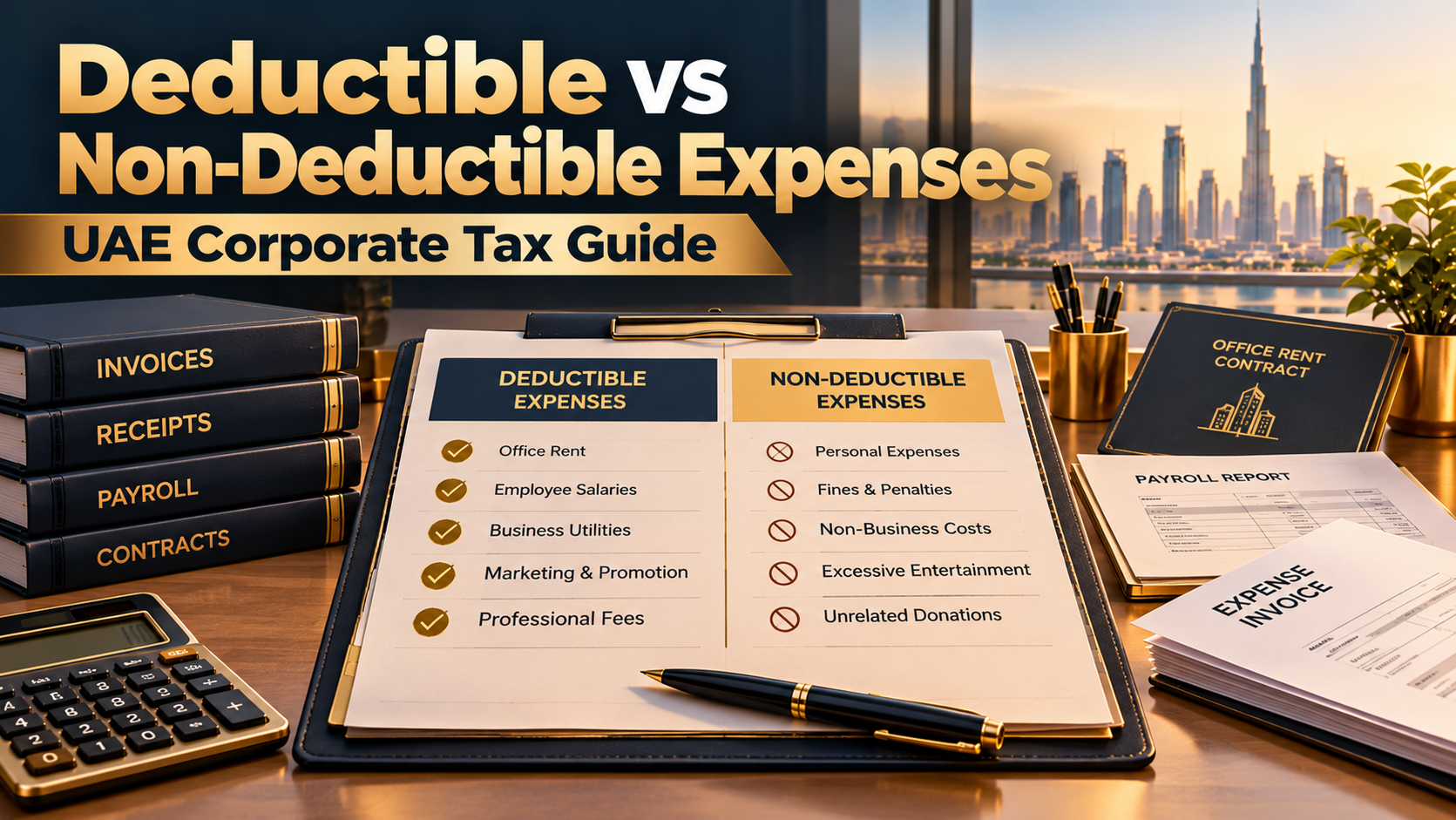
Understanding which business expenses are deductible under UAE Corporate Tax is essential for companies operating in Dubai and across the United Arab Emirates. Although many legitimate business expenses can reduce taxable income, not every expense recorded in a company’s accounts is automatically deductible for tax purposes.
The distinction between deductible and non-deductible expenses can affect a company’s taxable income, Corporate Tax liability and compliance obligations. Businesses that classify expenses incorrectly may calculate their tax incorrectly or overlook adjustments required when preparing their Corporate Tax return.
Under the UAE Corporate Tax framework, the general principle is that legitimate expenses incurred wholly and exclusively for business purposes may be deductible, subject to the specific conditions and restrictions in the law. Some expenses are only partially deductible, while others are expressly disallowed.
This guide explains deductible and non-deductible expenses under UAE Corporate Tax, provides practical examples and outlines how businesses can maintain appropriate records.
What Are Deductible Expenses Under UAE Corporate Tax?
Deductible expenses are qualifying business costs that can be deducted when determining taxable income under the applicable UAE Corporate Tax rules.
These expenses generally need to be incurred for the purposes of the business and must not fall within a category that is specifically disallowed or restricted under the law.
The Federal Tax Authority (FTA) explains that legitimate business expenses incurred to derive taxable income are generally deductible. However, the timing of the deduction can differ depending on the nature of the expense, the applicable accounting method and relevant tax rules.
For example, a Dubai-based consultancy may incur rent, employee salaries, software subscription fees and professional service charges to operate its business. These costs may generally qualify as deductions if they meet the applicable requirements and are properly documented.
However, a business should not assume that every payment appearing in its profit and loss statement will reduce taxable income by the same amount.
The key distinction is between an expense recognised in accounting records and an expense permitted as a deduction under Corporate Tax legislation.
Which Business Expenses Are Generally Deductible?
Many ordinary operating expenses can qualify for deductions when they are incurred for genuine business purposes, supported by appropriate records and not restricted by specific provisions.
The following examples illustrate common categories.
1. Office Rent and Business Premises Costs
Rent paid for an office, shop, warehouse or other business premises will generally qualify as a business expense when the premises are used for the company’s operations.
Depending on the arrangement, related costs such as utilities, maintenance and service charges may also qualify.
Businesses should retain tenancy agreements, invoices, payment evidence and other relevant documentation. If a property is used for both business and personal purposes, the appropriate business portion must be assessed rather than automatically deducting the entire cost.
2. Employee Salaries and Staff Costs
Employee salaries, wages and other genuine employment-related costs are generally deductible when incurred for business purposes and treated in accordance with the applicable rules.
Relevant costs may include:
- Salaries and wages.
- Contractual employee benefits.
- Employer-related employment costs.
- Qualifying staff training and development.
- Other legitimate employee expenses.
Businesses should maintain employment contracts, payroll records, payment evidence and supporting documentation.
Special rules may apply to certain employee benefits, pension contributions or arrangements involving owners and related parties. These should be reviewed separately rather than treated as automatically deductible.
3. Accounting, Bookkeeping and Professional Fees
Fees paid for legitimate business services can generally qualify as deductions where the relevant conditions are satisfied.
Examples include accounting and bookkeeping, audit services, tax compliance support, legal advice and business consultancy.
Accurate financial records help businesses identify these costs and assess their tax treatment. Companies that need help organising their financial records can explore SmartBiz accounting and bookkeeping services in Dubai.
The tax treatment should still be assessed according to the nature and purpose of the service, the supporting evidence and any applicable restrictions.
4. Marketing and Advertising Expenses
Business advertising and marketing expenditure can generally be deductible when incurred for legitimate business purposes.
Examples may include:
- Search engine advertising.
- Social media campaigns.
- Website development and maintenance.
- Marketing content production.
- Commercial promotions.
- Trade show participation and promotional materials.
The FTA’s Corporate Tax guidance distinguishes ordinary marketing expenditure from qualifying business entertainment. Ordinary advertising and promotional costs are not automatically subject to the 50% entertainment restriction.
However, costs involving hospitality for customers or business partners may need to be classified separately. The nature of the activity and the benefits provided determine the appropriate treatment.
5. Software, Technology and IT Expenses
Businesses often pay for accounting software, cloud services, cybersecurity tools, productivity applications and other technology needed to operate.
These costs may qualify as business deductions, subject to the applicable rules and the nature of the expenditure.
A recurring software subscription may be treated differently from purchasing a long-term asset or acquiring software rights that require capitalisation. Businesses should follow the applicable accounting treatment and determine when a deduction is permitted for Corporate Tax purposes.
6. Business Travel and Transportation
Travel and transportation expenses may be deductible when incurred for legitimate business activities and supported by appropriate evidence.
Examples include qualifying travel for client meetings, business conferences, supplier visits and operational requirements.
Businesses should document the purpose of the trip, relevant dates, receipts and payment details. Where an expense has both business and personal elements, only the eligible business portion should be considered.
7. Insurance and Other Operating Expenses
Commercial insurance, qualifying business licences, office supplies, communications and other ordinary operating costs may generally be deductible when incurred for business purposes and not specifically restricted.
The exact treatment depends on the nature of the cost. For example, an ordinary operating payment may be treated differently from a capital expenditure or a payment relating to exempt income.
Businesses should review significant or unusual expenses before including them in their tax calculations.
What Are Non-Deductible Expenses Under UAE Corporate Tax?
Non-deductible expenses are costs that cannot be deducted, or cannot be deducted in full, when calculating taxable income under the applicable Corporate Tax rules.
Article 33 of the UAE Corporate Tax Law identifies specific categories of expenditure for which deductions are disallowed. Other restrictions may arise under separate provisions of the law and related decisions.
Common examples include the following.
1. Personal Expenses
Costs incurred for personal purposes rather than for the company’s business generally cannot be deducted as business expenses.
Examples may include an owner’s private holiday, personal shopping or family expenses paid through the company.
Where a cost has both business and personal purposes, the appropriate allocation must be made. The business-related portion may qualify if the relevant conditions are met, but the personal portion should not automatically be deducted.
For example, if a company pays for a trip that combines a genuine business meeting with a personal holiday, the business should assess the costs based on their actual purpose and the applicable rules.
2. Fines and Penalties
Fines and penalties are generally non-deductible for UAE Corporate Tax purposes under Article 33, subject to the statutory wording and applicable exceptions.
Examples can include penalties imposed for regulatory or legal non-compliance.
Businesses should not assume that a fine becomes deductible merely because it appears in the accounting records or was paid from a business bank account.
It is also important to distinguish a fine or penalty from a contractual payment or compensation for damages. The legal nature of the payment matters when determining its tax treatment.
3. Bribes and Similar Improper Payments
Bribes and other payments specifically disallowed by the Corporate Tax Law are non-deductible.
A payment does not become a legitimate business deduction simply because it was made in connection with a commercial transaction. Businesses must comply with the applicable legal requirements and retain accurate records of legitimate transactions.
4. Donations to Non-Qualifying Organisations
Not all charitable donations qualify for Corporate Tax deductions.
Donations, grants or gifts to organisations that do not meet the relevant requirements for a Qualifying Public Benefit Entity are generally non-deductible under the applicable rules.
Businesses should verify the recipient’s qualifying status and maintain supporting documentation before claiming a deduction.
5. Expenses Related to Exempt Income
Expenditure incurred in deriving income that is exempt from Corporate Tax is generally not deductible to the extent specified by the law.
This means a business may need to review costs connected with exempt income separately from expenses relating to taxable business activities.
Where expenditure relates to more than one activity or income stream, an appropriate allocation may be necessary under the applicable rules.
6. Losses Unrelated to the Business
Losses that are not connected with, or do not arise out of, the taxpayer’s business are generally non-deductible.
Businesses should distinguish genuine commercial losses from personal losses or other amounts that do not meet the statutory requirements.
7. Certain Interest and Financing Costs
Interest expenditure may be subject to specific deduction limitations under UAE Corporate Tax legislation.
Businesses should not assume that every financing cost can be deducted in full. The applicable restrictions may depend on the nature of the borrowing, the relevant transactions and the taxpayer’s circumstances.
Companies with substantial borrowing, related-party financing or complex group arrangements should review the relevant provisions and current FTA guidance before calculating their deduction.
8. Recoverable VAT
VAT requires particular attention because VAT incurred on business purchases is not automatically a Corporate Tax expense.
Where input VAT is recoverable under the UAE VAT rules, the recoverable amount generally should not also be treated as a deductible Corporate Tax expense. Irrecoverable input VAT may receive different treatment, depending on the circumstances and applicable Corporate Tax rules.
Businesses should reconcile VAT records with their accounting entries to avoid claiming the same amount inappropriately.
Are Business Entertainment Expenses Fully Deductible?
No. Qualifying entertainment expenditure incurred to entertain customers, shareholders, suppliers or other business partners is generally subject to a 50% deduction limit under Article 32 of the UAE Corporate Tax Law.
Depending on the circumstances, entertainment expenditure may include costs relating to:
- Meals and hospitality.
- Accommodation.
- Transportation.
- Admission fees.
- Entertainment facilities and equipment.
The classification matters. Ordinary advertising, commercial promotion and certain marketing activities should not automatically be treated as entertainment expenditure merely because customers or business partners are involved.
For example, a company may incur AED 20,000 on qualifying entertainment for customers and suppliers.
| Item | Amount |
|---|---|
| Qualifying entertainment expenditure | AED 20,000 |
| Generally deductible portion (50%) | AED 10,000 |
| Non-deductible portion (50%) | AED 10,000 |
In this simplified example, AED 10,000 would be added back when calculating taxable income, assuming the entire amount qualifies as entertainment expenditure and no other adjustment applies.
The classification of the expense should be based on the actual activity, purpose and relevant FTA guidance.
Deductible vs Non-Deductible Expenses: Quick Comparison
| Expense category | General Corporate Tax treatment |
|---|---|
| Office rent for business premises | Generally deductible if requirements are met |
| Employee salaries | Generally deductible, subject to applicable rules |
| Accounting and professional fees | Generally deductible for qualifying business purposes |
| Ordinary advertising and marketing | Generally deductible, subject to applicable rules |
| Business software subscriptions | Generally deductible, depending on the nature of the cost |
| Personal expenses | Generally non-deductible to the extent personal |
| Qualifying business entertainment | Generally 50% deductible |
| Fines and penalties | Generally non-deductible, subject to statutory exceptions |
| Bribes | Non-deductible |
| Donations to non-qualifying organisations | Generally non-deductible |
| Expenses relating to exempt income | Generally non-deductible to the extent specified by law |
| Certain interest costs | May be restricted under specific rules |
| Recoverable input VAT | Generally not also deductible as a Corporate Tax expense |
This table is a practical overview, not a substitute for reviewing the relevant law and the facts of each transaction.
How Do Deductible Expenses Affect Taxable Income?
Corporate Tax is generally calculated on taxable income rather than simply on total revenue or accounting expenses.
The starting point is typically the accounting profit or loss, followed by the adjustments required under UAE Corporate Tax legislation.
Consider this simplified example:
A business reports accounting profit of AED 500,000. During the year, its accounts include AED 20,000 of qualifying entertainment expenditure, of which only 50% is deductible.
Assuming the entertainment expenditure has been included in the accounting expenses and no other tax adjustments apply:
- Accounting profit: AED 500,000
- Non-deductible portion of entertainment: AED 10,000
- Illustrative taxable income: AED 510,000
Under the standard Corporate Tax rate structure, and assuming no other adjustments or reliefs apply, the illustrative tax calculation would be:
- First AED 375,000 at 0%: AED 0
- Remaining AED 135,000 at 9%: AED 12,150
This is a simplified illustration. Actual tax payable depends on the company’s tax status, applicable law, qualifying reliefs, other adjustments and any relevant special rules.
The example demonstrates why businesses must review tax deductibility separately from their accounting profit.
How Should Businesses Document Expenses for Corporate Tax?
Appropriate documentation helps businesses substantiate deductions and explain adjustments when preparing their Corporate Tax returns.
A practical recordkeeping process should include the following steps.
1. Keep invoices and receipts
Retain invoices, receipts, contracts and other evidence that supports the amount and nature of each expense.
2. Record the business purpose
Document why a cost was incurred and how it relates to the business. This is especially important for travel, entertainment, unusual payments and expenses that may have a personal element.
3. Separate personal and business costs
Avoid mixing personal expenditure with company expenses. Where a cost has a dual purpose, assess the eligible business portion using an appropriate and supportable method.
4. Use clear accounting categories
Record rent, salaries, marketing, travel, entertainment and other expenses in suitable categories. Clear classification makes it easier to identify items that may require tax adjustments.
5. Review restricted expenses before filing
Identify expenses that are partially deductible, specifically disallowed or subject to special rules. Make the necessary adjustments when determining taxable income.
6. Reconcile accounts and supporting records
Check that accounting records agree with invoices, bank transactions, contracts and relevant tax documents. Investigate missing evidence or unusual balances before filing.
7. Maintain records for the required period
Businesses should retain Corporate Tax records and supporting documents for the applicable statutory retention period. Requirements can depend on the record type and the relevant legislation, so verify the current rules rather than applying one retention period to every document.
For additional help with financial recordkeeping, visit SmartBiz accounting and bookkeeping services in Dubai.
Common Mistakes When Claiming Business Expense Deductions
Businesses can make avoidable errors when they assume that accounting treatment and tax treatment are always identical.
Common mistakes include:
- Deducting personal expenditure as a company expense.
- Treating all customer hospitality as fully deductible.
- Assuming every donation qualifies for a deduction.
- Claiming fines or penalties as ordinary operating costs.
- Deducting recoverable VAT again as a business expense.
- Ignoring restrictions on certain interest costs.
- Failing to allocate expenses that relate to both business and personal activities.
- Claiming a full immediate deduction for an item that requires capitalisation or another tax treatment.
- Failing to retain invoices or other supporting evidence.
- Copying accounting profit directly into a tax calculation without checking the required adjustments.
A regular review of expense categories can help identify these issues before the Corporate Tax return is submitted.
Frequently Asked Questions
1. What expenses are deductible under UAE Corporate Tax?
Legitimate expenses incurred for business purposes may generally be deductible if they meet the applicable conditions and are not specifically restricted or disallowed. Common examples include qualifying rent, salaries, professional fees, marketing and operating costs.
2. Are all business expenses tax-deductible in the UAE?
No. Some expenses are non-deductible, while others may be only partially deductible or subject to specific conditions. The correct treatment depends on the nature of the expense and the relevant Corporate Tax rules.
3. Are entertainment expenses 100% deductible under UAE Corporate Tax?
Qualifying entertainment expenditure incurred to entertain customers, shareholders, suppliers or other business partners is generally only 50% deductible. Ordinary marketing and advertising expenditure should be assessed separately because it is not automatically subject to the same restriction.
4. Are fines and penalties deductible under UAE Corporate Tax?
Fines and penalties are generally non-deductible under the applicable Corporate Tax rules, subject to the statutory wording and relevant exceptions. Businesses should assess the legal nature of a payment before deciding its treatment.
5. Are employee salaries deductible?
Employee salaries and genuine employment-related costs are generally deductible when incurred for business purposes and when the applicable requirements are satisfied. Special restrictions or conditions may apply to particular payments or arrangements.
6. Can a business deduct personal expenses paid through its company account?
Personal expenditure generally cannot be deducted as a business expense. If a cost has both business and personal purposes, the appropriate allocation should be made and supported by evidence.
7. Are donations deductible under UAE Corporate Tax?
Donations to organisations that meet the applicable requirements for a Qualifying Public Benefit Entity may qualify for a deduction. Donations, grants or gifts to non-qualifying organisations are generally disallowed, subject to the applicable law.
8. Can a business deduct VAT paid on purchases?
The Corporate Tax treatment depends on whether the VAT is recoverable under the VAT rules and the circumstances of the expense. Recoverable input VAT generally should not also be claimed as a Corporate Tax expense. Irrecoverable VAT may be treated differently under the applicable rules.
9. How are deductible expenses reflected in a Corporate Tax return?
The starting point is generally accounting income, adjusted for items that are exempt, non-deductible, partially deductible or otherwise treated differently under the law. Supporting records should be retained for the amounts claimed and adjustments made.
10. Where can I verify the latest UAE Corporate Tax expense rules?
Refer to the Federal Tax Authority’s Corporate Tax FAQs, the official Corporate Tax legislation and guidance, and the UAE Ministry of Finance’s published tax materials. Review current rules before filing a return or making a tax decision.
Conclusion
Understanding deductible and non-deductible expenses under UAE Corporate Tax helps businesses calculate taxable income accurately and maintain better financial control.
Many legitimate business costs may qualify for deductions, but personal expenditure, certain fines, bribes, some donations and other specifically restricted items require different treatment. Qualifying entertainment expenses are generally subject to a 50% deduction limit, while capital expenditure and certain financing costs may follow separate rules.
The most reliable approach is to maintain accurate accounting records, document the purpose of expenses, identify restricted categories and review the required tax adjustments before submitting a Corporate Tax return.
For complex transactions or uncertain expense classifications, businesses should consult the current Federal Tax Authority guidance or a qualified UAE tax professional.
Disclaimer: This article is for general informational purposes only and does not constitute tax or legal advice. Deductibility depends on the applicable legislation, the facts of the transaction and any relevant conditions or exceptions. Verify current UAE Corporate Tax rules before relying on a deduction.