
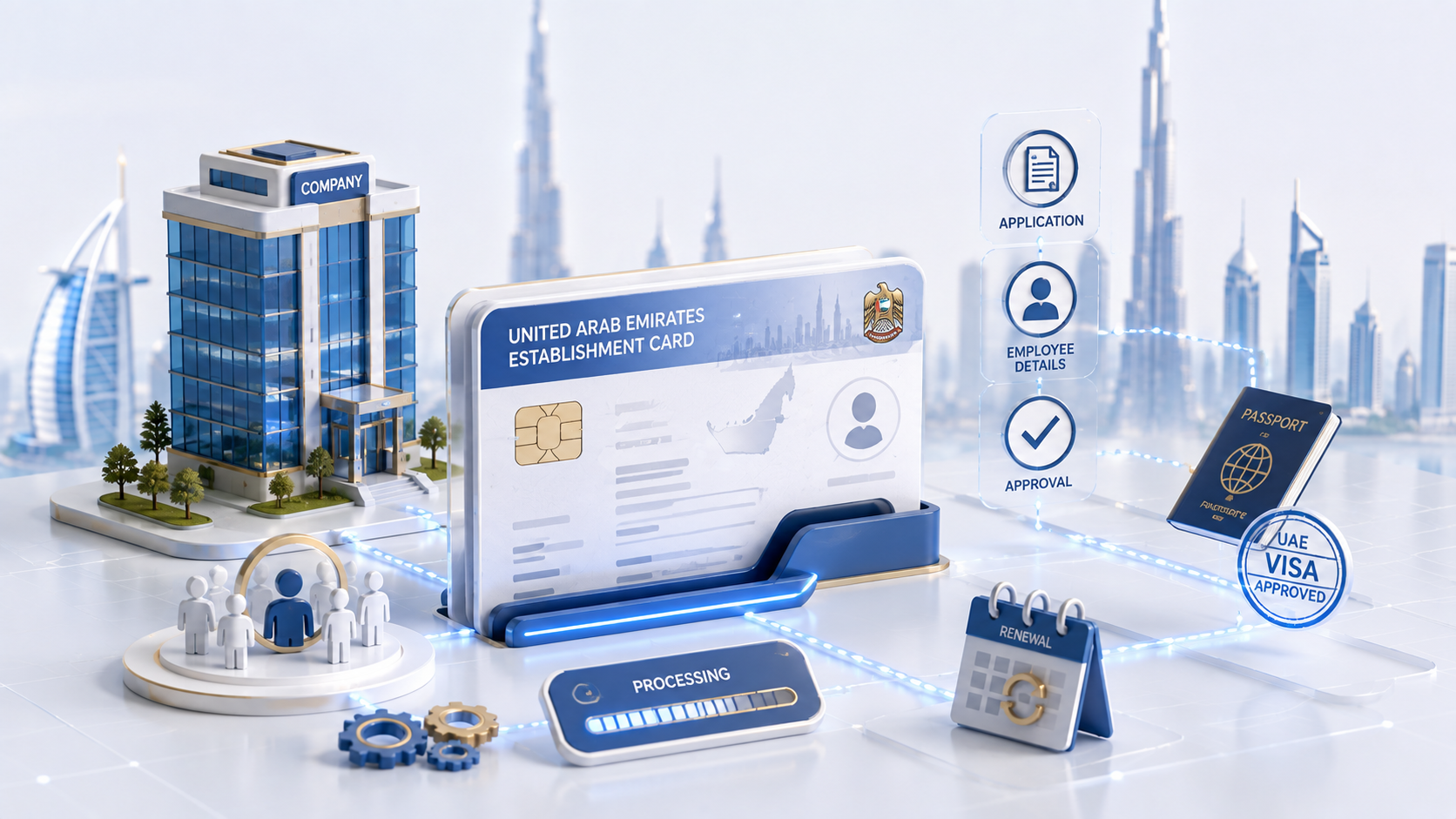
Quick Summary / AI Overview Snippet
Quick Answer: An establishment card UAE authorities issue is the official immigration file that allows a licensed company to sponsor employee and dependent visas. Every mainland company and most free zone entities need one before applying for labor cards or residence visas. Issued by the GDRFA (General Directorate of Residency and Foreigners Affairs) or free zone equivalent (ICP card UAE free zone), it typically costs AED 2,000–3,500 for mainland entities, takes 3–7 working days to issue, and must be renewed annually — an establishment card late fine applies for lapses beyond the grace period.
Introduction
For every newly licensed company in the UAE, the trade license alone doesn’t unlock the ability to hire staff or sponsor family visas. That capability sits behind a separate but equally essential document: the establishment card UAE immigration authorities require before any labor or residence visa application can proceed. Investors unfamiliar with UAE immigration architecture are often surprised to learn that licensing and visa sponsorship run through two entirely different government systems that must be linked correctly.
Whether you’ve just completed UAE Mainland Business Setup, launched through a UAE Freezone Setup, or are renewing an existing company’s immigration file UAE company record, understanding how the establishment card works — its cost, validity, renewal cycle, and failure penalties — is fundamental to keeping your UAE operations staffed and compliant in 2026.
This guide breaks down everything SmartBiz.ae advisors walk clients through when setting up or renewing an establishment card Dubai mainland or free zone file, including the practical pitfalls that catch first-time sponsors off guard.
What Is an Establishment Card in the UAE?
An establishment card UAE authorities issue is essentially a company’s immigration identity file — a physical or digital card confirming that a business is registered with the relevant immigration authority and is authorized to sponsor visa quota establishment card allocations for employees and their dependents.
Without an active establishment card, a company cannot:
- Apply for new employee labor cards or work permits
- Sponsor residence visas for staff
- Sponsor dependent (family) visas linked to company employees
- Process visa cancellations or status changes through the official immigration system
Think of the trade license as permission to operate a business, while the establishment card is permission to staff it. Both are required, but they are processed by different authorities and must remain synchronized — a mismatch between license status and establishment card status is one of the most common causes of visa processing delays SmartBiz.ae encounters.
Expert Tip: A surprising number of investors assume their trade license automatically grants visa sponsorship rights. It does not. The establishment card UAE application is a distinct, separate step that must be completed — and renewed — independently of license renewal.
Who Needs an Establishment Card?
Practically every operating company in the UAE that intends to hire staff needs this file, but the issuing authority and card format differ by jurisdiction.
| Business Type | Issuing Authority | Card Type |
|---|---|---|
| Mainland LLC / Branch | GDRFA (or federal ICP where applicable) | Establishment Immigration Card |
| Free Zone Company | Free zone authority (linked to ICP) | ICP card UAE free zone / Establishment Card |
| Foreign Branch Office | GDRFA | Establishment Immigration Card |
| Offshore Company | Not applicable | Offshore entities generally cannot sponsor visas |
Companies structured as a Dubai Offshore License should note that offshore entities are typically excluded from establishment card eligibility altogether, since offshore structures cannot lease physical office space or sponsor UAE residency — an important distinction for investors comparing entity types purely on visa-sponsorship needs.
Establishment Card UAE: Mainland vs Free Zone Comparison
Since the competitor content in this space largely omits a direct mainland-vs-free zone cost and process comparison, here’s the side-by-side breakdown investors actually need.
| Feature | Mainland (GDRFA) | Free Zone (ICP-linked) |
|---|---|---|
| Issuing Body | GDRFA / Federal ICP | Respective Free Zone Authority |
| Typical Cost (New Issuance) | AED 2,000 – 3,500 | AED 1,500 – 3,000 |
| Validity Period | 1 – 3 years (varies) | 1 – 3 years (varies by zone) |
| Renewal Processing Time | 3 – 7 working days | 2 – 5 working days |
| Visa Quota Allocation | Based on office size/activity | Based on facility type & package |
| Renewal Trigger | Linked to trade license renewal | Linked to lease & license renewal |
| Late Renewal Fine | Daily fines apply post-grace period | Daily fines apply, zone-dependent |
Expert Tip: Free zone establishment card renewal cycles are often bundled automatically with facility lease renewal — but mainland renewals are not automatic and require independent submission through GDRFA-approved typing centers or PRO channels. Missing this distinction is a leading cause of accidental card expiry.
Step-by-Step: How to Apply for an Establishment Card in Dubai
- Confirm Trade License Is Active — The establishment card application cannot proceed on a lapsed or pending license.
- Prepare Company Documents — Trade license copy, MOA, tenancy contract (Ejari), and passport copy of the authorized signatory.
- Submit Application via GDRFA-Approved Channel — File through an approved typing center, PRO service, or the relevant online immigration portal.
- Pay Applicable Fees — Settle establishment card issuance fees, which vary based on company type and activity classification.
- Receive Immigration File Number — Once approved, the company receives its unique immigration file UAE company number, which becomes the reference for all future visa transactions.
- Link Visa Quota — Confirm the allocated visa quota, which determines how many employees the company can sponsor based on office size, activity type, and — for some free zones — package tier.
- Card Issuance — Receive the physical or digital establishment card confirming active sponsorship status.
Documents Checklist
- Valid trade license copy
- Memorandum of Association (MOA)
- Valid tenancy contract / Ejari certificate
- Passport copy of company owner/authorized signatory
- Company stamp
- Board resolution (for branch offices and certain corporate structures)
- Previous establishment card (for renewals only)
How Much Does an Establishment Card Cost in Dubai 2026?
Cost estimates vary by jurisdiction, company activity, and whether the application is a new issuance or renewal. Based on current market patterns:
| Cost Element | Estimated Fee (AED) |
|---|---|
| New Establishment Card Issuance (Mainland) | 2,000 – 3,500 |
| Establishment Card Renewal (Mainland) | 1,500 – 2,800 |
| Free Zone Establishment/ICP Card | 1,500 – 3,000 |
| Visa Quota Increase Application | 500 – 1,500 (per review) |
| PRO Processing/Service Fee | 500 – 1,200 |
| Establishment Card Late Fine | Approx. AED 100–125 per day past grace period |
Expert Tip: The establishment card cost 2026 figures above reflect issuance and renewal fees only — they exclude labor card and individual visa costs, which are billed separately per sponsored employee. Investors budgeting for full-team sponsorship should calculate establishment card fees and per-employee visa costs as two distinct line items.
How Do I Renew My Establishment Card in UAE?
The establishment card renewal process mirrors the initial application but requires closer attention to timing, since renewal windows are strict and penalties escalate quickly.
- Track the Expiry Date — Establishment cards typically carry 1–3 year validity; mark renewal at least 30 days prior to expiry.
- Confirm License Renewal Status — Since the establishment card is tied to an active trade license, renew the license first if both are due concurrently.
- Update Company Documents — Submit any changed tenancy contracts, shareholder details, or MOA amendments alongside the renewal.
- Submit Renewal Application — File via GDRFA-approved channels or the applicable free zone immigration portal.
- Settle Renewal & Any Outstanding Fines — Clear renewal fees and any accrued establishment card late fine balances before the card reactivates.
- Receive Updated Card — Confirm the renewed validity period and updated visa quota, if applicable.
Expert Tip: SmartBiz.ae routinely sees companies attempt to renew visas for existing employees while their establishment card itself sits expired — this results in automatic rejection at the visa-processing stage. Always confirm establishment card validity before initiating any individual employee visa transaction.
What Happens If Your Establishment Card Expires?
An expired establishment card UAE entities fail to renew on time triggers a cascade of operational restrictions, not just a fine.
Immediate consequences include:
- Inability to process new visa applications or renewals for any employee
- Freezing of dependent/family visa sponsorship
- Accumulating establishment card late fine charges (daily, per GDRFA/free zone schedule)
- Potential flagging of the company’s immigration file UAE company record, complicating future PRO transactions
- Employees already in the UAE on company sponsorship risk visa status complications if renewals were pending at time of expiry
Recovery steps typically involve:
- Immediate submission of the renewal application
- Settlement of all accrued fines in full
- Verification that the trade license itself remains active and compliant
- Re-confirmation of visa quota before resuming employee sponsorship
Expert Tip: Fines compound the longer the card remains expired, and in prolonged cases, immigration authorities may require additional clearance steps before reactivating the file. Treating establishment card renewal as a fixed annual deadline — rather than a “when we get to it” task — avoids nearly all of these downstream complications.
Establishment Card and Visa Quota: How Sponsorship Limits Work
The visa quota establishment card allocation determines the maximum number of employees a company may sponsor, and this figure isn’t arbitrary — it’s calculated based on:
- Office/facility size (square footage directly impacts mainland quota calculations)
- Business activity classification
- Free zone package tier (for free zone entities)
- Compliance history with GDRFA/ICP and the Ministry of Human Resources and Emiratisation (MoHRE)
Companies outgrowing their initial quota can apply for a quota increase, which typically requires demonstrating expanded office space or upgrading to a higher-tier free zone package. This is a frequent friction point for fast-scaling companies that licensed with minimal flexi-desk space and then need to sponsor a growing headcount.
Why Establishment Card Compliance Matters Beyond Visas
Beyond its direct visa-sponsorship function, a company’s immigration file UAE company status feeds into broader regulatory checks. An inactive or fined establishment card can complicate:
- Bank Account Opening Support — banks routinely verify active immigration and licensing status during KYC/compliance checks
- Corporate Tax Registration and Corporate Tax Filing — FTA compliance reviews can flag inconsistencies between licensing, tax, and immigration records
- Company Audit Reports — auditors typically confirm active immigration file status as part of standard compliance verification
- Renewal of VAT Registration and ongoing VAT Filing & Return Services obligations, where administrative good standing across government systems is increasingly cross-referenced
Maintaining a consistently active establishment card is therefore not just an HR administrative task — it’s part of a company’s broader regulatory health, alongside financial reporting and tax compliance managed through services like Financial Management & Advisory.
Common Pitfalls With Establishment Cards in the UAE
- Assuming the trade license covers visa sponsorship — it does not; the establishment card is a separate mandatory file.
- Missing the renewal window — leading to accumulating establishment card late fine charges and visa processing freezes.
- Mismatched office size vs visa quota needs — companies leasing minimal flexi-desk space then struggling to sponsor the headcount they actually need.
- Renewing the license but forgetting the establishment card — these are separate renewal cycles that don’t automatically sync.
- Attempting employee visa transactions on an expired card — resulting in automatic rejection and wasted processing fees.
- Underestimating PRO processing lead times — especially during peak renewal periods when GDRFA and free zone processing queues extend beyond standard timelines.
Companies without dedicated in-house HR/immigration staff typically outsource this entire cycle to a PRO Services UAE partner, who tracks renewal deadlines, manages document submission, and prevents the compounding fines that come from missed windows.
Establishment Card Setup as Part of Your Broader Business Journey
For companies still finalizing their entity structure, it’s worth noting that establishment card requirements differ depending on the setup path chosen — mainland, free zone, or specialized licenses like a Trader Registration License for smaller import/export operations. Investors comparing these paths, or managing multiple moving pieces across licensing, banking, and compliance, often benefit from consolidating support through a single Business Services Hub rather than coordinating separate vendors for each function.
And for businesses distributing regulated goods alongside growing their sponsored workforce, aligning establishment card visa quota planning with Product Certification Support timelines ensures operational capacity (staffing) and market entry (product compliance) progress in parallel rather than creating bottlenecks on either side.
If a company’s operations wind down, note that establishment card cancellation is a required step within broader Company Closure Services procedures — outstanding establishment card fines or unresolved visa cancellations are a common cause of delayed liquidation, alongside final Company Liquidation Report processing.
FAQ: Establishment Card UAE 2026
Q1: What is an establishment card in the UAE? It’s the official immigration file — issued by GDRFA for mainland companies or the relevant free zone authority for free zone entities — that authorizes a business to sponsor employee and dependent visas. It is separate from, and required in addition to, the company’s trade license.
Q2: Do I need an establishment card to sponsor visas? Yes. No employee labor card, residence visa, or dependent visa can be processed without an active establishment card UAE authorities have issued and verified against the company’s immigration file.
Q3: How much does an establishment card cost in Dubai 2026? New mainland issuance typically ranges AED 2,000–3,500, while free zone ICP card UAE free zone issuance ranges AED 1,500–3,000. Renewal fees run slightly lower, and daily establishment card late fine charges apply for expired cards.
Q4: How do I renew my establishment card in UAE? Renewal requires an active trade license, updated company documents (tenancy contract, MOA), and submission through GDRFA-approved channels or the relevant free zone immigration portal — ideally initiated at least 30 days before expiry.
Q5: What happens if my establishment card expires? All visa sponsorship activity freezes immediately — no new visas, renewals, or dependent sponsorships can proceed. Daily fines accrue until renewal, and prolonged expiry can complicate the company’s broader immigration file UAE company standing with authorities.