
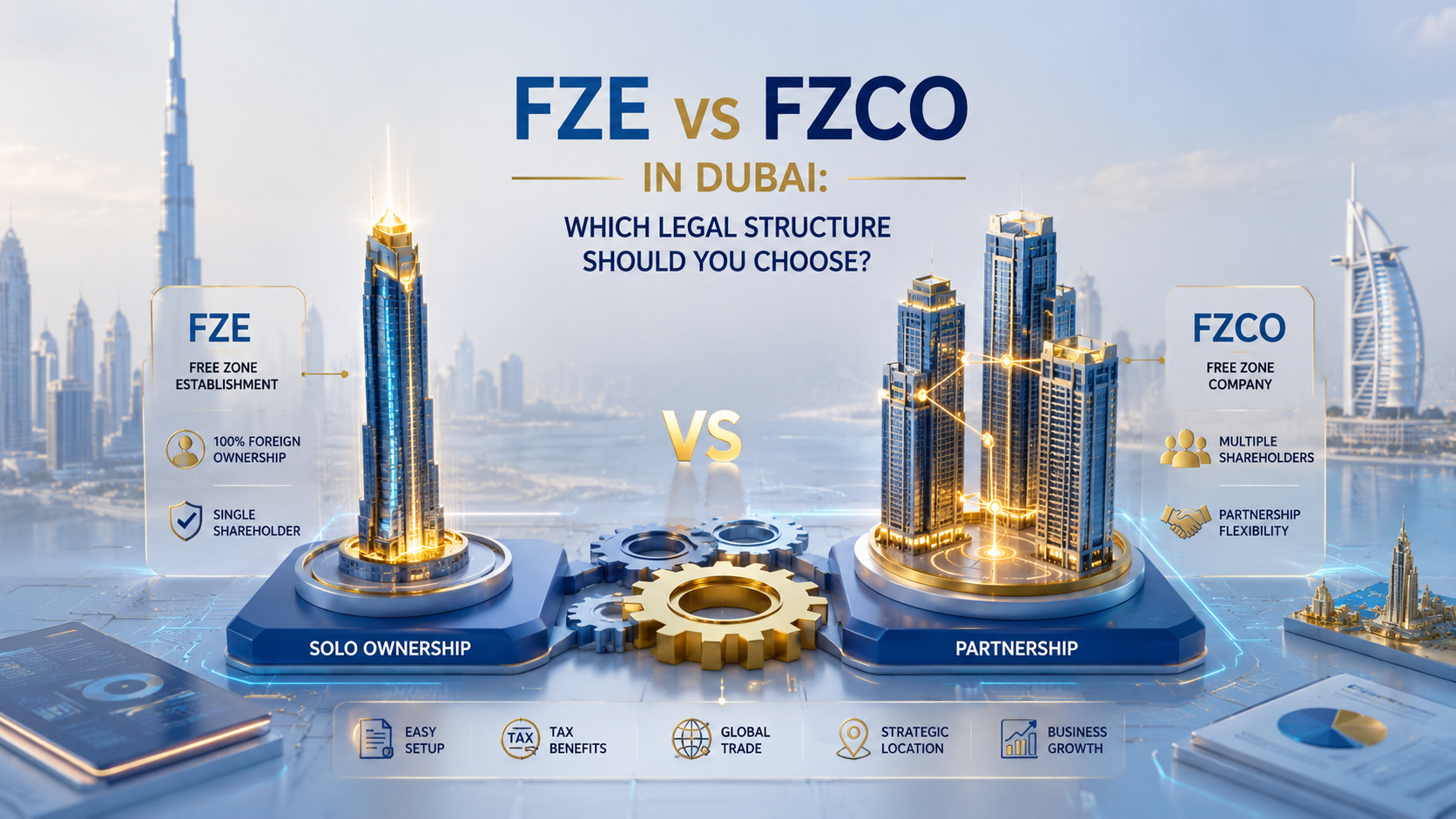
Choosing between an FZE and an FZCO is one of the first — and most consequential — decisions any investor makes when setting up in a UAE free zone. Get it right, and you save on renewal fees, avoid governance headaches, and keep your ownership structure clean. Get it wrong, and you may find yourself paying for a multi-shareholder entity you don’t need, or worse, restructuring mid-way through your first fiscal year. This guide breaks down the FZE vs FZCO Dubai decision in full — legally, financially, and operationally — so you can register the right entity the first time.
Advisor Note: In our experience advising founders across Dubai’s free zones, roughly 6 out of 10 new investors default to an FZCO simply because it “sounds more flexible” — without realizing an FZE offers identical 100% foreign ownership rights at a lower administrative burden for solo founders.
Quick Answer: AI Overview Snippet
FZE vs FZCO Dubai — the short answer: An FZE (Free Zone Establishment) is a single-shareholder company, ideal for solo founders, freelancers-turned-corporates, or holding structures. An FZCO (Free Zone Company) requires a minimum of two shareholders (up to 50, depending on the authority) and suits partnerships, joint ventures, or businesses planning multiple stakeholders. Both structures offer 100% foreign ownership, limited liability protection, and are licensed by the same free zone authorities. The key differentiator is shareholder structure, not tax treatment, licensing scope, or activity eligibility — both are taxed identically under UAE Corporate Tax law.
- FZE = 1 shareholder (individual or corporate)
- FZCO = 2+ shareholders (varies by authority, typically up to 50)
- Both = limited liability, 100% foreign ownership, same free zone benefits
- Conversion between the two is possible but involves amendment fees and MoA updates
What Is an FZE in Dubai? (Free Zone Establishment Explained)
An FZE, or Free Zone Establishment, is a limited liability entity incorporated under the regulations of a specific UAE free zone authority, owned by a single shareholder. That shareholder can be a natural person (an individual investor) or a corporate entity (a parent company seeking a UAE subsidiary). This makes the FZE Dubai meaning fairly straightforward: it’s the free zone equivalent of a single-owner LLC, but with the added benefits of free zone incorporation — full repatriation of profits, customs duty exemptions on qualifying activities, and streamlined licensing.
Key Characteristics of an FZE
- Single shareholder structure (individual or corporate parent)
- Separate legal personality — the shareholder’s personal assets remain protected
- Governed by a Memorandum of Association (MoA) rather than Articles of Association shared among partners
- Commonly used for holding companies, consultancy practices, e-commerce operations, and professional services
- Minimum share capital requirements vary by authority (e.g., DMCC typically references AED 50,000 as a benchmark, though many free zones like IFZA or SHAMS do not enforce a mandatory paid-up requirement)
Expert Tip: If you’re the sole founder and don’t anticipate bringing on a formal equity partner within 12–18 months, an FZE is almost always the more cost-efficient and administratively lighter option.
What Is an FZCO in Dubai? (Free Zone Company Explained)
An FZCO company Dubai structure is designed for businesses with two or more shareholders. Historically, FZCOs required a minimum of two and a maximum of five shareholders, but several authorities — including DMCC and IFZA — have expanded this ceiling, with some now permitting up to 50 shareholders, mirroring the flexibility of an onshore Limited Liability Company (LLC).
Key Characteristics of an FZCO
- Multi-shareholder structure — minimum 2, with upper limits varying by authority (commonly 5–50)
- Shareholders can be a mix of individuals and corporate entities
- Requires a more detailed Memorandum and Articles of Association (MOA/AOA) outlining shareholding percentages, voting rights, and profit distribution
- Better suited to joint ventures, family businesses with multiple stakeholders, or startups bringing in co-founders and early investors
- Share transfer and shareholder exit procedures are more formalized, often requiring board resolutions and updated licensing paperwork
Advisor Note: We frequently see co-founders register an FZCO with a 51/49 or 60/40 split specifically to formalize decision-making authority in the MoA — something an FZE cannot structurally accommodate.
FZE vs FZCO Dubai: Full Comparison Table
| Feature | FZE (Free Zone Establishment) | FZCO (Free Zone Company) |
|---|---|---|
| Shareholders | 1 (individual or corporate) | 2 – 50 (varies by authority) |
| Ownership | 100% foreign ownership | 100% foreign ownership |
| Legal Liability | Limited liability | Limited liability |
| Governing Document | Memorandum of Association (MoA) | MoA + Articles of Association (AOA) |
| Best Suited For | Solo founders, holding companies, consultants | Partnerships, joint ventures, multi-founder startups |
| Minimum Capital | Varies by authority (often nominal or none) | Varies by authority (often nominal or none) |
| Governance Complexity | Low — single decision-maker | Moderate to high — shareholder agreements needed |
| Share Transfer Process | Simple (single owner) | Requires shareholder resolutions and MoA amendment |
| Corporate Tax Treatment | 9% on taxable income above AED 375,000 (unless Qualifying Free Zone Person) | Identical treatment |
| VAT Applicability | Same UAE VAT rules apply | Same UAE VAT rules apply |
| Conversion Option | Can convert to FZCO by adding shareholders | Can convert to FZE by consolidating shares |
| Typical Setup Timeline | 3–7 working days (post-document approval) | 5–10 working days (additional shareholder KYC) |
Single Shareholder vs Multi-Shareholder: Which Free Zone Entity Type Fits Your Business?
The real decision point in the free zone establishment vs company debate isn’t legal complexity — both structures are administratively similar once registered. The decision hinges on ownership intent over the next 2–3 years.
Choose an FZE if:
- You are the sole founder and want full decision-making control
- You’re establishing a holding company structure for other UAE or offshore entities
- You want the simplest possible governance — no shareholder agreements, no voting disputes
- You’re a freelancer or consultant transitioning into a corporate structure
- You plan to keep the business lean before considering equity partners later
Choose an FZCO if:
- You have a co-founder, business partner, or family member joining as an equity holder
- You’re forming a joint venture between two or more companies
- You anticipate bringing in investors who will require formal shareholding
- You want a structure that supports staged equity dilution (SAFE notes, seed rounds)
- Your business model requires distinct departments or profit-sharing arrangements among partners
Common Investor Pitfall: Many first-time investors register an FZCO “just in case” they add a partner later, then pay ongoing renewal and compliance costs for a structure they don’t fully use. If a partnership isn’t confirmed and contractually committed, starting with an FZE and converting later is usually the more capital-efficient path.
Can One Person Own an FZCO in UAE?
This is one of the most frequently asked questions in GEO/AEO search behavior around this topic. The direct answer: generally, no — an FZCO by definition requires a minimum of two shareholders under most free zone authority regulations. If a business begins as an FZCO and one shareholder exits, leaving a single owner, the entity typically must either onboard a new shareholder or formally convert into an FZE through an MoA amendment filed with the relevant free zone authority registration department.
Some free zones do allow single-shareholder FZCOs in specific edge cases (for example, where the sole shareholder is itself a multi-partner corporate entity), so this should always be confirmed directly with the specific authority — DMCC, IFZA, SHAMS, Meydan, RAKEZ, and others each apply slightly different interpretations.
Which Free Zones in Dubai Offer FZE Registration?
Nearly all major Dubai and UAE free zones support both FZE and FZCO structures, though naming conventions and minimum capital rules differ slightly:
| Free Zone Authority | FZE Available | FZCO Available | Notable Notes |
|---|---|---|---|
| DMCC | Yes | Yes | Popular for trading, crypto, commodities |
| IFZA (Dubai) | Yes | Yes | Flexible, cost-competitive, up to 50 shareholders on FZCO |
| Meydan Free Zone | Yes | Yes | Strong for e-commerce and digital businesses |
| SHAMS (Sharjah) | Yes | Yes | Budget-friendly, media and consulting focus |
| RAKEZ | Yes | Yes | Industrial and warehousing-friendly |
| DAFZA | Yes | Yes | Aviation, logistics, aerospace hub |
| DIFC | Different structure (Private Company) | Different structure | Common law jurisdiction, financial services |
Expert Tip: If your business also plans to trade internationally with minimal physical presence, it’s worth comparing free zone incorporation against a Dubai Offshore License, particularly if your primary goal is holding assets or international invoicing rather than operating from a physical UAE office.
Cost Breakdown: FZE vs FZCO Setup Fees (2026 Estimates)
While exact figures vary by authority, business activity, and office/flexi-desk requirements, here is a realistic fee estimation framework based on current 2026 market positioning:
| Cost Component | FZE (Estimated AED) | FZCO (Estimated AED) |
|---|---|---|
| Trade License (1 year) | 12,500 – 18,000 | 13,500 – 19,500 |
| Registration Fee | 2,000 – 3,500 | 2,500 – 4,000 |
| MoA/AOA Drafting & Notarization | Included/nominal | 500 – 1,500 additional |
| Visa Allocation (per visa) | 3,500 – 6,500 | 3,500 – 6,500 |
| Flexi-Desk / Office Requirement | 4,000 – 10,000 | 4,000 – 10,000 |
| Approximate Total (Year 1) | 22,000 – 38,000 | 24,000 – 41,000 |
Figures are indicative estimates for planning purposes; actual costs depend on the chosen free zone, activity type, and visa quota. Always request a formal quotation before budgeting.
Because pricing overlaps significantly between the two structures, cost alone should rarely be the deciding factor — governance and ownership needs should drive the decision, with our UAE Freezone Setup advisory team helping you match the right authority to your budget and activity.
Regulatory Framework Governing FZE and FZCO Structures
Both entity types operate under UAE Federal Law and the specific free zone’s implementing regulations. Key legal touchpoints include:
- UAE Federal Decree-Law No. 32 of 2021 on Commercial Companies, which free zone regulations reference for governance principles
- Federal Decree-Law No. 47 of 2022 on Corporate Tax, applying a 9% rate on taxable income exceeding AED 375,000, with potential 0% treatment for entities qualifying as a Qualifying Free Zone Person (QFZP) under Ministerial guidance from the Ministry of Finance (MoF)
- Federal Decree-Law No. 8 of 2017 on VAT, administered by the Federal Tax Authority (FTA), applicable equally to FZEs and FZCOs unless operating within a Designated Zone under specific supply conditions
- Individual free zone rulebooks issued by each authority (DMCC Company Regulations, IFZA Regulations, etc.), which govern share capital, shareholder eligibility, and licensing categories
Advisor Note: Neither structure automatically qualifies for the 0% Corporate Tax QFZP regime — that status depends on meeting substance requirements, maintaining audited financials, and deriving qualifying income, regardless of whether you’re structured as an FZE or FZCO.
Compliance Obligations After Registration
Regardless of which structure you choose, both FZEs and FZCOs carry ongoing compliance responsibilities:
Standard Post-Registration Checklist
- Corporate Tax Registration with the FTA within the applicable deadline based on license issuance date
- VAT Registration Services if taxable turnover exceeds the AED 375,000 mandatory threshold
- Annual Corporate Tax Filing within nine months of the financial year-end
- Periodic VAT Filing & Return Services, typically quarterly
- Maintaining audited financials via Company Audit Reports, mandatory for many free zone renewals
- Bank Account Opening Support to activate operational banking — a step where FZCOs often face additional KYC scrutiny due to multiple shareholders
- Ongoing PRO Services UAE for visa renewals, Emirates ID processing, and labor card management
Common Investor Pitfall: FZCOs with multiple corporate shareholders frequently experience banking delays because UAE banks require Ultimate Beneficial Ownership (UBO) documentation for every shareholder entity in the chain — something solo-owned FZEs rarely encounter.
Converting Between FZE and FZCO
It’s entirely possible to convert an FZE into an FZCO (by adding a shareholder) or an FZCO into an FZE (by consolidating all shares under one owner). The process typically involves:
- Board/shareholder resolution approving the change
- Amendment of the Memorandum of Association
- Submission to the free zone authority with updated shareholder KYC
- Payment of amendment/licensing fees (typically AED 1,500 – 5,000 depending on authority)
- Reissuance of the trade license reflecting the new legal structure
This flexibility means the initial choice isn’t irreversible — but restructuring mid-year can disrupt bank account mandates, VAT registration continuity, and stakeholder agreements, so it’s best to plan the correct structure from day one wherever possible.
Liability, Governance, and Exit Planning Differences
Beyond shareholder count, founders should weigh two often-overlooked factors:
Governance Complexity: An FZCO requires clearly documented voting rights, profit-sharing ratios, and dispute-resolution mechanisms in its AOA. Without this, shareholder disputes can stall operations — we’ve seen this delay bank account activation and even license renewal in real cases.
Exit and Succession Planning: An FZE, being single-owner, allows for straightforward succession (particularly when the shareholder is a corporate holding entity). An FZCO’s exit process for any single shareholder requires formal share transfer documentation, other shareholders’ consent (if outlined in the AOA), and updated licensing — relevant to consider alongside Company Closure Services or Company Liquidation Report procedures if the business eventually winds down.
If your business also involves regulated goods, it’s worth reviewing Product Certification Support requirements early, since certification timelines are independent of your chosen legal structure but often run in parallel with licensing.
FZE, FZCO, or Mainland? A Brief Strategic Note
While this guide focuses on the free zone entity types UAE comparison, it’s worth noting that free zone structures (FZE/FZCO) restrict direct trading within the UAE local market without a distributor or dual-license arrangement. If your business model requires unrestricted access to the UAE mainland market, government contracts, or specific regulated sectors, comparing this against UAE Mainland Business Setup is a worthwhile parallel exercise before finalizing your jurisdiction.
For businesses testing UAE market entry through individual trading activity before scaling into a full free zone entity, a Trader Registration License can also serve as a lighter-weight starting point.
Financial Planning Considerations
Whichever structure you choose, sound paid-up capital free zone planning and financial governance from day one prevents costly restructuring later. This includes:
- Structuring share capital appropriately to the business’s operational scale (not just the authority’s minimum)
- Setting up management accounts before your first VAT/Corporate Tax filing deadline
- Engaging Financial Management & Advisory support to ensure your bookkeeping aligns with FTA audit-readiness requirements from formation, not retroactively
Expert Tip: Businesses that engage financial advisory support at incorporation — rather than at their first tax filing — consistently report smoother audits and fewer FTA compliance queries in our client experience.
Final Decision Framework: FZE vs FZCO Dubai
| If your priority is… | Choose |
|---|---|
| Full solo control, minimal governance overhead | FZE |
| Bringing in a business partner or co-founder | FZCO |
| Building a UAE holding structure | FZE |
| Formalizing a joint venture between companies | FZCO |
| Fastest, simplest setup timeline | FZE |
| Future equity fundraising flexibility | FZCO |
Frequently Asked Questions
What is the difference between FZE and FZCO in Dubai? An FZE has a single shareholder, while an FZCO requires two or more shareholders (with upper limits varying by free zone authority, often up to 50). Both offer 100% foreign ownership, limited liability, and identical tax treatment — the difference lies purely in shareholder structure and governance documentation.
Can one person own an FZCO in UAE? Generally no. FZCOs are designed for multi-shareholder ownership. A business intending to remain under single ownership should register as an FZE instead, and can convert to an FZCO later if a partner joins.
Which is better, FZE or FZCO, for a startup? It depends on founder count. Solo founders typically benefit from the lower governance overhead of an FZE, while startups with co-founders or early investors usually require an FZCO to formalize shareholding percentages and voting rights.
How many shareholders does an FZE allow? An FZE allows exactly one shareholder, which can be either an individual or a corporate entity acting as the parent company.
What free zones in Dubai offer FZE registration? Most major authorities — including DMCC, IFZA, Meydan Free Zone, DAFZA, and SHAMS — offer FZE registration alongside FZCO options, though specific capital and documentation requirements vary by authority.
Ready to Register Your FZE or FZCO in Dubai?
Choosing between an FZE and an FZCO shapes your governance, banking experience, and long-term flexibility — getting professional guidance before filing prevents costly restructuring down the line. SmartBiz.ae’s licensed advisors assess your ownership plans, activity type, and growth trajectory to recommend the exact structure and free zone authority that fits your business — then handle the entire registration, banking, and compliance process end-to-end.
Speak to a SmartBiz.ae business setup advisor today for a free structure consultation tailored to your investment goals.