
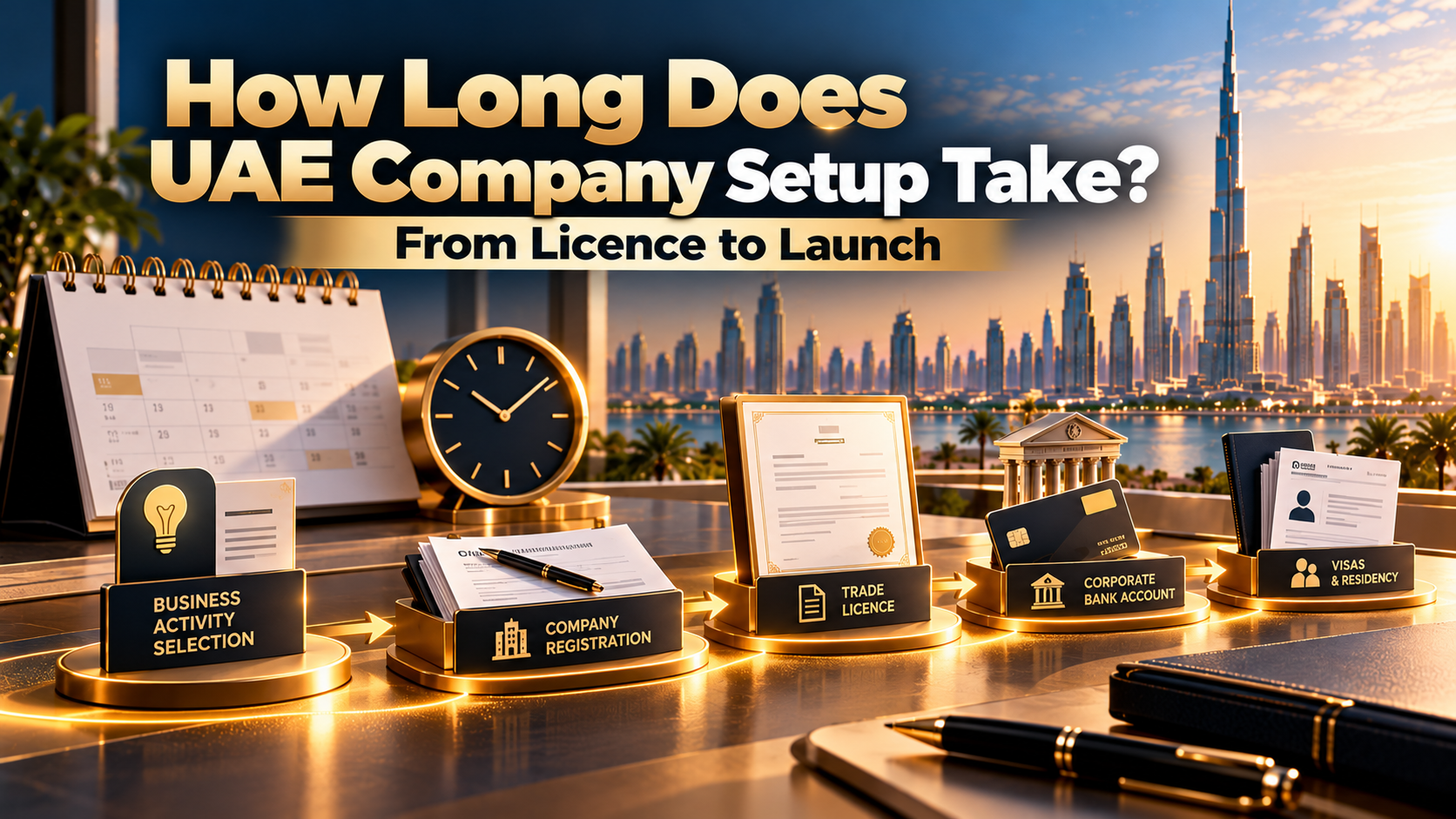
One of the first questions entrepreneurs ask when planning a business in the United Arab Emirates is: how long does it take to set up a company in the UAE?
The answer depends on several factors, including the type of business, the chosen jurisdiction, the activities being licensed, the completeness of the documents and whether additional approvals are required.
Some straightforward company formation applications can move through the licensing process relatively quickly once all requirements are satisfied. Other applications may take longer because of regulatory approvals, ownership documentation, premises requirements or immigration procedures.
It is also important to distinguish between receiving a trade licence and having a business fully ready to operate. Corporate banking, visas, tax registration and other operational arrangements may follow a different timeline.
This guide explains the main stages of UAE company formation, the factors that affect processing time and how entrepreneurs can prepare to avoid unnecessary delays.
How Long Does It Take to Register a Company in the UAE?
There is no single processing time that applies to every UAE company formation application.
The timeline depends on the jurisdiction, business activity, legal structure and the requirements of the relevant licensing authority.
For planning purposes, entrepreneurs should consider the following stages separately:
- Initial business planning and jurisdiction selection.
- Trade name and activity approval, where required.
- Preparation and submission of incorporation documents.
- Licence issuance and completion of registration formalities.
- Immigration and establishment procedures, if needed.
- Corporate bank account application.
- Corporate Tax and VAT registration, where applicable.
A straightforward application with complete documents and no additional approval requirements may progress faster than a complex application involving regulated activities, corporate shareholders or multiple external approvals.
The most useful approach is to ask for a timeline for your specific licence type and activity, rather than relying on a universal promise that every UAE company can be formed within a fixed number of days.
What Affects the UAE Company Formation Timeline?
Several factors can influence how quickly a business can be registered.
1. Mainland or Free Zone Company Formation
One of the first decisions is whether to establish a mainland company or a free zone company.
Mainland businesses are licensed by the relevant emirate’s licensing authority. In Dubai, many mainland business licensing services are handled through the Department of Economy and Tourism and its authorised channels.
Free zone companies are registered through the relevant free zone authority, each of which has its own application process, document requirements, licence options and administrative procedures.
Neither route is automatically faster for every business. The appropriate timeline depends on the activity, legal structure, approvals and specific authority handling the application.
For an overview of the available options, visit SmartBiz business setup services in Dubai.
2. Type of Business Activity
The proposed activity can have a significant impact on processing time.
A straightforward commercial, professional or consultancy activity may involve a different approval process from an activity regulated by a specialised government department.
Depending on the sector, additional requirements may involve technical documentation, professional qualifications, premises standards or external approvals.
Before submitting an application, confirm that the selected activity is permitted under the intended licence and identify any additional approvals required.
3. Legal Structure and Ownership
A company with a straightforward ownership structure may require less documentation than an entity involving corporate shareholders, multiple partners or a complex ownership arrangement.
Additional documentation may be needed to establish the identity and authority of shareholders, directors or authorised representatives.
Foreign corporate shareholders may also need to provide company registration documents, board resolutions or other supporting records. Authentication or attestation requirements depend on the documents and the authority involved.
Preparing the ownership documents early can help prevent delays during the application review.
4. Completeness of Documents
Incomplete or inconsistent documentation is a common source of delay.
The licensing authority may request clarification if names, passport details, ownership information or company documents do not match the application.
Before submitting the application, check that:
- Identity documents are valid and legible.
- Shareholder and manager details are consistent.
- Proposed activities are correctly identified.
- Company resolutions and agreements are complete, where required.
- Any necessary approvals or supporting documents are included.
- Documents meet the relevant authority’s format and authentication requirements.
A document checklist prepared for the specific jurisdiction is more useful than a generic list intended for every type of UAE company.
5. Additional Approvals and Premises Requirements
Some activities require approval from another regulator or government department.
Certain businesses may also need to satisfy premises, tenancy, technical or operational requirements before a licence can be issued or amended.
Where additional approvals are required, the overall timeline depends on the relevant authority and the time needed to satisfy its requirements.
Entrepreneurs should identify these conditions at the beginning rather than discovering them after the main application has been submitted.
What Are the Main Stages of Company Formation in the UAE?
Understanding the process helps business owners identify which tasks can be completed early and which depend on approval from another party.
Stage 1: Choose the Business Activity and Jurisdiction
Start by deciding what the business will do and where it should be licensed.
The activity, target customers, premises requirements and intended operating model can influence whether a mainland or free zone structure is appropriate.
This stage also involves reviewing the available legal structures, ownership arrangements and licence options.
Making these decisions early reduces the risk of having to revise the application later.
Stage 2: Reserve the Trade Name and Obtain Initial Approval
Depending on the authority and application route, the process may include selecting a compliant trade name and obtaining the required initial approval.
The proposed name must satisfy the applicable naming rules. The selected activity and ownership structure must also meet the authority’s requirements.
The sequence of these steps can vary, so follow the process prescribed by the relevant licensing authority.
Stage 3: Prepare and Submit the Documents
The business owner or authorised representative prepares the required application and supporting documents.
These may include identity documents, shareholder details, resolutions, constitutional documents and other records relevant to the company structure.
The authority reviews the application and may request additional information where necessary.
Providing a complete application can reduce avoidable back-and-forth communication.
Stage 4: Complete Licensing Formalities
Once the required approvals and documentation are accepted, the applicant completes the relevant licensing formalities and pays the applicable fees.
The licence is issued after the authority’s requirements have been satisfied.
The exact steps and order depend on the jurisdiction, legal structure and type of business.
Stage 5: Complete Immigration and Establishment Procedures
If the business intends to sponsor residence visas or employ staff, additional immigration and establishment procedures may be necessary.
These can involve establishment registration, immigration file procedures, visa applications, medical examinations, Emirates ID procedures and other requirements depending on the applicant and company.
These processes should be planned separately from the core licence issuance timeline.
The number of visas available may also depend on the licence package, premises, authority rules and other conditions.
Stage 6: Arrange Corporate Banking
Opening a corporate bank account is a separate process from obtaining a trade licence.
Banks conduct their own due diligence and may request information about the company’s ownership, business model, expected transactions, source of funds, customers, suppliers and operating activities.
The time required depends on the bank, the completeness of the application and the complexity of its compliance review.
A company should not assume that a trade licence guarantees immediate bank account approval.
Stage 7: Complete Applicable Tax Registrations
After incorporation, the business should assess its UAE Corporate Tax and VAT obligations.
Corporate Tax registration requirements and VAT registration criteria are separate. The applicable requirements depend on the company’s legal form, tax status, revenue and circumstances.
Tax registration should be included in the post-incorporation plan rather than treated as an automatic consequence of licence issuance.
Official guidance is available through the Federal Tax Authority.
Company Licence Issuance vs. Full Business Readiness
Receiving the trade licence is an important milestone, but it does not necessarily mean that every operational requirement has been completed.
| Milestone | What it means |
|---|---|
| Initial approval | The proposed business structure or application has progressed through the relevant preliminary approval stage, where applicable |
| Trade licence issued | The company has received the relevant business licence |
| Immigration procedures completed | The applicable establishment and visa processes have been completed, where required |
| Corporate bank account opened | The bank has completed its review and opened the account |
| Tax obligations addressed | Required tax registrations and filing arrangements have been assessed and completed where applicable |
| Operational readiness | The business has completed the relevant legal, administrative and practical steps needed for its intended activities |
These milestones can overlap, but they should not be treated as interchangeable.
For example, a company may receive its licence before its corporate bank account is approved. Similarly, an owner may need to complete immigration procedures after the business has been incorporated.
Planning around the actual milestones gives entrepreneurs a more realistic picture of when they can begin particular activities.
How Can You Avoid Delays When Setting Up a UAE Company?
Although some parts of the process depend on external authorities, preparation can reduce avoidable delays.
1. Select the Correct Business Activity
Review the activity list and confirm that the proposed activity matches the business model.
Do not select an activity simply because its name sounds similar. Licensing categories may have specific definitions, limitations or approval requirements.
2. Choose the Appropriate Jurisdiction
Compare mainland and free zone options based on the business’s operational needs, intended customers, permitted activities, premises requirements and ownership structure.
The cheapest package is not necessarily the most suitable option for every business.
3. Prepare Documents in Advance
Collect identity documents, ownership records and other supporting information before starting the application.
Where documents require authentication, confirm the applicable process and allow sufficient time for completion.
4. Identify External Approvals Early
Ask the relevant licensing authority whether the proposed activity requires additional approvals.
This is particularly important for businesses operating in regulated sectors or activities that have specific premises or professional requirements.
5. Respond Quickly to Requests
If the authority requests additional documents or clarification, respond promptly and ensure that the information is accurate and consistent.
Unanswered requests can delay the overall application.
6. Plan Post-Formation Tasks Separately
Create a checklist for immigration, banking, tax registration, accounting and any sector-specific operational requirements.
This allows the business owner to track the licence process separately from the tasks required to become fully operational.
7. Work With a Qualified Business Setup Adviser Where Appropriate
A professional adviser may help identify the relevant licensing route, prepare documents and coordinate application steps.
However, advisers cannot guarantee that every application will be approved by a particular date. Final processing depends on the authority and the applicant’s circumstances.
What Should You Do Immediately After Company Formation?
Once the licence has been issued, the business should move through its post-incorporation checklist.
Depending on the company’s requirements, this may include:
- Obtaining and organising official company documents.
- Completing applicable establishment and immigration procedures.
- Applying for a corporate bank account.
- Assessing Corporate Tax registration requirements.
- Assessing VAT registration requirements.
- Setting up accounting and bookkeeping processes.
- Establishing a recordkeeping system.
- Reviewing employment, payroll and insurance obligations where relevant.
- Preparing a calendar for licence renewals and tax filing deadlines.
The applicable requirements depend on the company and its activities. Not every business needs every item on this list immediately, but each should be assessed.
For financial recordkeeping and ongoing accounting support, businesses can explore SmartBiz accounting and bookkeeping services in Dubai.
Frequently Asked Questions
1. How long does it take to set up a company in the UAE?
There is no single timeline for every company. The time depends on the jurisdiction, business activity, legal structure, document readiness and additional approval requirements. Confirm the current estimate for the specific application with the licensing authority.
2. Is Dubai mainland company formation faster than free zone formation?
Not in every case. Mainland and free zone authorities follow different procedures. The faster route depends on the activity, documents, legal structure and specific authority requirements.
3. Can I receive a UAE trade licence quickly?
Some straightforward applications may be processed relatively quickly once the required documents and approvals are complete. However, processing times vary, and no universal completion time should be assumed.
4. Does obtaining a trade licence mean I can start every business activity immediately?
Not necessarily. Some activities require additional regulatory approvals or compliance with specific operating conditions. Confirm the permissions and requirements applicable to your business before commencing regulated activities.
5. How long does it take to open a corporate bank account after incorporation?
The timeline varies by bank and application. Banks carry out independent due diligence and may request additional information about the company, ownership, source of funds and expected transactions. Licence issuance does not guarantee immediate account approval.
6. Are visas included in the company formation timeline?
Visa and immigration procedures may be separate from the initial licensing process. Their timing depends on the relevant authority, application requirements and individual circumstances.
7. Do I need to register for Corporate Tax after forming a company?
Corporate Tax registration requirements should be assessed according to the company’s legal form, tax status and applicable rules. Incorporation and tax registration are separate processes, and the relevant deadline should be checked with the FTA.
8. What documents can delay company formation?
Incomplete identity documents, inconsistent ownership details, missing resolutions, incorrect activity information and absent external approvals can delay an application. The exact documents depend on the licensing authority and company structure.
9. Can a business setup consultant guarantee a fixed completion date?
A consultant may provide an estimated timeline based on the selected route and current process. However, final approval and processing depend on the relevant authority, the application and any additional requirements. A guaranteed date should not be assumed without a clear basis.
10. How can I check the status of my application?
Use the official application portal or service channel of the relevant licensing authority. Keep your application reference and respond to requests for information through the authorised channel.
Conclusion
The time required to set up a company in the UAE depends on the business activity, jurisdiction, legal structure, documents and any additional approvals required.
Rather than relying on a fixed number of days, entrepreneurs should break the process into clear milestones: selecting the business activity, completing the licence application, obtaining the licence and addressing the separate requirements for visas, banking and tax registration.
Preparing documents in advance, selecting the correct licensing route and identifying external approvals early can help reduce avoidable delays.
For businesses planning to establish a company in Dubai, SmartBiz business setup services can be a starting point for understanding the setup process and the options available.
Disclaimer: This article provides general information and is not legal, tax or regulatory advice. Processing times and requirements vary by authority, licence type and individual circumstances. Confirm current timelines and requirements directly with the relevant licensing authority before making business commitments.