
The family visa in UAE enables expatriate residents to sponsor their loved ones, bringing spouses, children, and sometimes parents to live together in the Emirates. As UAE continues modernizing its immigration framework in 2026, understanding eligibility criteria, application procedures, and compliance requirements becomes essential for every resident planning to unite their family. Whether you’re a newly hired professional or an established resident, this comprehensive guide explains everything about the UAE family visa application process, including salary thresholds, required documentation, renewal procedures, and legal obligations.
UAE’s family-friendly residency policies reflect the nation’s commitment to supporting expatriate communities who contribute significantly to economic growth and development. The streamlined processes in 2026 make family sponsorship more accessible than ever, though compliance with specific regulations remains mandatory. This guide provides the clarity and step-by-step instructions needed to successfully navigate how to apply family visa in UAE without unnecessary complications or delays.
What Is a Family Visa in UAE?
A family visa in UAE is a residence permit allowing expatriates with valid UAE employment or investor visas to sponsor family members for legal residency. This UAE residence visa for family grants sponsored dependents the right to live in the UAE under the sponsor’s responsibility, though it doesn’t automatically permit employment without separate work authorization.
Employment Visa vs Dependent Visa: While employment visas connect directly to specific job positions with employers acting as sponsors, dependent visas link to individual sponsors who are UAE residents. Employment visa holders can sponsor family members once they meet eligibility criteria including minimum salary requirements and proper documentation.
Who Can Be Sponsored: The family residence visa UAE system permits sponsorship of various family members with different requirements for each category.
Spouse Sponsorship: Male and female residents can sponsor their legally married spouse regardless of nationality. The marriage must be legally recognized and properly attested according to UAE requirements. Both husbands and wives with sufficient income can sponsor spouses, reflecting gender equality in modern UAE visa policies.
Children Sponsorship: Parents can sponsor unmarried children with male children typically sponsored until age 18 (extendable to 25 if studying full-time at recognized universities) and daughters sponsored with no upper age limit until marriage. Children with special needs can be sponsored indefinitely regardless of age, providing crucial family support for families with disabled dependents.
Parents Sponsorship: Sons (not daughters) who meet higher salary thresholds can sponsor their parents for UAE residency. This provision enables adult children to care for aging parents, though requirements are stricter than spouse and children sponsorship.
The UAE visa sponsorship for family creates legal obligations for sponsors who become responsible for sponsored family members’ compliance with UAE laws, financial support, and timely visa renewals. Understanding these responsibilities before initiating sponsorship prevents future complications.
UAE Family Visa Eligibility Requirements (2026)
Meeting UAE family visa eligibility criteria ensures smooth application processing and approval.
Sponsor Requirements: To sponsor family members, you must hold a valid UAE residence visa with minimum residency validity (typically 6-12 months remaining), meet minimum salary requirements based on who you’re sponsoring and whether accommodation is provided, work in an eligible profession (certain professions face restrictions), and obtain employer permission if required by your employment contract.
Profession-Based Restrictions: While most professionals can sponsor families, certain visa categories face limitations. Domestic workers, some entry-level laborers, and specific temporary work permit holders may be restricted from family sponsorship. Professional, managerial, and skilled positions generally face no profession-based restrictions.
Family Member Eligibility: Sponsored family members must meet specific criteria including legal relationship proven through attested documents, good health confirmed through mandatory medical examinations, clean criminal record with no security concerns, and age requirements (for children) or dependency status (for parents).
Emirates Family Visa Requirements for 2026 maintain gender neutrality, allowing both male and female residents with adequate income to sponsor family members equally. This progressive policy recognizes diverse family structures and women’s economic contributions.
Residency Stability: While not always explicitly stated, sponsors with stable employment history, longer UAE residency duration, and consistent income demonstrate lower risk profiles, potentially facilitating smoother approval processes.
Salary Required for Family Visa in UAE (2026)
The salary required for family visa in UAE represents one of the most critical eligibility factors. Understanding how much salary required for family visa in UAE helps residents plan sponsorship timing appropriately.
Minimum Salary Thresholds (2026):
| Family Members Sponsored | With Accommodation | Without Accommodation |
|---|---|---|
| Spouse only | AED 4,000/month | AED 5,000/month |
| Spouse + 1 child | AED 4,000/month | AED 6,000/month |
| Spouse + 2+ children | AED 5,000/month | AED 7,000-8,000/month |
| Parents | AED 20,000/month+ | AED 20,000/month+ |
Important Notes on Salary Calculation:
- Basic Salary: The calculation uses basic salary excluding allowances and benefits in most cases
- With Accommodation: If employer provides housing or pays housing allowance, lower thresholds apply
- Documentation: Salary must be proven through employment contract and bank statements
- Variations by Emirate: Dubai, Abu Dhabi, and other emirates may have slight threshold variations
Salary Source Requirements: The qualifying salary must come from legal UAE employment reflected in valid employment contracts, confirmed through official salary certificates from employers, demonstrated via bank statements showing regular salary deposits, and consistent across all documentation without discrepancies.
Alternative Income Sources: Some emirates accept combined income from multiple sources including rental income from owned UAE properties, investment returns from legitimate sources, and business profits for business owners and investors. However, employment salary remains the most straightforward qualification method.
The minimum salary for family visa UAE thresholds exist to ensure sponsors can adequately support families without public assistance. Meeting these requirements demonstrates financial stability and responsibility.
Documents Required for Family Visa UAE
Comprehensive documentation is crucial for successful applications. The documents required for family visa UAE vary based on who you’re sponsoring and your country of origin.
Documents for Sponsor:
- Valid passport copy with minimum 6 months validity
- Valid UAE residence visa copy
- Emirates ID copy (both sides)
- Employment contract or labor card copy
- Salary certificate from employer (recent, typically within 1 month)
- Bank statements (usually last 3-6 months)
- Tenancy contract (ejari) or accommodation letter from employer
- Marriage certificate (attested) when sponsoring spouse
- Children’s birth certificates (attested) when sponsoring children
- Passport-sized photographs (recent, white background)
Documents for Spouse:
- Valid passport copy with minimum 6 months validity
- Marriage certificate attested by home country, UAE embassy, and Ministry of Foreign Affairs (MOFA)
- Educational certificates (attested) if applicable
- Passport-sized photographs (recent, white background)
- Previous residence visa copy if changing sponsor within UAE
Documents for Children:
- Valid passport copy with minimum 6 months validity
- Birth certificate attested by home country, UAE embassy, and MOFA
- Passport-sized photographs (recent, white background)
- Mother’s consent (notarized and attested) if child is sponsored by father
- School enrollment documents if applicable
UAE Residence Visa Documents require careful attention to attestation requirements. Most documents need three-level attestation including notarization in home country, attestation by UAE embassy in home country, and final attestation by MOFA in UAE. Some countries with bilateral agreements may have simplified attestation processes.
Translation Requirements: Documents not in Arabic or English must be translated by approved translation services and attested. This applies particularly to marriage and birth certificates from non-English speaking countries.
Document Validity: Attested documents typically remain valid for 6 months from attestation date. Plan your application timeline accordingly to avoid document expiration during processing.
How to Apply Family Visa in UAE (Step-by-Step)
Understanding how to apply family visa in UAE involves following a structured process through multiple government entities.
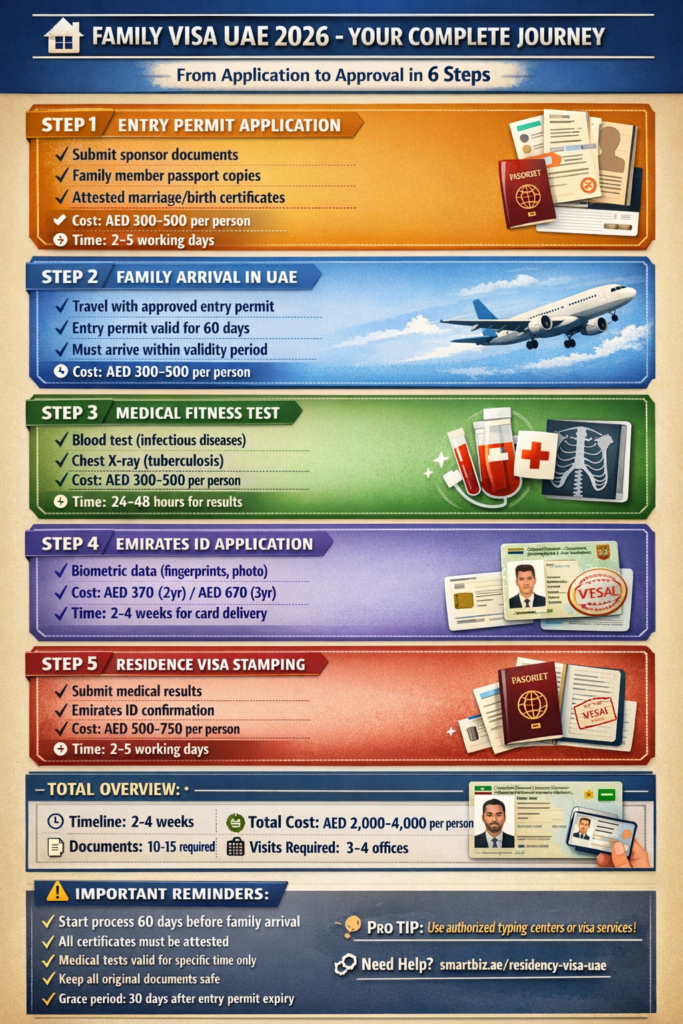
Step 1: Obtain Entry Permit – Submit application through immigration departments or typing centers with sponsor documents, family member passport copies, attested marriage/birth certificates, and application fees. Processing typically takes 2-5 working days. The entry permit allows family members to enter UAE legally and begin the residence visa process.
Step 2: Family Member Arrives in UAE – Family members travel to UAE using the approved entry permit, which is typically valid for 60 days from issuance. Ensure arrival occurs within entry permit validity to avoid complications requiring new applications.
Step 3: Medical Fitness Test – Schedule and complete mandatory medical examinations at approved health centers including blood tests screening for infectious diseases, chest X-ray checking for tuberculosis, and general health assessment. Medical results are typically available within 24-48 hours. Certain medical conditions may affect visa approval, though policies have become more inclusive in recent years.
Step 4: Emirates ID Application – Apply for Emirates ID through official channels providing biometric data (fingerprints, photograph), completed application forms, and required fees. Emirates ID serves as the primary identification for UAE residents and is mandatory for all residence visa holders.
Step 5: Visa Stamping – Submit for final residence visa stamping with medical fitness results, Emirates ID application confirmation, original passport, and stamping fees. Processing takes 2-5 working days. The stamped residence visa in the passport confirms legal residency status.
Step 6: Emirates ID Collection – Collect Emirates ID card once ready, typically within 2-4 weeks of application. Some emirates offer home delivery services for convenience.
The complete UAE family visa application process typically spans 2-4 weeks from entry permit application to final visa stamping, assuming all documents are correct and no complications arise. Working with authorized typing centers or professional visa service providers can streamline the process and reduce errors.
UAE Family Visa Fees & Processing Time
Understanding total costs helps budget appropriately for family sponsorship.
Breakdown of Fees (Approximate 2026):
- Entry permit: AED 300-500 per person
- Medical fitness test: AED 300-500 per person
- Emirates ID application: AED 370 (2 years) or AED 670 (3 years) per person
- Visa status change/stamping: AED 500-750 per person
- Typing center/service fees: AED 200-500 per person (if using services)
- Health insurance: Varies by emirate and coverage (mandatory in Dubai and Abu Dhabi)
Total Estimated Cost: AED 2,000-4,000 per family member for complete processing including all fees and services. Costs vary based on emirate, service providers used, and specific circumstances.
Processing Timeframes:
- Entry permit: 2-5 working days
- Medical fitness test: 1-2 days for results
- Emirates ID: 2-4 weeks for card delivery
- Visa stamping: 2-5 working days
- Overall process: 2-4 weeks for smooth applications
Expedited Services: Some emirates offer expedited processing for additional fees, reducing timelines to as little as 24-48 hours for critical steps. Evaluate whether urgency justifies additional expense.
How to Renew Family Visa in UAE
Understanding how to renew family visa in UAE ensures continuous legal status for sponsored family members.
Renewal Timing: Begin renewal process 30-60 days before visa expiry. While grace periods exist, early renewal avoids potential complications and ensures uninterrupted residency status.
Renewal Requirements: The family visa renewal process UAE requires similar documentation to initial applications including updated salary certificate, recent bank statements, valid tenancy contract or accommodation letter, current medical fitness certificates (required for renewal), updated Emirates ID renewal, and passport copies with minimum 6 months validity.
Renewal Process Steps:
- Obtain updated medical fitness certificates for all family members
- Gather updated sponsor documentation (salary certificate, bank statements, tenancy)
- Submit renewal application through immigration or typing centers
- Pay renewal fees
- Renew Emirates ID concurrently
- Collect renewed residence visa stamps
Renewal Fees: Similar to initial application fees (approximately AED 2,000-3,500 per person) including medical tests, visa renewal fees, Emirates ID renewal, and service charges.
Grace Period: UAE provides a 30-day grace period after visa expiry for renewal without penalties. Beyond this period, daily overstay fines apply (typically AED 25-50 per day), though fines are sometimes waived during renewal if processed promptly.
Automatic Renewal Considerations: Some emirates are piloting automatic renewal systems for qualifying residents with stable employment and clean records. Check with your local immigration department for availability.
How to Cancel Family Visa in UAE
Understanding how to cancel family visa in UAE is necessary when family members permanently leave UAE or transfer sponsorship.
When Cancellation Is Required: Cancel family visas when family members permanently relocate outside UAE, when transferring sponsorship to another sponsor (internal transfer), when sponsors change employment (in some cases), or when divorce occurs (for spouse visas).
Who Can Cancel: The original sponsor (typically the employer or family sponsor) and the visa holder with sponsor permission can initiate cancellation. Family members cannot independently cancel their own visas without sponsor involvement.
Cancellation Process Steps:
- Submit cancellation application to immigration department or typing center
- Provide sponsor and visa holder identification documents
- Pay applicable cancellation fees
- Surrender Emirates ID (physical card or official cancellation)
- Receive cancellation confirmation and exit stamp
- Exit UAE within grace period (typically 30 days from cancellation)
Post-Cancellation Grace Period: The cancellation of dependent visa UAE triggers a 30-day grace period allowing visa holders to settle affairs and depart UAE legally. Overstaying beyond this period incurs daily fines and potential future visa complications.
Cancellation Fees: Typically AED 200-500 for cancellation processing, though fees vary by emirate and specific circumstances.
Exit Requirements: After cancellation, the visa holder must exit UAE within the grace period or obtain new valid visa status. Re-entry requires new visa applications unless specific arrangements exist.
Important Considerations: Canceling employment visas may automatically cancel dependent family visas in some cases. Verify with immigration authorities to prevent unintentional status violations for family members.
Can Spouse Work on Dependent Visa in UAE?
A frequently asked question is whether spouse work permit on dependent visa UAE is possible.
Clear Answer: Spouses on dependent visas can work in UAE, but they need a separate work permit or employment visa from their employer. The dependent visa alone does not authorize employment.
Work Authorization Process: When spouse secures employment, the employer applies for work permit while spouse remains on family sponsor’s dependent visa, or the employer sponsors the spouse for employment visa (requiring cancellation of dependent visa). Many spouses prefer remaining on family sponsor’s dependent visa and obtaining only work permits to maintain stability independent of employment changes.
Advantages of Dependent Visa with Work Permit: This arrangement provides residency stability independent of employment status, flexibility to change jobs without visa cancellation complications, and continued sponsorship by family member providing security during career transitions.
Work Permit Requirements: Employers hiring spouses on dependent visas must obtain labor permits through Ministry of Human Resources and Emiratisation, meet quota and Emiratization requirements, and provide employment contracts meeting labor law standards.
Freelancer Permits: Dubai and some emirates offer freelancer permits allowing spouses on dependent visas to work independently without traditional employment sponsors, ideal for consultants, creatives, and service providers.
Legal Compliance: Working without proper permits, even while holding dependent visas, violates UAE law and can result in fines, deportation, and future visa bans. Always ensure proper work authorization before commencing employment.
Common Reasons for Family Visa Rejection
Understanding common rejection reasons helps applicants avoid preventable mistakes.
Salary Shortfall or Mismatch: Applications fail when actual salary falls below minimum thresholds, salary certificate and bank statements show discrepancies, or salary documentation is incomplete or improperly formatted. Ensure all salary documentation is current, consistent, and clearly demonstrates you meet or exceed minimum requirements.
Incorrect or Incomplete Documentation: Missing documents, expired attestations, improperly attested certificates, poor quality copies or scans, and missing translations cause rejections. Create checklists ensuring every required document is current, properly attested, and clearly legible.
Attestation Issues: Many rejections stem from incorrect attestation levels (missing embassy or MOFA attestation), attestations from wrong authorities, or expired attestations (typically valid 6 months). Follow attestation requirements precisely and verify documents are within validity periods.
Medical Fitness Failures: Certain medical conditions detected during mandatory health screening may result in visa denial, though UAE has become more inclusive in recent years. Infectious diseases remain primary medical concerns affecting approval.
Incomplete Sponsor Information: Applications suffer when sponsor’s residence visa has insufficient remaining validity, employment documentation is outdated or unclear, or sponsor has compliance issues or pending violations.
Administrative Errors: Simple mistakes like name spelling inconsistencies across documents, incorrect application form completion, missing signatures or stamps, or using unauthorized service providers cause unnecessary rejections.
Prevention Strategies: Use authorized typing centers or visa services familiar with current requirements, double-check all documentation before submission, ensure attestation compliance, verify salary documentation accuracy and consistency, and allow adequate time for corrections if initial applications face issues.
Important Rules & Tips for 2026
Maintaining compliance ensures smooth family visa management throughout residency.
Staying Legally Compliant: Ensure continuous validity of all family member residence visas, renew visas and Emirates IDs before expiry, maintain sponsor salary above minimum thresholds, and update immigration authorities of any status changes (address, employment, marital status).
Emirates ID Updates: Keep Emirates ID current with accurate address information, renew concurrently with residence visa to avoid gaps, and carry Emirates ID at all times as UAE law mandates.
Impact of Job Changes: When sponsors change employment, inform new employers of family sponsorship responsibilities, transfer family visa sponsorship to new employer if required, or ensure new employment maintains required salary levels for continued sponsorship. Some emirates require family visa transfer when changing employers; others allow visas to remain independent of specific employers.
Overstay Penalties: Overstaying residence visa validity incurs daily fines (typically AED 25-50 per day), accumulated fines must be paid before visa renewal or exit, and excessive overstay may result in entry bans affecting future UAE visa applications. The 30-day grace period after expiry allows renewal without penalties but should not be relied upon habitually.
Travel Considerations: Sponsored family members need valid residence visas stamped in passports for re-entry to UAE after international travel. Extended absence from UAE (typically 6 months continuously) may result in automatic visa cancellation. If planning extended travel, verify requirements to maintain visa validity or consult professional visa advisors for guidance on maintaining status during prolonged absences.
Health Insurance Compliance: Dubai and Abu Dhabi mandate health insurance for all residents including family visa holders. Ensure continuous coverage avoiding gaps that may affect visa renewal or compliance status.
Document Organization: Maintain organized files of all visa-related documents including copies of applications and approvals, attestation documentation, medical certificates, salary certificates and bank statements, and renewal correspondence. This organization facilitates smooth renewals and addresses any queries from authorities.
Frequently Asked Questions (FAQs)
Can parents be sponsored on family visa in UAE?
Yes, sons can sponsor their parents if they meet higher salary requirements, typically AED 20,000+ per month or equivalent. The sponsor must be male (sons can sponsor parents; daughters cannot under current regulations) and meet additional documentation requirements including proof of family relationship and financial capability.
Can family stay outside UAE for extended periods?
Sponsored family members should not remain outside UAE for more than 6 consecutive months without proper arrangements. Extended absence may result in automatic visa cancellation. If planning long-term travel, consult immigration authorities about maintaining visa validity through re-entry permits or other mechanisms.
Can family visa be transferred between sponsors internally?
Yes, family visas can be transferred from one UAE sponsor to another (for example, from husband to wife, or when changing employers) without family members exiting UAE. This internal transfer requires new sponsor meeting eligibility requirements, cancellation by previous sponsor, new entry permit and status change application, and relevant fees.
What happens to family visa if sponsor loses employment?
If the sponsor’s employment visa is cancelled, dependent family visas may be automatically cancelled or may have grace periods depending on emirate regulations. Options include transferring sponsorship to another eligible family member in UAE, securing new employment quickly and maintaining sponsorship, or family members obtaining independent visa status (employment, investor, etc.).
Is there age limit for sponsoring children?
Sons can typically be sponsored until age 18, extendable to 25 if enrolled in full-time university education. Daughters can be sponsored until marriage with no upper age limit. Children with special needs or disabilities can be sponsored indefinitely regardless of age with proper medical documentation.
Conclusion
The family visa in UAE system enables expatriate residents to build comprehensive lives with loved ones in this dynamic, multicultural nation. Understanding eligibility criteria, salary requirements, documentation needs, and procedural steps empowers you to navigate how to apply family visa in UAE confidently and successfully. From initial applications through renewals and potential cancellations, compliance with regulations ensures smooth family residency experiences.
The documents required for family visa UAE and salary required for family visa in UAE represent critical factors demanding careful attention and preparation. Meeting these requirements, maintaining organized documentation, and staying informed about regulatory updates protects your family’s legal status and provides peace of mind.
Whether you’re a newly arrived professional planning to bring your family or an established resident managing visa renewals, the information in this comprehensive guide serves as your roadmap to successful family sponsorship. The UAE’s welcoming approach to family unification, combined with your diligent compliance and preparation, creates opportunities for enriching family life in one of the world’s most dynamic countries.
For personalized guidance on your specific family visa situation, complex cases requiring special consideration, or assistance navigating the application process, consulting authorized immigration consultants and residency visa experts ensures compliance while minimizing stress and potential complications. Your family’s successful UAE residency journey begins with informed preparation and careful attention to the requirements outlined in this guide.