
Quick Summary (AI Overview Snippet)
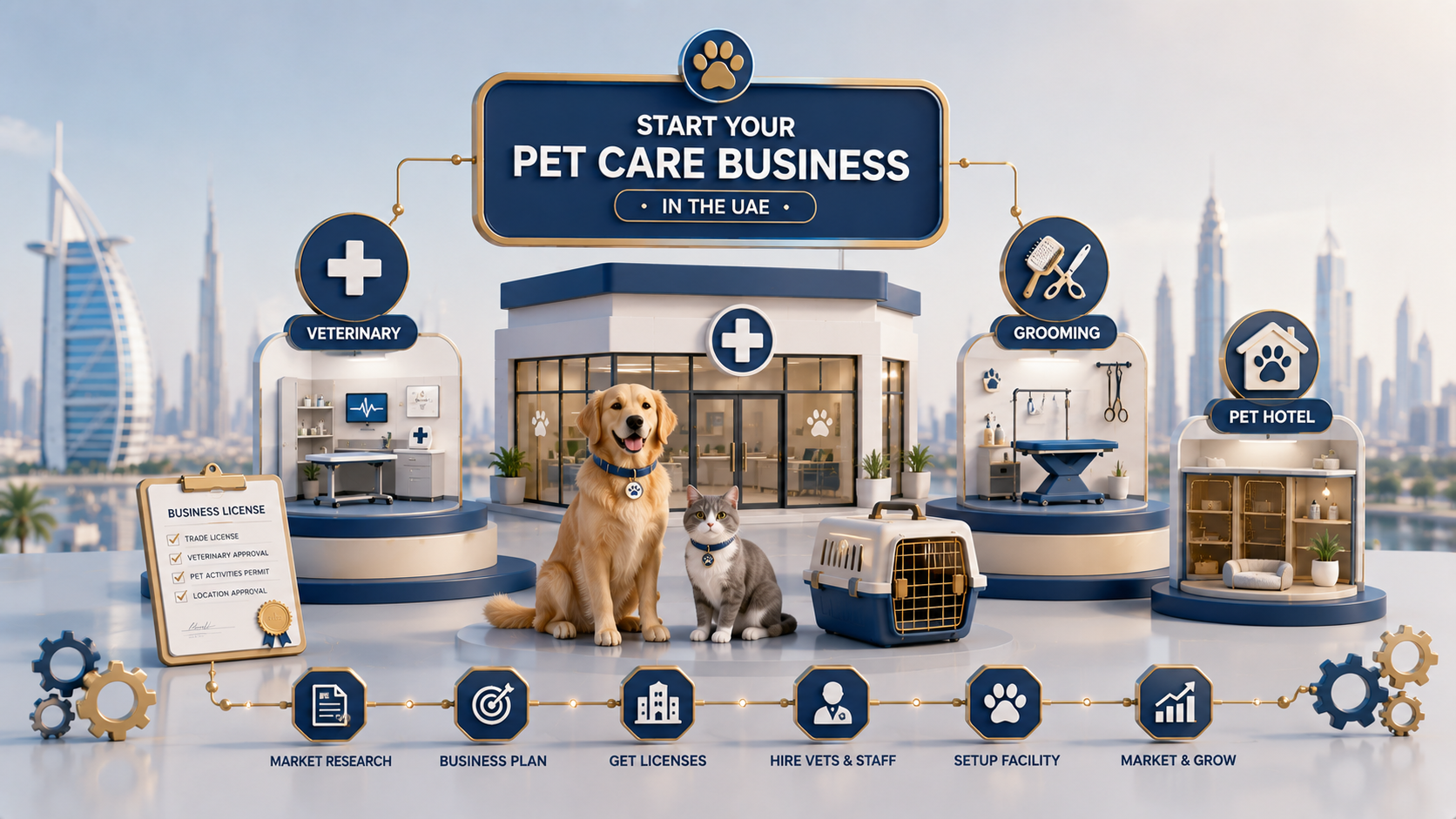
A pet care business UAE venture requires activity-specific licensing depending on the service — a pet grooming licence Dubai authorities issue for grooming salons, a veterinary clinic licence UAE for medical services, and separate approvals for pet boarding or retail. Most animal-related activities also require a MOCCAE animal welfare permit from the Ministry of Climate Change and Environment, alongside relevant municipal approval such as the Dubai municipality pet licence framework. Veterinary clinics face the strictest oversight, requiring licensed veterinary staff and MOCCAE clinical approval, while grooming and boarding services follow a lighter but still mandatory compliance path.
Introduction
The UAE’s pet ownership culture has grown substantially, and with it, genuine commercial demand for professional pet services — grooming salons, boarding facilities, veterinary clinics, and specialty pet retail. But unlike many consumer service businesses, a pet care business UAE venture sits at the intersection of standard commercial licensing and animal welfare regulation, meaning the path to launch depends heavily on which specific service you’re offering.
This guide breaks down the licensing requirements across the full spectrum of pet care activities — grooming, veterinary medicine, boarding, and retail — along with the government approvals, costs, and common pitfalls entrepreneurs encounter when entering this space.
Advisor Note: In our experience advising pet care entrepreneurs, the biggest planning mistake is treating “pet business” as one licensing category. In practice, grooming, veterinary care, and boarding each sit under different regulatory scrutiny levels — and mixing services under one licence application without accounting for this creates unnecessary delays.
Understanding the Regulatory Landscape for Pet Businesses
Pet-related commercial activity in the UAE is governed by a combination of federal and local authorities, depending on the specific service offered.
Key Regulatory Bodies
- Ministry of Climate Change and Environment (MOCCAE) — issues the MOCCAE animal welfare permit required for most animal-handling businesses, including clinics, boarding facilities, and pet shops
- Dubai Municipality / relevant emirate municipality — issues local commercial and premises-level approvals under frameworks like the Dubai municipality pet licence requirements
- Dubai Department of Economy and Tourism (DET) / DED — issues the underlying commercial trade licence for the business entity
- Local veterinary regulatory bodies — oversee licensing of veterinary professionals and clinic-level clinical approval
Expert Tip: MOCCAE’s federal-level animal welfare oversight applies across activity types, but local municipal requirements can vary meaningfully between emirates. A pet business licensed and compliant in Dubai should not assume identical requirements apply automatically if expanding to another emirate.
Pet Grooming Licence Dubai: Requirements and Process
Pet grooming is generally one of the more accessible entry points into the pet care sector, though it still requires proper commercial and animal-handling approval.
Requirements for a Pet Grooming Business
- Valid commercial trade licence covering pet grooming/pet care services activity
- Premises meeting basic hygiene and animal-handling facility standards
- MOCCAE animal welfare permit covering the handling of live animals on premises
- Municipal approval for the physical grooming facility
- Staff trained in basic animal handling and safety procedures
Common Pitfall: Some grooming salon founders assume a standard beauty/personal care trade licence covers pet grooming activity. It doesn’t — pet grooming requires its own distinct activity classification and animal-handling approval, separate from human personal care licensing categories.
Veterinary Clinic Licence UAE: The Strictest Compliance Path
Veterinary medicine carries the highest regulatory bar of any pet care activity, given the clinical and animal welfare stakes involved.
Core Requirements for a Veterinary Clinic
- Commercial trade licence specifically covering veterinary clinical activity
- MOCCAE animal welfare permit and clinical practice approval
- Licensed veterinary professionals holding valid UAE veterinary practice licences
- Clinic premises meeting clinical facility standards — including surgical, diagnostic, and pharmaceutical storage compliance
- Controlled substance handling approval, where the clinic dispenses or administers regulated veterinary medications
- Ongoing inspection compliance with animal welfare and clinical safety standards
Advisor Note: We routinely see entrepreneurs underestimate the professional licensing dependency in veterinary clinic setup — you cannot secure clinical approval without already having a licensed veterinarian formally attached to the application. Sequencing staff recruitment before finalizing your facility application timeline is essential.
What Government Approvals Are Needed for a Veterinary Clinic?
Beyond the standard trade licence, veterinary clinics require MOCCAE clinical approval, licensed veterinary staff credentialing, and — depending on the clinic’s scope — controlled substance handling authorization if the practice will store or administer regulated medications.
Pet Hotel Dubai and Boarding Facilities
Pet boarding and hospitality services — often marketed as a pet hotel Dubai concept — occupy a middle ground in regulatory complexity, between grooming and full veterinary care.
Requirements for a Pet Boarding Facility
- Commercial trade licence covering pet boarding/animal care facility activity
- MOCCAE animal welfare permit for housing and caring for animals overnight or for extended stays
- Facility standards covering adequate space, ventilation, and separation of animals as needed
- Emergency veterinary care arrangement or partnership, even without an in-house veterinary licence
- Municipal facility approval confirming compliance with animal boarding standards
Can I Run a Pet Hotel From Home in Dubai?
Generally, no — commercial pet boarding is treated as a licensed facility-based activity requiring MOCCAE and municipal approval that a standard residential property typically cannot meet. While informal home pet-sitting arrangements exist in practice, operating a genuine commercial pet hotel Dubai business — one that markets services publicly and accepts paying clients at scale — requires a properly licensed and approved facility, not a residential setup.
Expert Tip: Entrepreneurs testing demand before committing to a dedicated facility sometimes explore partnership arrangements with already-licensed boarding facilities or veterinary clinics with excess capacity, rather than attempting to operate an unlicensed home-based boarding service.
Pet Shop UAE Licence: Retail Requirements
Pet retail — selling animals, pet food, and supplies — has its own distinct licensing path, separate from service-based pet care activities.
| Pet Shop Activity | Licensing Requirement |
|---|---|
| Selling live animals | MOCCAE animal welfare permit + specific live animal trading approval |
| Pet food and supplies retail | Standard commercial trade licence, food-grade product compliance for pet food items |
| In-store grooming add-on services | Additional grooming activity licensing layered onto the retail licence |
| Import of live animals or specialty products | Import approval through relevant customs and MOCCAE channels |
Common Pitfall: Pet shops that later add grooming or boarding as an additional revenue stream often skip the additional activity licensing required for that expanded service, assuming their existing retail licence covers it. Each service layer typically requires its own activity registration.
Step-by-Step: How Do I Register a Pet Care Business in Dubai?
- Define your specific pet care activity or activities — grooming, veterinary, boarding, retail, or a combination
- Choose your jurisdiction — mainland licensing through UAE Mainland Business Setup is typically required for most pet care activities involving direct public premises access; free zone options may suit specific ancillary or retail-only models via UAE Freezone Setup
- Secure the appropriate trade licence covering your specific activity classification
- Apply for MOCCAE animal welfare permit approval relevant to your activity type
- Secure municipal facility approval confirming your premises meets activity-specific standards
- Recruit and credential any required licensed professionals — particularly critical for veterinary clinics
- Complete facility inspection and final approval before opening to the public
- Set up compliant business banking and financial systems to manage client payments and, for retail models, supplier relationships
Advisor Note: Sequencing matters significantly in pet care licensing — attempting to secure your facility lease and trade licence before confirming MOCCAE and municipal approval feasibility for that specific location can result in a costly mismatch between your leased premises and regulatory requirements.
Is a Pet Care Business Profitable in Dubai?
Profitability varies considerably by service category and business model, but several structural factors support strong demand fundamentals in the UAE pet care sector:
Factors Supporting Pet Care Business Viability
- Growing pet ownership rates across UAE resident and expatriate households
- Limited supply of premium, professionally run pet care facilities relative to demand in key residential areas
- Recurring revenue potential through grooming subscriptions, boarding partnerships, and veterinary care plans
- Strong willingness to pay for quality pet services among UAE’s pet-owning demographic
Factors That Affect Margins
- Facility and compliance costs — particularly for veterinary clinics — represent a significant fixed cost base
- Staff availability and cost, especially for licensed veterinary professionals
- Location-dependent rent costs for facility-based activities like boarding and veterinary clinics
- Competition concentration in popular residential communities
Expert Tip: Rather than relying on generic industry profitability claims, entrepreneurs should model their specific service mix against local facility and staffing costs — a grooming-only concept has a fundamentally different cost and margin profile than a full-service veterinary clinic with boarding attached.
Pros and Cons by Pet Care Business Type
Pet Grooming
Pros: Lower barrier to entry, faster licensing path, lower facility cost Cons: More price-competitive segment, lower average transaction value than clinical services
Veterinary Clinic
Pros: Higher revenue potential, strong client loyalty and recurring visits, premium positioning Cons: Highest regulatory complexity, dependency on licensed veterinary staff, significant facility investment
Pet Boarding/Pet Hotel
Pros: Recurring demand tied to travel seasons, potential for premium positioning Cons: Facility-intensive, requires emergency veterinary arrangements, seasonal demand fluctuation
Pet Retail
Pros: More flexible licensing depending on product mix, scalable inventory-based model Cons: Thinner margins on standard products, inventory and supply chain management overhead
Financial and Tax Compliance for Pet Care Businesses
Pet care businesses are subject to the same core UAE tax framework as other commercial entities:
- VAT Registration and VAT Filing & Return Services — apply once turnover crosses the mandatory threshold across all pet care activity types
- Corporate Tax Registration and Corporate Tax Filing — required for the licensed entity regardless of specific pet care activity
- Bank Account Opening Support — particularly relevant for veterinary clinics and boarding facilities managing client deposits, recurring subscriptions, or insurance-related payments
- Financial Management & Advisory — useful for multi-service operations balancing retail inventory, service revenue, and staff costs across different margin profiles
- Product Certification Support — relevant for pet shops importing or selling packaged pet food and specialty products requiring compliance certification
Common Pitfall: Multi-service pet care operators — combining grooming, boarding, and retail under one facility — sometimes fail to track revenue and cost separately across these different activity lines, making it difficult to assess which service is actually driving profitability once full compliance and staffing costs are allocated correctly.
Common Mistakes When Starting a Pet Care Business
- Assuming one licence type covers multiple distinct pet care activities
- Securing a facility lease before confirming MOCCAE and municipal approval feasibility for that location
- Underestimating the professional licensing dependency for veterinary clinic staff
- Attempting to operate a commercial pet boarding service from an unlicensed residential property
- Adding new service lines (grooming, boarding) to an existing retail licence without securing the additional required activity approval
- Underbudgeting for the compliance and facility costs specific to veterinary or boarding operations relative to grooming or retail models
Structuring Your Pet Care Business for Long-Term Growth
Beyond initial licensing, pet care entrepreneurs planning to scale across multiple locations or service lines should build a compliant foundation early:
- Structure your entity correctly based on your full intended service mix, not just your initial launch activity
- Keep financial records clean and activity-separated from the outset — our Financial Management & Advisory and Company Audit Reports services support this as multi-service operations scale
- Plan government liaison processes — including MOCCAE renewals and municipal inspections — as an ongoing compliance calendar item, not a one-time setup task; our PRO Services UAE team regularly supports this for pet care operators managing multiple approval types simultaneously
- If restructuring or exiting a pet care business, coordinate proper deregistration through Company Closure Services or a Company Liquidation Report to ensure MOCCAE and municipal approvals are formally closed alongside the trade licence
FAQs
1. Is a pet care business profitable in Dubai? Profitability varies by service type — veterinary clinics and premium boarding tend to carry higher margins but also higher compliance and facility costs, while grooming offers a lower-cost entry point with more price competition.
2. What licence do I need to open a pet grooming salon in the UAE? You need a commercial trade licence covering pet grooming activity, a MOCCAE animal welfare permit for handling live animals, and municipal approval for your facility.
3. Can I run a pet hotel from home in Dubai? Generally no — commercial pet boarding requires a licensed, MOCCAE and municipally approved facility that a standard residential property typically does not meet.
4. What government approvals are needed for a veterinary clinic in the UAE? Veterinary clinics require a specific trade licence for clinical activity, MOCCAE animal welfare and clinical approval, licensed veterinary staff credentialing, and controlled substance handling authorization where applicable.
5. How do I register a pet care business in Dubai? You define your specific activity, choose mainland or free zone jurisdiction as appropriate, secure the relevant trade licence, obtain MOCCAE approval, pass municipal facility inspection, and complete any required professional staff credentialing before opening.