
Qualifying Free Zone Person: How to Maintain 0% Corporate Tax in 2026
Having a free zone license doesn’t give your company a 0% corporate tax rate. That’s the single most common misunderstanding among UAE free zone business owners, and it’s an expensive one because Qualifying Free Zone Person status isn’t a label you get once and keep forever. It’s a compliance position the FTA re-tests every single tax year, and losing it means your entire taxable income for that year, not just the disqualifying portion, gets taxed at the standard 9% rate.
With FTA enforcement tightening through 2026 including AI-assisted cross-referencing of trade licenses, bank statements, and EmaraTax filings understanding exactly what QFZP status requires, and where it quietly breaks down, matters more this year than it did when the corporate tax regime first launched. This guide walks through the framework in plain terms: what qualifies, what doesn’t, and how to keep your 0% rate intact.
Table of Contents
- What Is a Qualifying Free Zone Person?
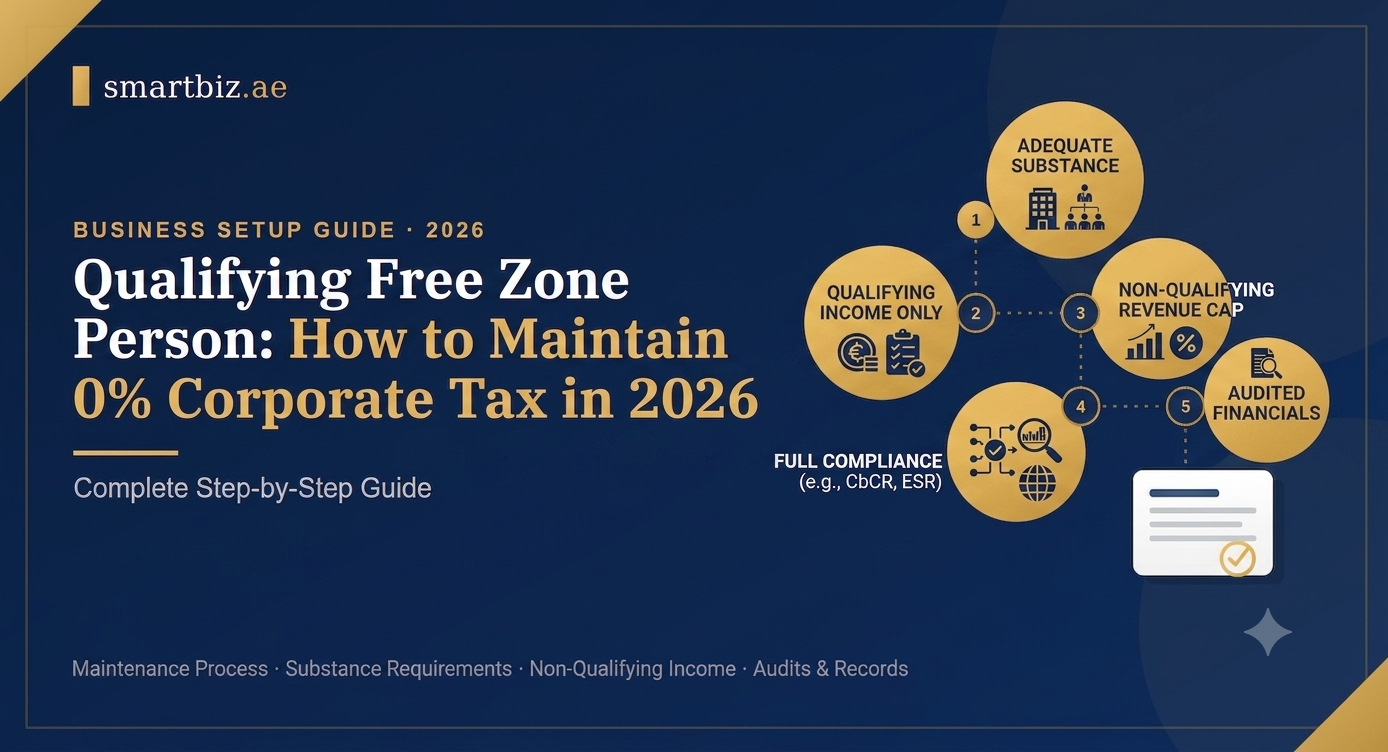
- The Five Conditions You Must Meet Simultaneously
- What Counts as Qualifying Income
- Qualifying vs. Excluded Activities
- The De Minimis Rule Explained
- Economic Substance: The Condition Most Businesses Underestimate
- Transfer Pricing and Related-Party Transactions
- What Happens If You Lose QFZP Status
- Registration and Filing Deadlines for 2026
- How to Protect Your QFZP Status Year-Round
- Frequently Asked Questions
What Is a Qualifying Free Zone Person?
Under Federal Decree-Law No. 47 of 2022, a Qualifying Free Zone Person is a free zone juridical person that meets a defined set of statutory conditions, allowing it to apply a 0% corporate tax rate specifically to its Qualifying Income. Everything else the same entity earns non-qualifying income above the permitted threshold is taxed at the standard 9% rate, with no AED 375,000 relief buffer once QFZP status applies. That threshold only protects standard mainland-style taxpayers; QFZP treatment works differently.
The important distinction: QFZP is not a registration category or a box you tick once during setup. It’s an annually assessed compliance position, verified through your financial records, income structure, and documentation each time you file.
The Five Conditions You Must Meet Simultaneously
To qualify as a QFZP, a free zone company must satisfy all of the following at the same time missing even one disqualifies the entire status for that tax period:
- Maintain adequate substance in the UAE genuine operations with sufficient staff, physical assets, and operating expenditure to support the income being earned
- Derive Qualifying Income income falling within categories the law specifically recognizes as eligible for the 0% rate
- Not have elected into the standard 9% regime some free zone companies choose to opt out of QFZP treatment entirely; if you have, this framework doesn’t apply to you
- Comply with the arm’s-length principle related-party transactions must be priced as they would be between independent parties, supported by transfer pricing documentation
- Satisfy the de minimis requirement non-qualifying revenue must stay under a strict cap, covered in detail below
Alongside these, QFZPs must prepare audited financial statements a requirement that doesn’t apply to every small free zone business outside this framework, but becomes mandatory the moment you’re claiming QFZP treatment.
What Counts as Qualifying Income
Qualifying Income generally includes:
- Income from transactions with other free zone persons, where that counterparty is the beneficial recipient of the goods or services
- Income from transactions with persons located outside the UAE entirely
- Income from specific Qualifying Activities, regardless of counterparty location, within permitted limits
What typically falls outside Qualifying Income:
- Income from mainland UAE clients for activities not on the Qualifying Activities list
- Rental income or gains from immovable property located outside a free zone
- Income exceeding the de minimis threshold from non-qualifying sources
A useful way to think about it: income earned from genuine international trade or free-zone-to-free-zone transactions tends to qualify. Income earned by directly serving the UAE mainland market, outside a specific qualifying category, tends not to.
Qualifying vs. Excluded Activities
Ministerial Decision No. 229 of 2025 sets out the current list of Qualifying and Excluded Activities, replacing the earlier Ministerial Decision 265 of 2023, and applies retroactively from 1 June 2023. Qualifying Activities generally include:
- Manufacturing and processing
- Holding of shares and other securities
- Ownership, management, and operation of ships
- Fund management, subject to regulatory oversight
- Wealth and investment management
- Headquarters services to related parties
- Treasury and financing services to related parties
- Providing services to foreign group companies
- Reinsurance and certain insurance-related activities
- Aircraft and vessel financing and leasing
Qualifying Intellectual Property income is treated separately it only reaches the 0% rate under the OECD’s modified nexus formula, which ties the tax benefit to actual R&D activity conducted in the UAE. Trademark income specifically is excluded and taxed at the standard 9% rate regardless of structure.
If your business activity doesn’t clearly fall into a recognized Qualifying Activity, income from that activity particularly if it involves mainland UAE clients is very likely non-qualifying, and should be tracked separately from day one rather than assumed to be covered.
The De Minimis Rule Explained
The de minimis rule gives QFZPs some breathing room a small amount of non-qualifying revenue doesn’t automatically blow up your entire status. But the threshold is tighter than most business owners expect: non-qualifying revenue must not exceed the lower of AED 5,000,000 or 5% of total revenue.
That “lower of” wording matters enormously. For most companies, the 5% test bites first, not the flat AED 5 million figure. A company earning AED 22 million from qualifying free zone and export transactions, alongside AED 3 million from mainland clients, would need to check both tests and in many real-world revenue mixes, the percentage cap is the binding constraint long before the flat AED 5 million ceiling comes into play.
Exceed either limit and the consequence isn’t a partial penalty the entire QFZP status for that tax period is lost, and all income becomes taxable at 9%, not just the excess above the threshold.
Economic Substance: The Condition Most Businesses Underestimate
Adequate substance is frequently the condition that quietly disqualifies businesses that otherwise look compliant on paper. It requires genuine core income-generating activity happening physically in the UAE, backed by sufficient staff, assets, and operating expenditure proportionate to the income being claimed as qualifying.
A free zone company with a flexi-desk, no employees, and income routed through the UAE entity from operations genuinely run elsewhere is a textbook example of a substance failure even if every other box is technically checked. This is precisely the kind of gap FTA audits are increasingly designed to catch, since substance is verifiable against real-world indicators like payroll records, lease agreements, and actual operating costs, not just claimed intent.
If your free zone entity is closer to a holding structure than an operating business with real UAE presence, it’s worth reviewing your substance position specifically, rather than assuming license validity alone is sufficient. Our Financial Management service can help assess whether your current setup supports a defensible substance position.
Transfer Pricing and Related-Party Transactions
Any transactions between your QFZP entity and related parties a parent company, sister entity, or common-ownership structure must be priced on an arm’s-length basis, as if negotiated between unrelated parties. This requires maintaining transfer pricing documentation that demonstrates the pricing methodology used and justifies it against comparable market transactions.
This condition catches businesses that route intercompany services, licensing arrangements, or management fees through a QFZP entity without documenting why the pricing reflects fair market value. Without that documentation on file, the FTA can challenge the arrangement and reclassify the related income, which can cascade into a broader loss of QFZP status if the reclassified amount pushes non-qualifying revenue past the de minimis threshold.
What Happens If You Lose QFZP Status
Losing QFZP status isn’t a gradual or partial penalty it applies retroactively to the entire tax period in question. All taxable income for that year, including income that would otherwise have qualified, becomes subject to the standard 9% rate. There’s no proportional adjustment for the portion that would have passed the test independently.
Beyond the immediate tax exposure, a lost QFZP status in one year can also affect FTA scrutiny of subsequent filings, since it flags the entity for closer review going forward. This is why the framework is better understood as an annual test to pass cleanly, rather than a status to defend only when challenged.
Registration and Filing Deadlines for 2026
All juridical persons incorporated in the UAE, including every free zone company, must register for corporate tax with the FTA through the EmaraTax portal this applies regardless of whether QFZP treatment is being claimed. Registration deadlines are set based on your trade license issuance month, and missing this window carries administrative penalties even where no tax is ultimately due.
Corporate tax returns must be filed within nine months of the end of your relevant tax period. For a company with a financial year ending 31 December 2025, that puts the filing deadline at 30 September 2026. The return itself must accurately declare QFZP status if claimed, and clearly separate qualifying from non-qualifying income a return that doesn’t make this distinction cleanly invites closer FTA review by default.
If you haven’t yet completed initial registration, our Corporate Tax Registration guide covers the process and deadline structure in detail, and Corporate Tax Filing walks through what the actual return submission requires.
How to Protect Your QFZP Status Year-Round
Given that QFZP status is tested annually rather than granted permanently, the businesses that maintain it consistently tend to build these habits into their regular operations rather than treating tax season as a once-a-year event:
- Track income by source and category continuously, not retroactively at filing time knowing which revenue is qualifying versus non-qualifying should be a live number, not a year-end reconstruction project
- Monitor de minimis exposure monthly, especially if your client mix includes both free zone/international and UAE mainland counterparties catching a drift toward the threshold early gives time to adjust before it becomes a filing-time crisis
- Maintain transfer pricing documentation as transactions happen, not after an FTA query arrives
- Keep audited financial statements current, since this is a standing QFZP requirement, not an optional add-on
- Review your substance position periodically staff, lease, and operating expenditure records should genuinely reflect the income being claimed as qualifying, and this only gets harder to demonstrate retroactively if it’s not maintained as you go
Businesses managing this alongside broader compliance VAT Registration, trade license renewal, and general Financial Management tend to find it far easier to route everything through one coordinated process rather than treating QFZP compliance as an isolated annual scramble. A Business Services Hub that tracks your income classification, filing deadlines, and documentation together reduces the risk of a single missed condition undoing an otherwise compliant year.
Frequently Asked Questions
Does every free zone company automatically get 0% corporate tax? No. A free zone license alone doesn’t grant 0% tax. The company must qualify as a Qualifying Free Zone Person and earn Qualifying Income, tested annually against strict statutory conditions.
What happens if I fail just one of the five QFZP conditions? Failing any single condition disqualifies the entire QFZP status for that tax period, meaning all taxable income becomes subject to the standard 9% rate, not just the disqualifying portion.
How much non-qualifying income can a QFZP earn without losing its status? The de minimis threshold is the lower of AED 5,000,000 or 5% of total revenue. For most companies, the 5% test is the binding limit long before the flat AED 5 million figure applies.
Is a free zone company still required to register for corporate tax even with 0% qualifying income? Yes. Registration through EmaraTax is mandatory for all UAE juridical persons, including free zone companies, regardless of whether tax is ultimately due.
What is considered “adequate substance” for QFZP purposes? Genuine core income-generating activity conducted in the UAE, supported by sufficient staff, physical assets, and operating expenditure proportionate to the income being claimed as qualifying.
Does income from UAE mainland clients disqualify QFZP status entirely? Not automatically it depends on whether the activity falls within a Qualifying Activity and whether the resulting non-qualifying revenue stays within the de minimis threshold.
When is the corporate tax return deadline for 2026? Returns are due within nine months of your tax period’s end. For a company with a financial year ending 31 December 2025, the deadline is 30 September 2026.
Not confident your free zone company would pass a QFZP review this year? Talk to our team we’ll check your income classification, substance position, and documentation before your filing deadline arrives.