
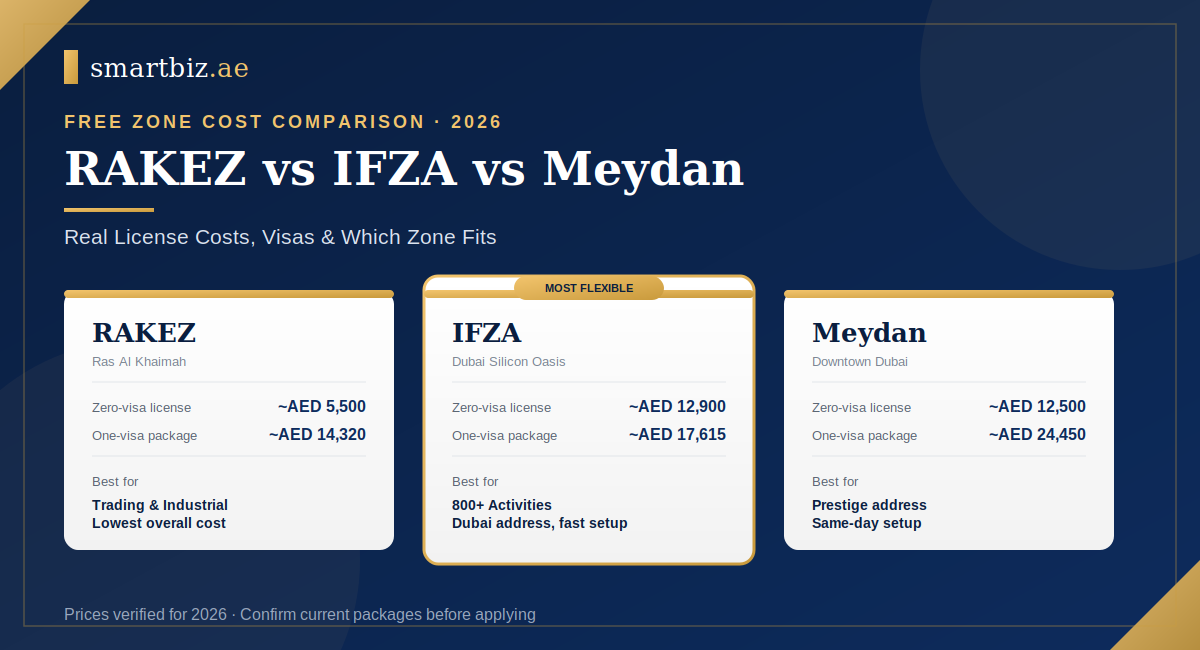
RAKEZ vs IFZA vs Meydan: Free Zone Cost Comparison for 2026
These three free zones account for a large share of new UAE company formations every year, and for good reason all three offer 100% foreign ownership, fast setup, and genuinely competitive pricing compared to premium zones like DMCC or DIFC. But “competitive” isn’t the same as “identical.” Once you look past the headline license fee, RAKEZ, IFZA, and Meydan are built around different priorities, and picking based on price alone is one of the most common reasons founders end up paying to fix a mismatch a year later.
This comparison breaks down real 2026 pricing across all three, what each visa package actually includes, and more importantly which business types each zone is genuinely built for.
Table of Contents
- Quick Comparison at a Glance
- IFZA: Cost and What It’s Built For
- Meydan: Cost and What It’s Built For
- RAKEZ: Cost and What It’s Built For
- Visa Package Comparison
- Business Activities: Where Each Zone Wins
- Dubai Address vs. Lower Cost The Real Trade-off
- Banking and Reputation Differences
- Corporate Tax and Compliance Across All Three
- Which Zone Fits Your Business
- Frequently Asked Questions
Quick Comparison at a Glance
| IFZA | Meydan | RAKEZ | |
|---|---|---|---|
| Location | Dubai (Silicon Oasis) | Dubai (Downtown-adjacent) | Ras Al Khaimah |
| Zero-visa license | ~AED 12,900 | ~AED 12,500 | From ~AED 5,500–6,000 |
| One-visa package | ~AED 17,600 | ~AED 24,450 | ~AED 14,320 |
| Setup speed | 2–5 days | Same-day options available | Typically 3–7 days |
| Activity range | 800+ activities | Narrower, service-focused | Broad, including industrial |
| Best for | Consultancy, trading, holding | Lean service companies wanting a Dubai address | Trading, industrial, warehousing, budget setups |
These figures move regularly as each authority revises packages, so always confirm current pricing directly before committing but the relative positioning between the three has stayed consistent through 2026.
IFZA: Cost and What It’s Built For
IFZA relocated to Dubai Silicon Oasis in 2020 and has since become one of the most recognized budget-tier Dubai free zones, having licensed well over ten thousand companies. Its pricing model is built around flexible, tiered visa packages:
- License only (zero visas): approximately AED 12,900
- One residence visa: approximately AED 17,615
- Two residence visas: approximately AED 24,080
- Three residence visas: approximately AED 30,545
What sets IFZA apart isn’t just the entry price it’s package flexibility. IFZA offers roughly ten different package configurations, which matters once you start adding shareholders or activities beyond a simple single-visa consultancy. It also supports a notably wide activity list, with more than 800 approved business activities, making it a strong fit for holding companies, trading businesses, and multi-activity licenses that would require upgrades in narrower zones.
One practical note for 2026: IFZA introduced mandatory annual financial statement submission requirements in late 2025, which caught a number of existing licensees off guard. Factor this into your ongoing compliance planning rather than treating IFZA as a purely no-maintenance option.
Meydan: Cost and What It’s Built For
Meydan Free Zone sits in a Downtown-adjacent Dubai location and has built its reputation around speed and digital simplicity. Its pricing:
- License only (zero visas): approximately AED 12,500 currently the cheapest Dubai-based zero-visa entry point
- One residence visa: approximately AED 24,450
- Two residence visas: approximately AED 34,400
- Three residence visas: approximately AED 44,350
Notice the visa cost curve here: Meydan’s zero-visa entry is marginally cheaper than IFZA’s, but once you add even a single visa, Meydan becomes meaningfully more expensive than IFZA’s equivalent package. This makes Meydan a strong fit specifically for businesses that don’t need a visa attached holding structures, remote consultancies run by non-resident owners and a comparatively weaker value proposition once residency enters the picture.
Meydan also offers a distinctive fast-track option: a 60-minute “Fawri” license process for time-sensitive setups, along with instalment payment plans stretching from three to twelve months a genuinely useful feature for founders managing cash flow carefully in year one.
RAKEZ: Cost and What It’s Built For
RAKEZ, based in Ras Al Khaimah rather than Dubai, consistently wins on raw price. Its zero-visa entry starts around AED 5,500–6,000 for e-commerce or service licenses, and even its one-visa package roughly AED 14,320 comes in well below IFZA’s equivalent, despite IFZA’s own package being positioned as budget-friendly.
RAKEZ’s real differentiator isn’t only price, though. It supports a genuinely broad activity list including industrial, manufacturing, and warehousing categories that neither IFZA nor Meydan accommodate as naturally, with access to physical warehouse and industrial space at costs that would be difficult to match in Dubai proper. RAKEZ has also built one of the largest registered company bases in the UAE, with roughly 40,000 licensed businesses compared to IFZA’s estimated 5,000 reflecting its long-standing position as a high-volume, cost-focused zone.
The trade-off is straightforward: you get a Ras Al Khaimah address instead of a Dubai one, which matters for businesses where client perception ties specifically to a Dubai presence, and matters far less for trading, logistics, or industrial operations where the license terms and activity fit outweigh the emirate on your paperwork.
Visa Package Comparison
Visa cost is where these three zones diverge most sharply, and it’s the single biggest factor that should influence your choice if residency is part of your plan:
- RAKEZ offers the lowest cost per visa by a wide margin its one-visa package undercuts IFZA’s equivalent by more than AED 3,000, and Meydan’s by over AED 10,000
- IFZA sits in the middle, with a visa cost curve that scales more gently than Meydan’s as you add additional visa holders
- Meydan has the steepest visa cost curve of the three cheap to enter with zero visas, but the most expensive of the three once you’re adding two or three
If your business plan involves bringing on a co-founder, employee, or family member on a residence visa within the first year, running the full package cost not just the entry price through each zone’s calculator before deciding is worth the extra ten minutes.
Business Activities: Where Each Zone Wins
- IFZA broadest general activity list (800+), strong for consultancy, general trading, holding companies, and multi-activity licenses
- Meydan narrower but well-suited to lean, single-activity service companies; also offers mainland trading rights that neither IFZA nor RAKEZ provide directly
- RAKEZ strongest for trading, import/export, manufacturing, and any activity requiring physical warehouse or industrial space
If your business is purely a desk-based service or consultancy, all three can technically accommodate you the decision then comes down to visa cost and address preference rather than activity fit. If your business involves physical goods, storage, or industrial processing, RAKEZ is the more natural fit regardless of price.
For businesses weighing a jurisdiction outside these three entirely, it’s also worth comparing against Freezone Company Formation options more broadly, or against Mainland Company Setup if direct UAE market trading is a core part of the business model a decision none of these three free zones fully resolve on their own.
Dubai Address vs. Lower Cost The Real Trade-off
This is the underlying decision behind almost every RAKEZ vs. IFZA vs. Meydan comparison, and it’s worth stating plainly: a Dubai address carries genuine perception value with certain clients, banks, and partners, and RAK trades some of that prestige for meaningfully lower cost.
Neither choice is objectively correct. A B2B consultancy pitching enterprise clients may find the Dubai address worth the premium. An e-commerce or trading business where clients never see the free zone name on a letterhead may find RAKEZ’s savings sometimes several thousand dirhams even before visas are added a straightforwardly better use of capital.
Banking and Reputation Differences
UAE banks don’t treat all free zones identically when reviewing account applications. Zones with longer track records and larger registered company bases which favors RAKEZ’s volume and IFZA’s growing Dubai presence tend to face somewhat smoother account approval than newer or smaller zones, though this varies by bank and changes over time. Meydan has built a reasonably strong banking reputation despite its comparatively recent growth, partly due to its digital-first registration processes appealing to banks’ own compliance systems.
Whichever zone you choose, confirming your target bank’s current stance on that specific free zone before applying rather than assuming based on general reputation avoids a stalled account opening after your license is already issued. Our Bank Account Support service can check this against your specific zone and bank preference before you commit to either.
Corporate Tax and Compliance Across All Three
All three zones fall under the same UAE corporate tax framework 0% on qualifying income up to AED 375,000 and 9% above that threshold for non-qualifying free zone income, with registration mandatory regardless of profit level. None of the three offers an exemption from this baseline requirement. Our Corporate Tax Registration guide covers registration steps and deadlines that apply equally across all three zones.
Where compliance does differ slightly is in ongoing administrative requirements IFZA’s 2025 introduction of mandatory annual financial statement submission is a good example of a zone-specific requirement that didn’t previously exist, and similar changes can happen at any of these authorities without much advance notice. Once your license is active, staying current on VAT thresholds via VAT Registration and keeping renewal-linked compliance on track through a Business Services Hub tends to catch these changes before they become a renewal-time surprise.
Which Zone Fits Your Business
- Choose IFZA if you want a Dubai address, a wide activity list for a multi-activity or holding structure, and don’t mind a moderate visa cost curve
- Choose Meydan if you specifically want a prestigious Downtown-adjacent Dubai address, plan to operate with zero or one visa, or need urgent same-day licensing
- Choose RAKEZ if cost is the primary driver, your business involves trading, industrial, or warehouse activity, or you plan to add multiple visa holders and want the lowest per-visa cost of the three
For businesses genuinely undecided, working through your specific activity, visa count, and target client profile with a setup consultant before applying tends to surface the right answer faster than comparing headline license fees alone. Our Business Services Hub can run this comparison against your exact requirements before you commit to any one zone.
Frequently Asked Questions
Which is cheaper, RAKEZ or IFZA? RAKEZ is consistently cheaper, both at the zero-visa entry point (roughly AED 5,500–6,000 versus IFZA’s AED 12,900) and at the one-visa tier (roughly AED 14,320 versus IFZA’s AED 17,615).
Is Meydan cheaper than IFZA? Only at the zero-visa level Meydan’s entry price of roughly AED 12,500 is marginally lower than IFZA’s AED 12,900. Once a visa is added, IFZA becomes meaningfully cheaper than Meydan.
Which free zone is best for a Dubai address? Both IFZA and Meydan offer Dubai addresses. IFZA is based in Dubai Silicon Oasis; Meydan sits in a Downtown-adjacent location often considered more prestigious for client-facing businesses.
Is RAKEZ a good choice if I want a Dubai address? No RAKEZ is based in Ras Al Khaimah, not Dubai. It’s the right choice when cost and activity fit (particularly trading or industrial activity) matter more than a Dubai address specifically.
Which zone supports the most business activities? IFZA offers the broadest general activity list among the three, with over 800 approved activities, making it well suited to multi-activity licenses and holding structures.
Do all three zones require corporate tax registration? Yes. Corporate tax registration is mandatory across all UAE free zones regardless of profit level, including IFZA, Meydan, and RAKEZ.
Which zone is fastest to set up? Meydan offers a notable “Fawri” 60-minute license option for urgent cases, though IFZA’s standard 2–5 day setup is also considered fast. RAKEZ typically takes slightly longer, around 3–7 days.
Can I switch free zones later if I choose the wrong one? Switching typically means closing your existing license and setting up fresh in the new zone, which carries its own cost and time investment this is exactly why comparing activity fit and visa needs upfront, rather than price alone, saves money in the long run.
Still weighing RAKEZ, IFZA, or Meydan for your specific business? Talk to our team we’ll run the real cost comparison against your activity and visa needs before you commit.