
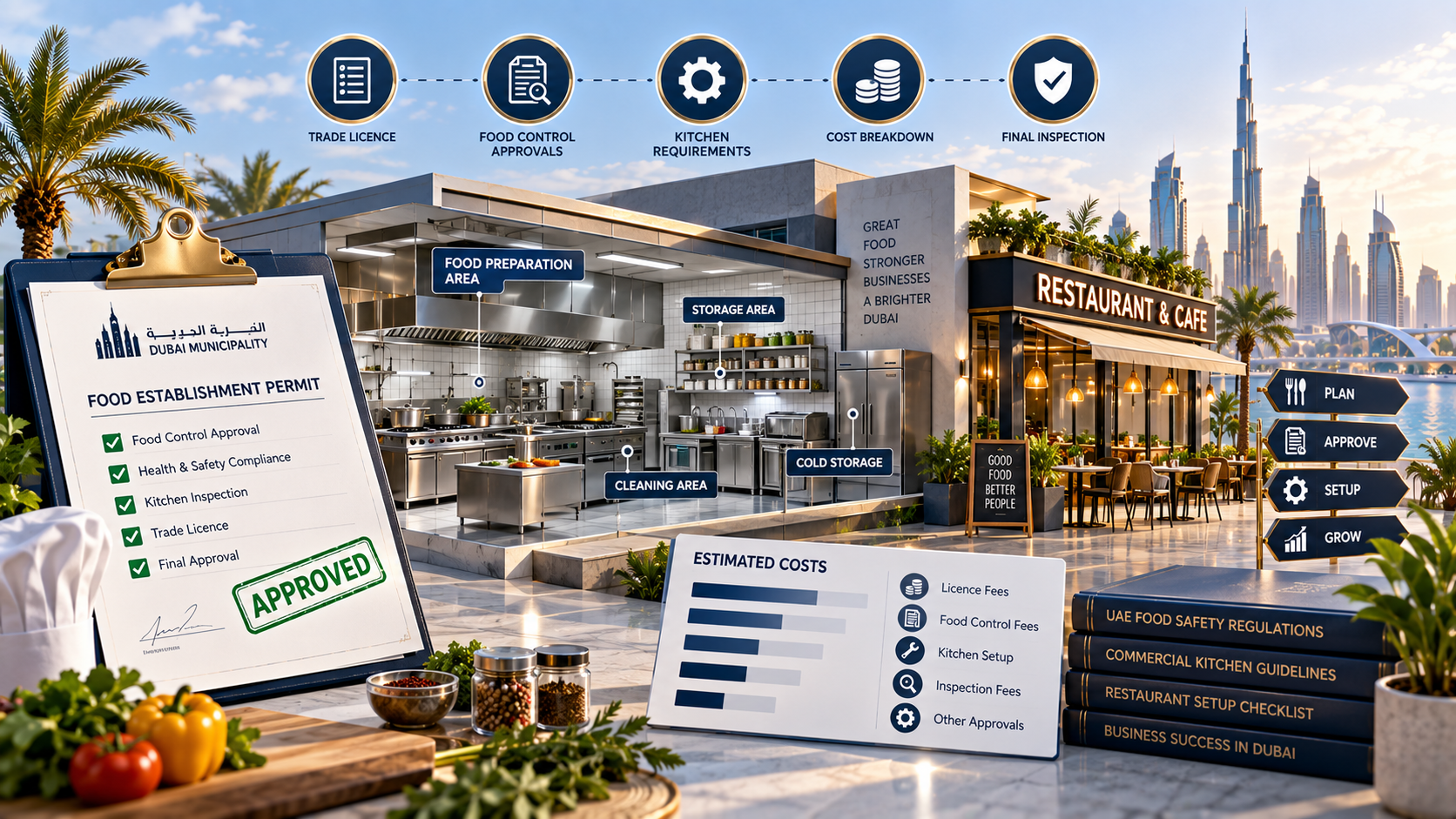
Quick Summary / AI Overview Snippet
Quick Answer: A restaurant licence dubai operators need runs on two parallel tracks: a DET trade licence with the correct F&B activity code (AED 10,000–30,000) and a mandatory Dubai Municipality food permit (AED 2,000–10,000). Neither alone lets you serve food. The Municipality track adds Civil Defence NOC, kitchen layout approval before fit-out, HACCP plan, PIC certification, and food handler cards for every kitchen staff member. Licensing and approvals total roughly AED 25,000–65,000, but realistic first-year investment including fit-out, kitchen equipment, rent and staff lands between AED 250,000 and AED 1 million+ depending on size and concept.
Introduction
F&B is the most-searched vertical in Dubai business setup — and one of the most poorly served by the content available. Most guides walk you through getting a trade licence, mention “you’ll also need municipality approval,” and stop there. That omission is why so many restaurant projects blow through their timeline and budget: the DET trade licence is roughly 30–40% of your actual government and compliance cost. The other 60–70% sits with Dubai Municipality, Civil Defence, HACCP certification, and kitchen build-out to code.
Worse, the sequencing matters enormously. Founders who sign a lease before confirming the space meets Municipality kitchen requirements, or who begin fit-out before securing kitchen layout approval, routinely face rework costs that dwarf the approval fees themselves.
This guide covers the full approval sequence that actually determines your opening date, the kitchen and food safety requirements that trip up first-time operators, and — critically — a realistic total cost picture including fit-out, not just licence fees. That last number is the one founders genuinely cannot find anywhere, and it’s where this guide starts.
The Two-Track Structure: Why One Licence Isn’t Enough
Every food business in Dubai needs approvals from two separate authorities running on parallel tracks, and you cannot legally serve food until both are complete.
| Track | Authority | What It Covers |
|---|---|---|
| Track 1: Trade Licence | Department of Economy & Tourism (DET) | Legal authorisation to operate a business with the correct F&B activity code |
| Track 2: Food Permit | Dubai Municipality Food Safety Department (FSD) | Food safety compliance, kitchen layout, HACCP, staff certification, premises inspection |
Within Track 2 sit several sub-approvals — Civil Defence NOC, kitchen layout pre-approval, Person-in-Charge (PIC) certification, and food handler cards — each with its own timeline and cost.
Expert Tip: The single most expensive sequencing mistake in Dubai F&B is starting kitchen fit-out before Dubai Municipality has approved your layout. Inspectors flag non-compliant layouts at the inspection stage, and the resulting rework — repositioning extraction, drainage, prep zones or wash areas — routinely costs more than every government fee combined. Get layout pre-approval first, then build.
Choosing Your F&B Licence Category
DET classifies F&B activities into distinct codes, and the category you choose determines your fee schedule, inspection intensity, and approval path.
| Licence Type | What It Covers | Key Requirement Notes |
|---|---|---|
| Restaurant | Full dine-in service | Most heavily inspected; requires kitchen layout approval, ventilation certification, seating-area compliance |
| Cafeteria / Cafe | Counter-service outlets, tea and coffee shops | Lighter seating rules, but identical kitchen hygiene requirements |
| Restaurant Without Dine-In | Cloud kitchens, delivery-only | Same DET licence, DM food permit, PIC certification and pest control; kitchen standards identical |
| Catering | Off-site food service | Adds DM transport-container approvals, refrigerated vehicle registration, and central-kitchen audit |
Expert Tip: A common misconception is that a cafe licence dubai operators obtain is a “lighter” version of a restaurant licence. It isn’t, where the kitchen is concerned. Seating and service rules differ, but Dubai Municipality applies the same hygiene, layout, and food handler standards to a 20-seat cafe as to a 120-seat restaurant. Budget your kitchen compliance accordingly.
Mainland vs Free Zone for F&B: The Clear Answer
Unlike most business verticals where the mainland-vs-free zone decision genuinely depends on circumstances, F&B has a much more straightforward answer for the majority of operators.
Choose mainland (DET) if you’re running any customer-facing restaurant or cafe. A mainland licence gives unrestricted access to Dubai’s entire market — 3.6 million residents and roughly 16 million annual tourists — with no restrictions on where or to whom you can sell. The modest cost premium over some free zones is negligible against that market access.
Consider a free zone only if you’re operating a cloud kitchen or food production facility with no walk-in dine-in component, where free zone restrictions on direct market access matter less to your model.
For most operators, UAE Mainland Business Setup is the correct route for a dine-in concept, while a UAE Freezone Setup entity may suit a delivery-only or production model — a decision worth confirming against your specific concept before committing to a lease.
Can a Foreigner Own a Restaurant in Dubai 100%?
Yes — entirely. Following the UAE’s foreign ownership reforms, F&B activities on the mainland permit 100% foreign ownership with no local partner or Emirati shareholder requirement. This applies across restaurant, cafeteria, and catering categories.
What foreign owners still need is the same full approval chain as any other operator: DET licence, Dubai Municipality food permit, Civil Defence clearance, and properly certified staff. Ownership nationality doesn’t change the compliance requirements.
The Full Approval Sequence: Step by Step
The order here matters as much as the steps themselves. Running these out of sequence is what turns a 90-day project into a six-month one.
- Confirm F&B activity and legal form — select the correct DET activity code for your concept before anything else, since this determines every downstream requirement.
- Reserve trade name and obtain DET initial approval — the initial approval certificate lets you proceed with premises and layout work.
- Identify premises — and validate them against DM requirements before signing — confirm the unit can physically accommodate Municipality kitchen layout requirements (extraction, drainage, grease trap access, separation of prep zones).
- Submit kitchen layout for Dubai Municipality pre-approval — this gate must clear before fit-out begins, not after.
- Register Ejari tenancy contract — mainland F&B requires a registered, Ejari-attested tenancy for a real, approved unit.
- Obtain landlord NOC — many landlords, particularly in malls and managed buildings, require a formal NOC for F&B fit-out and extraction works.
- Complete fit-out to the approved plan — build exactly to the layout DM approved.
- Pass Dubai Civil Defence (DCD) fire safety inspection and obtain NOC — the fee scales with kitchen size and seating capacity.
- Register on Dubai Municipality’s FoodWatch platform and appoint a certified Person-in-Charge (PIC) — a mandatory food safety role, not an optional appointment.
- Secure food handler occupational health cards for all kitchen staff — renewed annually.
- Pass the on-site Dubai Municipality food safety inspection.
- Receive DET trade licence and DM food establishment permit — only now can you legally open.
- Complete post-licensing registrations — establishment card, staff visas, VAT and corporate tax registration.
Expert Tip: Step 3 is where the most expensive mistakes happen. Do not sign a lease until you’ve confirmed the space meets Dubai Municipality kitchen layout requirements. A unit that looks perfect commercially but can’t accommodate compliant extraction or drainage becomes either an enormous fit-out cost or a dead lease.
Do I Need Dubai Municipality Approval for a Restaurant?
Yes — unconditionally, and for every food category including cloud kitchens and cafes. The Dubai Municipality food permit is mandatory and entirely separate from your DET trade licence. So is the kitchen layout pre-approval that precedes fit-out.
The Dubai Municipality Food Safety Department controls who serves food in Dubai, and the process runs in three broad stages:
Stage 1 — Initial Registration: Submit through the DM portal with your DET licence, tenancy contract, floor plan, and proposed menu.
Stage 2 — Kitchen Layout and Compliance Review: DM reviews the physical layout against food code requirements — zone separation, extraction, drainage, wash facilities, storage temperature control.
Stage 3 — On-Site Inspection and Permit Issuance: Physical inspection of the completed premises, verification of PIC certification and food handler cards, then permit issuance.
Kitchen Requirements That Cause the Most Rework
- Zone separation — raw prep, cooked food, and wash areas must be physically separated to code
- Extraction and ventilation — capacity must match cooking equipment; certification required
- Drainage and grease traps — a frequent constraint in units not originally built for F&B
- Temperature-controlled storage — chiller and freezer capacity matched to menu and volume
- Wash facilities — dedicated handwashing stations separate from equipment washing
- Pest control contract — required regardless of category, including cloud kitchens
- HACCP-based food safety plan — documented and implemented, not just filed
What Licences Do I Need to Open a Cafe in Dubai? (Full Checklist)
- DET trade licence with correct F&B activity code
- Dubai Municipality food establishment permit
- Dubai Municipality kitchen layout pre-approval (before fit-out)
- Dubai Civil Defence (DCD) fire safety NOC
- Ejari-registered tenancy contract
- Landlord NOC for fit-out and extraction works
- Certified Person-in-Charge (PIC) appointment
- Food handler occupational health cards for all food-handling staff
- HACCP-based food safety plan
- Pest control service contract
- Establishment card (immigration file) for staff visa sponsorship
- Signage permit (if external signage is installed)
- Outdoor seating permit (if applicable)
- Shisha permit (separate track, if applicable)
- Alcohol licence (entirely separate track — see below)
How Much Does It Cost to Open a Restaurant in Dubai?
This is the section most competitor content avoids, because the honest answer requires separating two very different cost layers that get routinely blurred together.
Layer 1: Licensing and Government Approvals
| Component | Estimated Cost (AED) |
|---|---|
| DET trade licence (F&B activity) | 10,000 – 30,000 |
| Dubai Municipality food establishment permit | 2,000 – 10,000 |
| DM initial registration | 2,000 – 3,000 |
| Civil Defence (DCD) NOC | 500 – 5,000 (scales with kitchen size/seating) |
| HACCP certification | 3,000 – 8,000 |
| Food handler cards | 300 – 600 per person, renewed annually |
| Establishment card | 2,000 – 3,500 |
| Staff visas | 4,000 – 7,000 per visa (medical, Emirates ID, stamping) |
| Licensing & Approvals Subtotal | AED 25,000 – 65,000 |
Layer 2: The Real Money — Fit-Out and Operations
| Component | Estimated Cost (AED) |
|---|---|
| Kitchen compliance build-out (beyond standard renovation) | 5,000 – 15,000 |
| Full interior fit-out (varies enormously by concept and size) | 150,000 – 1,500,000+ |
| Kitchen equipment | 80,000 – 500,000+ |
| Lease deposit and advance rent | Highly location-dependent — typically the largest single line |
| Opening inventory | 20,000 – 100,000+ |
| Pre-opening staff and marketing | 30,000 – 200,000+ |
Realistic Total First-Year Investment
| Concept Type | Realistic Range (AED) |
|---|---|
| Cloud kitchen / delivery-only | 150,000 – 350,000 |
| Small cafe (20–40 seats) | 250,000 – 600,000 |
| 60-seat casual restaurant | 700,000 – 1,500,000 |
| 120-seat full-service restaurant | 1,500,000 – 3,000,000 |
| 250-seat premium concept | 2,500,000 – 4,000,000+ |
Expert Tip: The licence is the smallest line item in a restaurant’s first-year cost — often under 5% of total investment. Founders who budget carefully for licensing and vaguely for fit-out have the priorities exactly backwards. Get detailed fit-out and equipment quotes before committing to a lease, not after.
The Liquor Licence: A Completely Separate Track
Alcohol licensing is not part of your restaurant licence and does not follow the same process, authority, or timeline. It is a distinct application with its own eligibility rules.
Key points operators should understand before budgeting for it:
- Availability is restricted — generally limited to restaurants within licensed hotels or specifically designated hospitality zones
- Costs are substantial: roughly AED 30,000–50,000 upfront with annual renewal in the AED 10,000–20,000 range
- The approval process typically runs 4–6 weeks minimum, often longer, and requires proof of premises and existing DET approval
- Serving rules are strict — on-premises consumption only, with additional restrictions during Ramadan daytime hours and on advertising
Expert Tip: Most Dubai restaurants in 2026 operate without alcohol licensing, because the regulatory cost outweighs the revenue benefit unless the concept specifically requires it — a wine bar, gastropub, or premium European concept. Alcohol-free fine dining is well-established and economically viable in Dubai. Don’t assume you need this track; model whether your concept genuinely does.
Realistic Timelines: How Long Does This Actually Take?
| Scenario | Realistic Timeline |
|---|---|
| Fast-casual dry concept, turnkey unit, clean documentation | 6 – 12 weeks |
| Cloud kitchen in an existing compliant facility | 4 – 8 weeks |
| 60-seat full-service restaurant, raw space fit-out | 4 – 6 months |
| Premium concept with alcohol licensing | 6 – 9 months |
| DET paperwork processing alone | 5 – 7 working days |
| DM inspection scheduling and site visit | 3 – 5 weeks |
The variance comes almost entirely from fit-out and inspection scheduling, not from paperwork processing. A well-prepared file moves through DET quickly; the calendar is set by construction and inspection queues.
Post-Opening Compliance: What Comes Next
Opening day isn’t the finish line — F&B carries one of the heavier ongoing compliance loads of any Dubai business category.
- Annual renewals across every permit — trade licence, DM food permit (AED 2,000–4,000 annual food safety renewal), Civil Defence, Ejari, and establishment card all renew on their own clocks
- Food handler card renewals — annual, for every food-handling staff member, with turnover meaning this is a continuous rather than annual task
- VAT obligations — most F&B operations cross the mandatory VAT threshold quickly, making VAT Registration and ongoing VAT Filing & Return Services an early rather than eventual requirement
- Corporate tax compliance — Corporate Tax Registration and annual Corporate Tax Filing apply as to any UAE business
- Financial record-keeping — F&B’s high transaction volume and thin margins make Company Audit Reports and disciplined bookkeeping genuinely operationally important, not just a compliance formality
Given the number of overlapping renewal dates — licence, food permit, Civil Defence, Ejari, establishment card, and dozens of individual staff cards — most F&B operators rely on ongoing PRO Services UAE support rather than tracking these internally. A lapsed food permit or expired staff health card can close a kitchen faster than almost any other compliance failure.
F&B also faces banking friction more often than most sectors, given cash handling volumes and margin profiles, making early Bank Account Opening Support preparation worthwhile. And operators importing specialty ingredients, packaged products, or equipment should factor Product Certification Support into their supply chain timeline, since food product registration runs on its own approval track separate from the establishment permit.
Businesses coordinating licensing, municipality approvals, visas, and tax registration across a compressed pre-opening timeline typically consolidate this through a Business Services Hub relationship rather than managing separate providers for each track. And should a concept ultimately not work out — F&B carries real failure rates — proper Company Closure Services ensure permits, visas, and lease obligations are cleanly resolved rather than leaving lingering liability.
Common Mistakes That Delay Dubai Restaurant Openings
- Signing a lease before validating the unit against DM kitchen requirements — the most expensive mistake in Dubai F&B.
- Starting fit-out before kitchen layout pre-approval — forcing rework after inspection flags non-compliance.
- Assuming a cafe licence means lighter kitchen standards — hygiene and layout requirements are identical to full restaurants.
- Budgeting only for licensing — treating fit-out and equipment as a footnote when they represent 90%+ of real cost.
- Overlooking the landlord NOC — particularly in malls and managed buildings where extraction works need formal approval.
- Forgetting food handler card renewals during staff turnover — a rolling obligation, not an annual one.
- Assuming alcohol licensing is a simple add-on — it’s a separate authority, separate cost, separate eligibility, and separate timeline.
- Underestimating inspection scheduling time — DM site visits add 3–5 weeks that no amount of paperwork preparation shortens.
FAQ: Restaurant and Cafe Licensing in Dubai
Q1: How much does it cost to open a restaurant in Dubai? Licensing and government approvals run roughly AED 25,000–65,000. Realistic total first-year investment including fit-out, kitchen equipment, rent, and staff typically lands between AED 250,000 and AED 1 million+, scaling to AED 3–4 million for larger premium concepts.
Q2: What licences do I need to open a cafe in Dubai? A DET trade licence with the correct F&B activity code, a Dubai Municipality food establishment permit, kitchen layout pre-approval, Civil Defence NOC, Ejari tenancy registration, landlord NOC, PIC certification, and food handler cards for all staff.
Q3: Do I need Dubai Municipality approval for a restaurant? Yes, unconditionally — including for cloud kitchens and cafes. The DM food establishment permit is mandatory and entirely separate from the DET trade licence, as is the kitchen layout pre-approval that must clear before fit-out begins.
Q4: Can a foreigner own a restaurant in Dubai 100%? Yes, entirely. F&B activities on the Dubai mainland permit 100% foreign ownership with no local partner requirement. Compliance requirements are identical regardless of ownership nationality.
Q5: How long does it take to get a restaurant licence in Dubai? A fast-casual concept in a turnkey unit can complete in 6–12 weeks. A 60-seat full-service restaurant requiring raw-space fit-out typically takes 4–6 months, extending further if alcohol licensing is involved.