
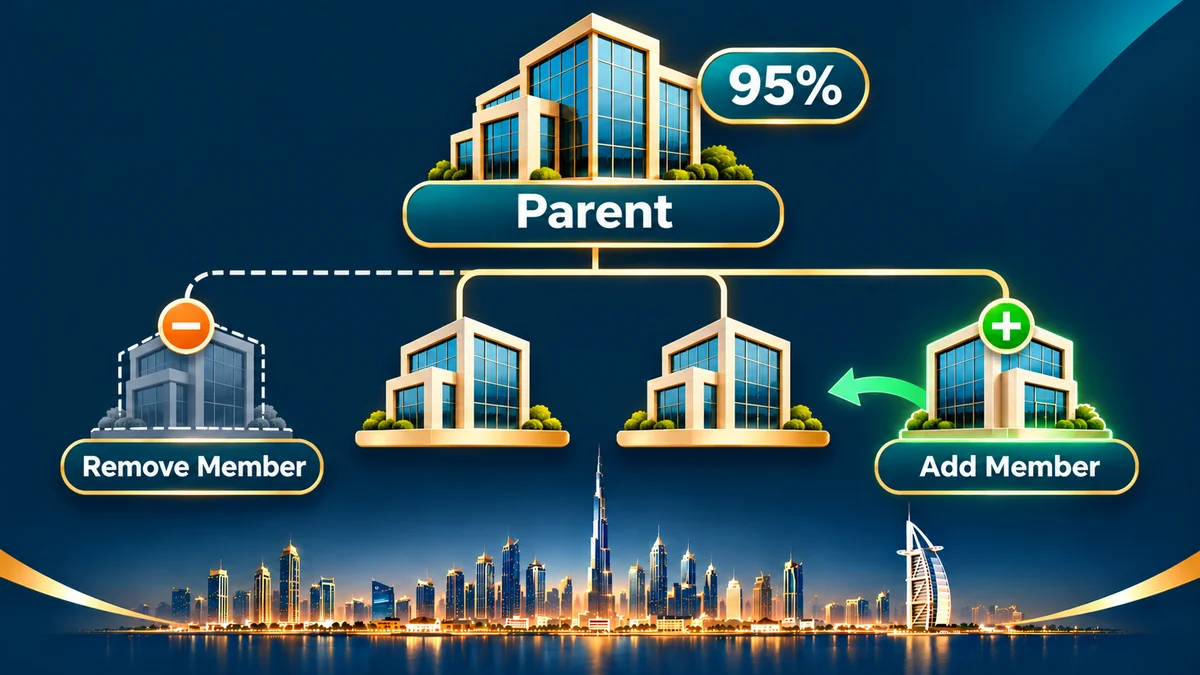
Quick Answer: UAE corporate tax group formation is a joint application by a UAE-resident parent company and each eligible subsidiary to the Federal Tax Authority (FTA) through EmaraTax. The application must be submitted before the end of the tax period from which the group should apply, and cannot apply retrospectively. Every member must already hold a Corporate Tax Registration Number, share the same financial year and accounting standards, and meet the 95% ownership conditions continuously. A new subsidiary can be added by a further application before the period ends, and a newly incorporated company can join from its date of incorporation. A member can be removed by application. If a member stops meeting the conditions, the parent must notify the FTA within 20 business days, and the member is treated as leaving from the start of that tax period.
Forming a Corporate Tax Group can simplify compliance for UAE business groups: one return, consolidated results and the elimination of intra-group transactions. But the real work is procedural. Deadlines are strict, conditions must be met for the whole tax period, and every change in membership has tax consequences for losses, asset transfers and filings.
This guide focuses on the practical process: how to form a corporate tax group in the UAE, what to prepare before applying, how to add a member to a corporate tax group, how to remove a member, what happens when the parent changes, and how the group ends.
UAE Corporate Tax Group Formation: Key Procedural Numbers
| Figure | What it means |
|---|---|
| 95% | Ownership, voting rights, profits and net assets the parent must hold in each subsidiary |
| 2+ | Minimum number of UAE-resident juridical persons needed to form a group |
| Before period end | Deadline to apply to form a group or add a member |
| Date of incorporation | Earliest date a newly incorporated subsidiary can join |
| 20 business days | Deadline to notify the FTA when a member or the group stops meeting the conditions |
| 2 years | Window in which certain intra-group transfers can be clawed back if a party leaves |
| 1 | Corporate Tax return filed by the parent for the whole group |
The Legal Framework at a Glance
| Rule | Source |
|---|---|
| Conditions to form a Tax Group | Article 40 of Federal Decree-Law No. 47 of 2022 (Corporate Tax Law) |
| Dates of formation, joining, leaving and cessation | Article 41 of the Corporate Tax Law |
| Taxable income of a Tax Group, losses and exit rules | Article 42 of the Corporate Tax Law |
| Detailed procedures and timing | Ministerial Decision No. 301 of 2024 on Tax Groups (for tax periods starting on or after 1 January 2025, replacing Ministerial Decision No. 125 of 2023) |
| Practical guidance | FTA Corporate Tax Guide on Tax Groups |
If you are still deciding whether a Corporate Tax Group or a VAT Group suits your structure, see our separate comparison of the two. This guide assumes you have decided to form a Corporate Tax Group.
Step 1: Confirm Eligibility Before You Apply
Before preparing any application, check that the parent and every intended subsidiary meets all conditions. The conditions must be met throughout the tax period, not only on the application date.
| Condition | What to check |
|---|---|
| UAE-resident juridical persons | Each member is a company that is tax resident in the UAE and not tax resident elsewhere under a tax treaty |
| 95% ownership | The parent holds at least 95% of share capital, directly or indirectly through group members |
| 95% voting rights | The parent holds at least 95% of voting rights |
| 95% profits and net assets | The parent is entitled to at least 95% of profits and net assets |
| Not excluded | No member is an Exempt Person or a Qualifying Free Zone Person (QFZP) |
| Same financial year | All members’ financial years end on the same date |
| Same accounting standards | All members prepare financial statements under the same standards |
| Corporate Tax registration | Each member already holds its own Corporate Tax Registration Number |
Fix mismatches first. If a subsidiary has a different financial year-end, it must align it, with FTA approval where required, before joining. A mismatch cannot be fixed retrospectively after filing. Similarly, a free zone company must give up QFZP treatment before it can join.
Step 2: Prepare Your Corporate Tax Group Application
A corporate tax group application in the UAE is stronger when the evidence is ready in advance. Typical preparation includes:
| Document / information | Purpose |
|---|---|
| Group ownership chart | Shows direct and indirect holdings for every member |
| Share registers, MOAs/AOAs and share certificates | Proves the 95% ownership and voting conditions |
| Trade licences / certificates of incorporation | Confirms each member’s legal existence in the UAE |
| Corporate Tax Registration Numbers | One for the parent and each subsidiary |
| Financial year-end and accounting standards confirmation | Proves alignment across all members |
| Latest financial statements | Supports the group’s financial position |
| Evidence of UAE tax residence | Especially for entities with foreign links or management abroad |
| Confirmation of non-QFZP and non-exempt status | Shows no excluded entities are included |
| Authorised signatory details | For the parent and each subsidiary |
Step 3: Submit the Application on EmaraTax
Who applies
Formation is a joint application: the parent company and each subsidiary that wants to join must apply to the FTA. A parent-only application is not enough. The parent then becomes responsible for the group’s Corporate Tax obligations.
When to apply
| Action | Deadline | Effective from |
|---|---|---|
| Form a new Tax Group | Before the end of the tax period from which the group should apply | The start of the tax period specified in the application (or as the FTA determines) |
No retrospective formation. If the application is filed after the tax period ends, the group can only start from a later period. Filing in the final days of a period also leaves little time to answer FTA queries, so apply early.
What happens next
- The FTA reviews the application and may request additional information.
- The group is not treated as formed until the FTA approves the application.
- FTA approval does not confirm that conditions will be met for the whole period. The FTA can review compliance at any time.
- Members keep their registrations, but stop filing standalone Corporate Tax returns. The parent files one return for the group.
Worked example: forming a group
A Dubai holding company with a 31 December year-end owns 100% of two mainland LLCs with the same year-end and accounting standards.
| Date | Action |
|---|---|
| 1 January | New tax period begins; all conditions are met |
| By mid-year | Joint application submitted on EmaraTax by the parent and both subsidiaries |
| Before 31 December | FTA approval received |
| Effective date | 1 January (start of the tax period specified in the application) |
| Following September | Parent files one consolidated Corporate Tax return within 9 months of the period end |
How to Add a Member to a Corporate Tax Group
Groups change. New subsidiaries are incorporated or acquired, and existing companies become eligible. Here is how to add a member to a corporate tax group in the UAE.
Adding an existing subsidiary
| Item | Rule |
|---|---|
| Who applies | The parent and the joining subsidiary |
| Deadline | Before the end of the tax period from which the subsidiary should join |
| Effective from | The start of the tax period specified in the application |
| Conditions | The subsidiary must meet all conditions for that whole period |
Adding a newly incorporated subsidiary
Under Ministerial Decision No. 301 of 2024, a newly incorporated company can join from its date of incorporation, provided it meets the conditions from that date and the application is made within the required timeframe.
| Scenario | Effective date of joining |
|---|---|
| New subsidiary incorporated on 1 April; joins in the same tax period | 1 April (date of incorporation) |
| Existing subsidiary that becomes eligible during the year | Start of the tax period specified in the application, provided it meets the conditions for the whole period |
Acquired subsidiaries need care. A company bought mid-year may not have met the 95% conditions from the start of that tax period. In many cases, it can only join from the next tax period. Check the timing with your adviser before the acquisition closes.
Pre-grouping losses when a member joins
If a joining company brings unused tax losses, these are called pre-grouping losses. They are subject to special rules:
- They can generally only be offset against the taxable income attributable to that member, subject to the normal 75% limit and ownership conditions.
- The group may need to calculate taxable income at member level to apply these losses correctly.
- Under the current rules, available pre-grouping losses must be used to the fullest extent possible each period, or they risk being forfeited.
How to Remove a Member From a Corporate Tax Group
There are two ways a subsidiary leaves a group: voluntarily, by application, or automatically, when it stops meeting the conditions.
Voluntary removal (by application)
| Item | Rule |
|---|---|
| Who applies | The parent (with the subsidiary) |
| Effective from | The start of the tax period specified in the application, or as the FTA determines |
| Typical reasons | Planned sale of the subsidiary, restructuring, or a business decision to file separately |
Automatic exit (conditions no longer met)
| Trigger | Effect | Action required |
|---|---|---|
| Ownership drops below 95% (e.g., shares sold to a third party) | Member treated as leaving from the start of the tax period in which conditions stopped being met | Notify the FTA within 20 business days |
| Member becomes a Qualifying Free Zone Person or Exempt Person | Same as above | Notify the FTA within 20 business days |
| Member becomes tax resident in another country under a treaty | Treated as leaving from the start of that tax period | Notify the FTA within 20 business days |
| Financial year or accounting standards no longer aligned | Conditions no longer met | Notify the FTA within 20 business days |
The retrospective trap: If a subsidiary is sold on 30 September, it is generally treated as leaving from 1 January of that tax period, not from 30 September. Its results for the whole period fall outside the group return, and it must file its own return for that period.
What happens to a member that leaves?
| Issue | Treatment |
|---|---|
| Tax losses | Group tax losses generally stay with the group. The leaving member takes only its own unused pre-grouping losses |
| Standalone financial statements | Prepared on the same accounting basis and elections as the group, using group values as opening balances |
| Assets transferred within the group in the last 2 years | If the transferor or transferee leaves within 2 years of a transfer, previously deferred income may be brought into tax on the exit date |
| Future filings | The leaving member files its own Corporate Tax return from the period it is treated as leaving |
| Liability | Joint and several liability for the group’s tax periods while it was a member can still apply |
Replacing the Parent Company
The parent of a Corporate Tax Group can change, for example after a restructuring.
| Scenario | Rule |
|---|---|
| Application to replace the parent | Must be made before the end of the relevant tax period. The new parent must meet the conditions from the start of that period |
| Parent transfers its whole business to a group member and ceases | That member can replace the parent from the date the transfer takes effect |
| Newly incorporated company becomes the new parent | It can replace the parent from its date of incorporation, if conditions are met |
| Parent replaced and group continues | Group tax losses remain with the continuing group |
When a Corporate Tax Group Ends
A Corporate Tax Group ceases when:
| Trigger | Effective date / action |
|---|---|
| The parent applies to dissolve the group | From the start of the tax period specified in the application, or as the FTA determines |
| The parent no longer meets the conditions | Notify the FTA within 20 business days; treated as ceasing from the start of the relevant tax period |
| Only two members, and one transfers its whole business to the other and ceases | The group ceases on the date the transfer takes effect |
| FTA decision | The FTA can dissolve a group or change the parent on its own initiative, with notice to the parent |
Losses on cessation: If the group ends without a replacement parent, group losses generally stay with the parent if it remains a taxable person. They are not available to individual subsidiaries, apart from their own pre-grouping losses.
Ongoing Compliance for a Corporate Tax Group
Once the group is formed, compliance does not stop. The parent should:
- Monitor ownership every month. Any drop below 95% during the period can affect the whole period.
- Keep financial years and accounting standards aligned across all members.
- Prepare consolidated financial statements each period, eliminating intra-group transactions.
- Keep arm’s length documentation for intra-group transactions where required, even though they are eliminated.
- Track pre-grouping losses member by member.
- Track intra-group asset transfers for the 2-year clawback window.
- Notify the FTA within 20 business days of any event that breaks the conditions.
- File one Corporate Tax return within 9 months of the period end.
Group consolidation depends on accurate member-level books. Our accounting and bookkeeping services in Dubai support consolidated reporting across group companies.
Common Mistakes in Forming and Changing a Tax Group
- Applying after the period ends. The group cannot be formed retrospectively.
- Parent-only applications. Each subsidiary must also apply.
- Mismatched year-ends or accounting standards. These must be aligned before applying.
- Including a QFZP or Exempt Person. Excluded entities make the application fail.
- Missing the 20-business-day notification. Filing on an outdated group composition creates errors.
- Ignoring the retrospective exit rule. A mid-year sale usually removes the subsidiary from the start of the period.
- Overlooking pre-grouping losses. Under-using them can mean losing them.
- Forgetting the 2-year clawback. Intra-group transfers can become taxable when a party leaves.
Corporate Tax Group Procedure Checklist
| Stage | Action | Done? |
|---|---|---|
| Before applying | Ownership chart confirms 95% for all members | ☐ |
| Financial years and accounting standards aligned | ☐ | |
| No QFZPs or Exempt Persons included | ☐ | |
| All members hold Corporate Tax Registration Numbers | ☐ | |
| Application | Joint application submitted on EmaraTax before period end | ☐ |
| Supporting documents uploaded | ☐ | |
| FTA approval received | ☐ | |
| During membership | Ownership monitored; changes notified within 20 business days | ☐ |
| Pre-grouping losses tracked by member | ☐ | |
| Intra-group asset transfers logged (2-year window) | ☐ | |
| Changes | New subsidiaries added before period end (or from incorporation) | ☐ |
| Exits and parent changes handled by application or notification | ☐ | |
| Filing | Consolidated return filed by the parent within 9 months | ☐ |
How SmartBiz Helps Business Groups With Corporate Tax Grouping
SmartBiz helps UAE business groups structure, form and maintain Corporate Tax Groups correctly:
- Business setup in Dubai and company formation in the UAE, with group structures designed for 95% ownership and aligned year-ends
- Mainland company setup for new subsidiaries joining your group
- Accounting and bookkeeping in Dubai for consolidated group reporting
- VAT registration and VAT filing, so your VAT position stays aligned with your group structure
- Business PRO services for licence amendments and shareholder changes
- A single point of contact through our business services hub in Dubai
Planning to form a Corporate Tax Group or change its members?
SmartBiz checks your eligibility, aligns your entities and prepares your application before the deadline. Book a Consultation
Frequently Asked Questions
How does a UAE business apply to form a Corporate Tax Group?
The parent company and each subsidiary submit a joint application to the FTA through EmaraTax before the end of the tax period from which the group should apply. Each member must already be registered for Corporate Tax and meet all conditions.
What is the deadline to form a Corporate Tax Group in the UAE?
The application must be submitted before the end of the tax period from which the group is to take effect. A Corporate Tax Group cannot be formed retrospectively.
What documents are needed for a Corporate Tax Group application?
Typically: an ownership chart, share registers and constitutional documents, trade licences, each member’s Corporate Tax Registration Number, confirmation of aligned financial years and accounting standards, recent financial statements, and evidence of UAE tax residence and non-QFZP status.
How can a new subsidiary be added to a Corporate Tax Group?
The parent and the subsidiary apply to the FTA before the end of the relevant tax period. A newly incorporated subsidiary can join from its date of incorporation if it meets the conditions from that date.
How can a member leave or be removed from a Corporate Tax Group?
A member can be removed by application, effective from the start of the specified tax period. If it stops meeting the conditions, the parent must notify the FTA within 20 business days, and the member is treated as leaving from the start of that tax period.
What happens to tax losses when a member leaves a Corporate Tax Group?
Group tax losses generally stay with the group. The leaving member takes only its own unused pre-grouping losses.
Can the parent company of a Corporate Tax Group be changed?
Yes. An application to replace the parent must be made before the end of the relevant tax period, and the new parent must meet the conditions from the start of that period. Special rules apply for business transfers and newly incorporated parents.
Do group members still need their own Corporate Tax registration?
Yes. Each member must hold a Corporate Tax Registration Number before joining. Once in the group, members stop filing standalone returns, and the parent files one return for the group.
Sources and Legal References
- Federal Decree-Law No. 47 of 2022 on the Taxation of Corporations and Businesses: Articles 40, 41 and 42
- Ministerial Decision No. 301 of 2024 on Tax Groups (replacing Ministerial Decision No. 125 of 2023 for later tax periods)
- Federal Tax Authority: Corporate Tax Guide on Tax Groups
- Federal Tax Authority: tax.gov.ae
Disclaimer: This article provides general information based on UAE Corporate Tax legislation and FTA guidance available at the time of writing. It is not tax advice. Tax group rules are complex, particularly for acquisitions, losses and restructurings, so confirm your position with a qualified tax adviser before applying.