
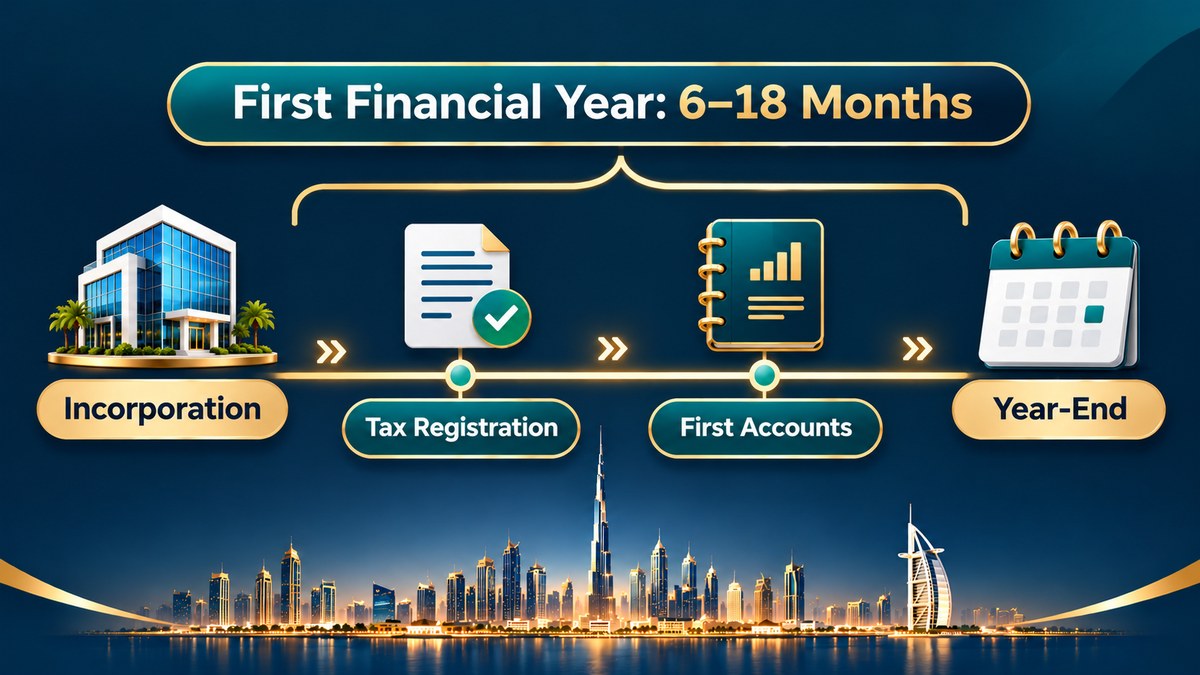
Quick Answer: The first financial year of a UAE company starts on the date the company is incorporated and ends on the financial year-end chosen in its constitutional documents. Under the UAE Commercial Companies Law, this first accounting period can run for between 6 and 18 months, so it does not have to be exactly 12 months. For UAE Corporate Tax, the company’s first Corporate Tax period generally follows this same first financial year. The Federal Tax Authority (FTA) has confirmed that no separate application is needed for a first period of 6 to 18 months. The Corporate Tax return and payment are due within 9 months after that first period ends.
Every new UAE company has to answer a question that sounds like admin but has real tax consequences: when does our first financial year end? The answer decides when your first financial statements are prepared, when your first Corporate Tax return is due, how much time you have before your first tax payment, and whether you will need to apply to the FTA later to change it.
This guide explains how the first financial year of a UAE company is determined, how it connects to the first Corporate Tax period in the UAE, what the 6 to 18 month rule means in practice, and when and how a company can change its UAE company financial year.
First Financial Year in the UAE: Key Numbers at a Glance
| Figure | What it means |
|---|---|
| 6 months | Shortest permitted first financial year under the Commercial Companies Law |
| 18 months | Longest permitted first financial year under the Commercial Companies Law |
| 12 months | Standard length of every financial year after the first |
| 3 months | Deadline for a newly incorporated company to register for Corporate Tax, counted from incorporation |
| 9 months | Deadline to file the Corporate Tax return and pay tax after the tax period ends |
| AED 10,000 | Administrative penalty for late Corporate Tax registration |
| AED 375,000 | Taxable income taxed at 0% before the 9% rate applies |
What Is a Financial Year for a UAE Company?
Under Article 57 of Federal Decree-Law No. 47 of 2022 (the Corporate Tax Law), a financial year is either:
- the Gregorian calendar year (1 January to 31 December), or
- the 12-month period for which the business prepares its financial statements (for example, 1 April to 31 March).
The Corporate Tax Law then defines the tax period as the financial year, or part of it, for which a tax return must be filed. In other words, your financial year and your Corporate Tax period are designed to match.
Most UAE companies pick a 31 December year-end, but there is no legal requirement to do so. Businesses that belong to a foreign group often choose a year-end that matches their parent company, such as 31 March or 30 June.
Key point: You choose your UAE company financial year when the company is formed. That choice then flows into your accounting records, your Corporate Tax registration and every tax return you file.
How Is the First Financial Year of a UAE Company Determined?
The first financial year is different from every year that follows. A company is rarely incorporated on the first day of its chosen financial year, so its first period is usually longer or shorter than 12 months.
It is determined by two dates:
- Start date: the date the company is incorporated, meaning the date its commercial licence or certificate of incorporation is issued.
- End date: the financial year-end stated in the company’s Memorandum or Articles of Association (or the year-end selected with its licensing authority).
The 6 to 18 month rule
Under the UAE Commercial Companies Law, a company’s first financial year may be a period of between 6 and 18 months. This flexibility lets a new company line up with its chosen year-end without producing an unusually short or long set of accounts.
The FTA confirmed in its Public Clarification on the First Tax Period of a Juridical Person that, where the first financial year is between 6 and 18 months, it is also accepted as the first Corporate Tax period. No FTA application to change the tax period is needed.
Visual: How the 6 to 18 month window works
| First period length | Allowed? | What it means |
|---|---|---|
| Under 6 months | ✘ Too short | Extend the first period to the following year-end |
| 6 to 12 months | ✔ Allowed | Short first period ending on the chosen year-end |
| Exactly 12 months | ✔ Allowed | Standard period (rare unless incorporated on day 1 of the financial year) |
| 12 to 18 months | ✔ Allowed | Long first period, usually chosen when incorporation happens late in the year |
| Over 18 months | ✘ Too long | Bring the first year-end forward to the earlier year-end |
Practical Examples: Calculating the First Financial Year
The examples below assume the company chooses a 31 December year-end.
| Incorporation date | Option A: end on the first 31 December | Option B: end on the next 31 December | Valid first financial year |
|---|---|---|---|
| 1 February | 11 months ✔ | 23 months ✘ | 1 Feb to 31 Dec (11 months) |
| 15 May | about 7.5 months ✔ | about 19.5 months ✘ | 15 May to 31 Dec (about 7.5 months) |
| 1 August | 5 months ✘ | 17 months ✔ | 1 Aug to 31 Dec of the following year (17 months) |
| 20 September | about 3.4 months ✘ | about 15.4 months ✔ | 20 Sep to 31 Dec of the following year (about 15.4 months) |
| 1 July | 6 months ✔ | 18 months ✔ | Either option. Choose based on cash flow and reporting needs |
The July window: A company incorporated on 1 July with a December year-end can choose either a 6-month or an 18-month first period. A shorter period brings the first tax return forward. A longer one gives more time before the first filing, but produces one larger set of accounts covering 18 months.
How Does the First Financial Year Affect the First Corporate Tax Period?
For most new companies, the first Corporate Tax period in the UAE is the same as the first financial year. That single decision then fixes your first compliance deadlines.
Deadline chain for a new company
Example: a mainland LLC is incorporated on 1 August, chooses a 31 December year-end and takes a 17-month first financial year.
| Step | Deadline | Timing rule |
|---|---|---|
| Incorporation | 1 August (Year 1) | Start of the first financial year |
| Corporate Tax registration | By 31 October (Year 1) | Within 3 months of incorporation |
| End of first financial year / first tax period | 31 December (Year 2) | 17 months after incorporation |
| First Corporate Tax return and payment | By 30 September (Year 3) | Within 9 months of the period end |
If the same company had been incorporated on 15 May and chosen a 7.5-month first year ending 31 December (Year 1), its first return would be due by 30 September (Year 2), a full year earlier.
Planning insight: The first-year choice can move your first tax return and payment by up to 12 months. Discuss it with your accountant before the Memorandum of Association is finalised, not after.
Are thresholds reduced for a short or long first period?
According to the FTA’s clarification, when the first tax period is longer or shorter than 12 months, thresholds in the Corporate Tax Law generally do not need to be apportioned by time. The main exception is the AED 12 million threshold under the General Interest Deduction Limitation Rule, which is adjusted for the length of the period.
In practice, this means the AED 375,000 0% band is generally applied to the first tax period as a whole, whether that period is 7 months or 17 months.
Registering for Corporate Tax: Why the Financial Year Matters
When a new company registers for Corporate Tax on EmaraTax, it must enter its financial year-end. The FTA uses this to set the company’s tax periods and return due dates.
- Newly incorporated UAE companies, both mainland and free zone, must register within 3 months of incorporation.
- Late registration attracts an AED 10,000 administrative penalty.
- The financial year-end in EmaraTax should match the year-end in the company’s constitutional documents and its accounting system. A mismatch creates problems later when returns and financial statements do not line up.
Setting this up correctly is part of a clean company formation process in the UAE. If you are still planning your launch, our guide on how to register a company online in the UAE explains the setup steps.
Mainland vs Free Zone: Does the First Financial Year Work Differently?
| Point | Mainland company | Free zone company |
|---|---|---|
| Rules on first financial year | UAE Commercial Companies Law (6 to 18 months) | Free zone authority’s own company regulations, which commonly allow a similar first-period flexibility |
| Where the year-end is recorded | Memorandum/Articles of Association filed with the economic department | Articles or registration documents filed with the free zone authority |
| Corporate Tax registration | Required within 3 months of incorporation | Required within 3 months of incorporation, including for Qualifying Free Zone Persons |
| First Corporate Tax period | Generally follows the first financial year | Generally follows the first financial year |
| Audited financial statements | Required if revenue exceeds AED 50 million | Required for Qualifying Free Zone Persons regardless of revenue, and if revenue exceeds AED 50 million |
Planning a mainland company setup in Dubai? Your year-end should be decided at the same time as your licence activities and shareholding structure.
Which Accounting Standards Apply to the First Financial Year?
The first financial statements must follow the accounting standards set out in Ministerial Decision No. 114 of 2023:
| Revenue in the tax period | Accounting standard |
|---|---|
| Up to AED 3 million | Cash basis of accounting may be used |
| Up to AED 50 million | IFRS for SMEs may be used |
| Above AED 50 million | Full IFRS required |
Companies with revenue above AED 50 million, and all Qualifying Free Zone Persons, must also prepare audited financial statements under Ministerial Decision No. 82 of 2023.
A first financial year of 15 or 17 months produces one combined set of accounts covering the whole period. Professional accounting and bookkeeping services from day one make that first close far easier.
Financial Year vs VAT Tax Period: Not the Same Thing
New business owners often confuse the financial year with the VAT tax period. They are separate:
| Point | Financial year / Corporate Tax period | VAT tax period |
|---|---|---|
| Length | 12 months (first year: 6 to 18 months) | Usually quarterly; monthly for some businesses |
| Who decides | The company, in its constitutional documents | The FTA assigns it on VAT registration |
| Return frequency | One Corporate Tax return per tax period | One VAT return per quarter or month |
| Filing deadline | Within 9 months of period end | 28 days after the end of each VAT period |
So a company with a 17-month first financial year will still file several VAT returns during that time if it is VAT-registered. If you are approaching the VAT threshold, see our VAT registration and VAT filing services.
Can a UAE Company Change Its Financial Year?
Yes, but after the first financial year, changing the Corporate Tax period requires FTA approval under Article 58 of the Corporate Tax Law and FTA Decision No. 5 of 2023.
Accepted reasons for changing the tax period
The FTA may approve a change for any one of these reasons:
- Liquidation of the company
- Aligning with another UAE resident company to form or join a Corporate Tax Group
- Aligning with a head office, parent, subsidiary or ultimate parent for financial reporting
- Benefiting from a tax relief under UAE or foreign tax law
- Any other valid commercial, economic or legal reason
How the change can be made
| Option | Limit |
|---|---|
| Extend the current tax period | Maximum 18 months in total |
| Shorten the next tax period | Between 6 and 12 months |
Further conditions apply:
- The application should be made in the first half of the original tax period, so at least 6 months before that period ends.
- No tax return must have been filed for the period covered by the application.
- The current or a past tax period cannot be shortened.
Don’t forget the corporate side: Changing the financial year for tax purposes usually also means updating the year-end in the company’s constitutional documents with its licensing authority, and in its accounting system.
Common Mistakes With the First Financial Year
- Accepting the default year-end without thinking. The first-year choice can move your first tax return by up to 12 months.
- Choosing a first period shorter than 6 months. If you incorporate late in the year, the first year usually needs to run to the following year-end.
- Choosing a first period longer than 18 months. This is outside the permitted window.
- Different year-ends in different places. The licence documents, EmaraTax and the accounting system must match.
- Registering for Corporate Tax late. The 3-month deadline starts at incorporation, not at the first trading day.
- Assuming the VAT period is the financial year. VAT returns follow their own quarterly or monthly cycle.
- Trying to change the year-end too late. Applications to change the tax period must be made early in the original period.
First Financial Year Checklist for New UAE Companies
| When | Action |
|---|---|
| Before incorporation | Decide the financial year-end with your accountant; check alignment with any parent company |
| At incorporation | Confirm the year-end in the Memorandum/Articles of Association |
| Within 3 months | Register for Corporate Tax on EmaraTax using the same year-end |
| Month 1 onwards | Set up the accounting system with the correct first-period dates |
| Throughout year 1 | Monitor revenue for VAT registration, audit and accounting-standard thresholds |
| At first year-end | Close the books and prepare the first financial statements (audited where required) |
| Within 9 months of year-end | File the first Corporate Tax return and pay any tax due |
How SmartBiz Helps New Companies Get the First Year Right
SmartBiz helps founders make the first-year decision before it becomes a tax problem:
- Business setup in Dubai and company formation in the UAE, with the financial year-end planned into your documents
- Mainland company setup and Dubai CommerCity setup for e-commerce businesses
- Accounting and bookkeeping aligned to your first accounting period
- VAT registration and VAT filing once you cross the threshold
- Business PRO services for licence amendments if your year-end ever needs to change
- One point of contact through our business services hub in Dubai
Setting up a new UAE company?
SmartBiz helps you choose the right financial year-end, register for Corporate Tax on time and set up your books from day one. Book a Consultation
Frequently Asked Questions
How is the first financial year of a UAE company determined?
It begins on the date of incorporation and ends on the financial year-end chosen in the company’s constitutional documents. Under the UAE Commercial Companies Law, the first financial year can be between 6 and 18 months long.
Can the first financial year of a UAE company be 18 months?
Yes. A first financial year of up to 18 months is permitted. This is common for companies incorporated in the second half of the year that want their first year-end to fall on the following 31 December.
Can the first financial year be less than 12 months?
Yes, provided it is at least 6 months. For example, a company incorporated on 1 February with a 31 December year-end can have an 11-month first financial year.
Is the first financial year the same as the first Corporate Tax period in the UAE?
Generally yes. The FTA has confirmed that a first financial year of 6 to 18 months is accepted as the first Corporate Tax period without a separate application to change the tax period.
When is the first Corporate Tax return due for a new UAE company?
Within 9 months after the end of the first tax period. For example, if the first financial year ends on 31 December, the return and any tax payment are due by 30 September of the following year.
When must a new company register for Corporate Tax in the UAE?
A newly incorporated UAE company must register within 3 months of incorporation. Late registration attracts an AED 10,000 administrative penalty.
Can a UAE company change its financial year later?
Yes, with FTA approval. Valid reasons include liquidation, aligning with a tax group or parent company, accessing a tax relief, or another valid commercial reason. The current period can be extended to a maximum of 18 months, or the next period shortened to 6 to 12 months.
Is the financial year the same as the VAT tax period?
No. The financial year is chosen by the company and is usually 12 months. VAT tax periods are assigned by the FTA and are usually quarterly, with VAT returns due 28 days after each period ends.
Sources and Legal References
- Federal Decree-Law No. 47 of 2022 on the Taxation of Corporations and Businesses: Article 57 (Tax Period) and Article 58 (Change of Tax Period)
- Federal Decree-Law No. 32 of 2021 on Commercial Companies
- FTA Public Clarification on the First Tax Period of a Juridical Person
- FTA Decision No. 5 of 2023 on Conditions for Change in Tax Period
- FTA Decision No. 3 of 2024 on the Timeline for Registration of Taxable Persons for Corporate Tax
- Ministerial Decision No. 114 of 2023 on Accounting Standards and Methods
- Ministerial Decision No. 82 of 2023 on Audited Financial Statements
- Federal Tax Authority: tax.gov.ae
Disclaimer: This article provides general information based on UAE legislation and FTA guidance available at the time of writing. It is not tax or legal advice. Free zone regulations and FTA practice can differ or change, so confirm your company’s position with a qualified adviser.