
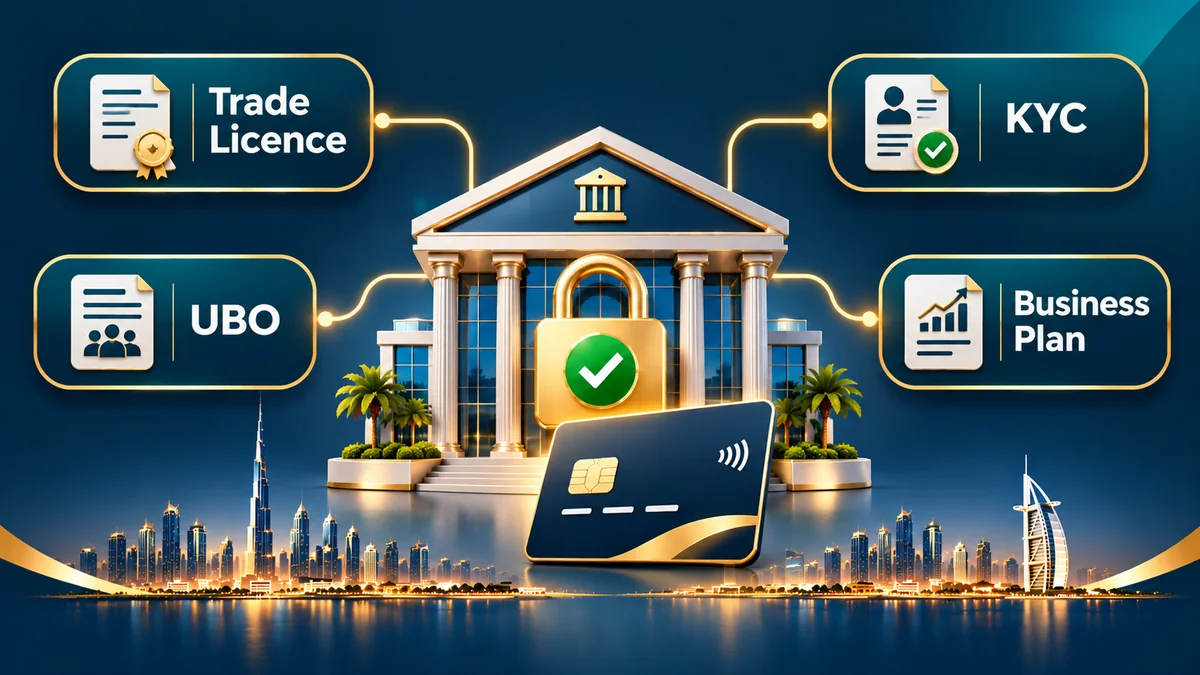
Quick Answer: Business bank account opening in the UAE happens after your company is licensed. Banks carry out detailed KYC (Know Your Customer) and anti-money laundering checks before approving an account. You will typically need your trade licence, Memorandum or Articles of Association, share certificates, a board resolution, passports, Emirates IDs or visas of shareholders and signatories, a UBO declaration, and evidence of real business activity such as a business plan, contracts and an office lease. Opening usually takes 1 to 2 weeks with digital banks and 3 to 6 weeks with traditional banks, and longer for non-residents or complex ownership structures. Approval is never automatic. It depends on how clearly you can show who owns the business, where the money comes from and what the company actually does.
For many new UAE companies, getting the trade licence is the easy part. Opening the corporate bank account is where delays begin. UAE banks operate under strict anti-money laundering and counter-terrorist financing rules, and their compliance teams review every application carefully before a business can transact.
This guide explains UAE corporate bank account requirements in practical terms: what banks check, which documents to prepare, how long the process takes, why applications are delayed or rejected, and how a newly formed company can prepare a stronger application to open a business bank account in Dubai or anywhere in the UAE.
Business Bank Account Opening UAE: Key Numbers at a Glance
| Figure | What it means |
|---|---|
| 25% | Ownership or control level at which individuals are typically identified as Ultimate Beneficial Owners (UBOs) |
| 6 months | Minimum remaining passport validity commonly required for shareholders and signatories |
| 1 to 2 weeks | Typical account opening time with digital-first banks |
| 3 to 6 weeks | Typical account opening time with traditional banks |
| 6 to 10 weeks | Typical time for non-resident owners or complex structures |
| 6 to 12 months | Period of existing bank statements often requested from owners or parent companies |
| 90%+ | Share of UAE businesses that are SMEs, which makes SME banking access a policy priority |
Why Opening a Business Bank Account in the UAE Takes Effort
UAE banks are required by law to know exactly who they are dealing with. Under the UAE’s anti-money laundering and counter-terrorist financing (AML/CFT) framework and the Central Bank’s rules, every bank must:
- Identify and verify the company, its shareholders, directors and signatories
- Identify the Ultimate Beneficial Owners, the real people who ultimately own or control the company
- Understand the business model, expected transactions and countries involved
- Verify the source of funds and source of wealth behind the business
- Monitor the account on an ongoing basis after opening
This is why UAE business banking compliance is more document-heavy than in many other countries. A well-prepared application moves faster. A vague one stalls in compliance review.
Key point: Banks are not only checking documents. They are checking whether your story makes sense: your licence activity, your business plan, your expected transactions, your clients, your suppliers and your owners’ background should all point to the same picture.
Documents for a Business Bank Account in the UAE
Requirements vary by bank and by business, but most banks ask for documents in three groups.
1. Company documents
| Document | Purpose |
|---|---|
| Trade licence (mainland or free zone) | Confirms the company is legally licensed and shows its permitted activities |
| Certificate of incorporation / registration | Confirms legal existence (especially for free zone companies) |
| Memorandum and/or Articles of Association | Shows ownership, management structure and signing authority |
| Share certificates or shareholder register | Shows each shareholder’s ownership percentage |
| Board or shareholder resolution | Authorises opening the account and names the authorised signatories |
| Power of attorney (if applicable) | Confirms authority of any representative |
| UBO declaration / register | Identifies the individuals who ultimately own or control the company |
| Office lease (Ejari or free zone lease) | Confirms the company’s physical presence in the UAE |
2. Shareholder, UBO and signatory documents (KYC)
| Document | Who it applies to |
|---|---|
| Passport copy (usually with at least 6 months’ validity) | All shareholders, UBOs, managers and signatories |
| Emirates ID and UAE residence visa | UAE-resident shareholders and signatories |
| Proof of residential address (utility bill or bank statement) | Shareholders and signatories, especially non-residents |
| CV or professional profile | Shareholders and managers, to show relevant experience |
| Personal bank statements (often 6 to 12 months) | Shareholders, to support source of funds |
| Bank reference letter (sometimes requested) | Shareholders or parent companies |
3. Business activity evidence
| Document | Why banks ask for it |
|---|---|
| Business plan or company profile | Explains what the company does, its market and how it earns revenue |
| Expected transaction profile | Monthly inflows and outflows, payment methods and countries involved |
| Client and supplier contracts, LOIs or invoices | Proves real commercial activity |
| Website and online presence | Supports the business profile; should match the licence activity |
| Source of funds / source of wealth explanation | Explains where the initial capital came from |
| Parent company documents (for corporate shareholders) | Certificate of incorporation, registers and financial statements of the parent |
Corporate shareholders need more. If the UAE company is owned by another company, banks will usually ask for the parent’s corporate documents (often attested) and will look through the structure to identify the individual UBOs.
UBO Requirements: Why Banks Ask Who Really Owns the Company
The UAE requires companies to identify and record their Ultimate Beneficial Owners, generally individuals who own or control 25% or more of the company, or who otherwise exercise control. These rules are set by Cabinet Decision No. 109 of 2023 on Beneficial Owner procedures.
Banks use your UBO information to:
- Screen the owners against sanctions, PEP (politically exposed person) and adverse media lists
- Understand ownership chains through holding companies or trusts
- Confirm that the people controlling the account are the people who own the business
Inconsistent UBO information between your licensing authority records, your company documents and your bank application is one of the most common causes of delay.
How to Open a Business Bank Account in the UAE: Step by Step
- Complete company formation. Obtain your trade licence and constitutional documents. Our company formation services in the UAE cover this stage.
- Prepare a complete document pack. Assemble company, KYC and business-activity documents in one organised file.
- Choose the right type of bank. Compare traditional and digital banks on minimum balance, fees, branch access, international transfers and how well they understand your sector.
- Pre-screening. Many banks run an initial eligibility check on your activity, owners’ nationalities and expected transactions before a full application.
- Submit the application. This is done online or through a relationship manager, with all documents and the transaction profile.
- Compliance review. The bank’s compliance team reviews the application and may ask follow-up questions or request extra documents.
- Meeting and verification. Signatories may need to attend an in-person or video meeting. Some banks also conduct a site visit to your office.
- Approval and activation. Once approved, sign the account documents, make the initial deposit and set up online banking.
Visual: Typical account opening timeline
| Stage | Digital bank | Traditional bank |
|---|---|---|
| Pre-screening | 1 to 3 days | 3 to 7 days |
| Application and document submission | 1 to 2 days | 3 to 7 days |
| Compliance review and follow-up questions | 3 to 7 days | 2 to 4 weeks |
| Meeting / verification | Often by video | In person or video |
| Account activation | 1 to 2 days | 3 to 5 days |
| Typical total | 1 to 2 weeks | 3 to 6 weeks |
Timelines can be shorter for simple, UAE-resident ownership structures with low-risk activities. They can be much longer for non-residents, multi-layer structures or higher-risk sectors.
Traditional Banks vs Digital Banks: What’s the Difference?
| Factor | Traditional banks | Digital-first business banks |
|---|---|---|
| Account opening speed | Slower (often weeks) | Faster (often days to 2 weeks) |
| Minimum balance | Often higher | Often lower or none |
| Branch access | Yes | Limited or none |
| Trade finance, loans and cheque books | Broad range | More limited |
| International transfers | Broad coverage | Varies |
| Best suited for | Established businesses, trading, import/export, higher volumes | Startups, freelancers, service businesses, e-commerce |
Minimum balances vary widely. Depending on the bank and account type, required average balances for business accounts can range from nothing with some digital banks to AED 25,000 to AED 500,000 or more with premium traditional accounts. Always confirm the current terms directly with the bank.
Why Business Bank Account Applications Get Delayed or Rejected
Understanding the common reasons for rejection is the best way to avoid one.
| Reason | What the bank sees | How to fix it |
|---|---|---|
| Unclear source of funds | Capital arrives with no explanation of where it came from | Provide bank statements, sale agreements, salary or dividend records |
| Vague business description | “General trading” with no clients, products or markets named | Give a specific business plan, named suppliers, clients and products |
| Licence vs activity mismatch | Planned transactions don’t match licensed activities | Align your business plan with your licence, or amend the licence |
| No physical presence | No real office or staff in the UAE | Lease suitable premises and show local operations |
| Complex or opaque ownership | Several holding layers, nominee shareholders or trusts | Provide a clear ownership chart and full UBO documents |
| High-risk countries or sectors | Expected payments to sanctioned or high-risk jurisdictions, or high-risk activities | Explain the commercial rationale and controls in detail |
| Inconsistent information | Different addresses, names or ownership figures across documents | Check every document for consistency before applying |
| Incomplete documents | Missing resolutions, expired passports, unsigned forms | Use a checklist and submit a complete pack |
| Adverse background findings | Negative media, past banking issues or sanctions matches | Disclose issues upfront with explanations |
A rejection is not permanent. Many businesses that are refused by one bank are accepted by another once the gaps are fixed. Before reapplying, understand why you were refused, correct the issue, and avoid submitting multiple weak applications at the same time.
Can a Non-Resident Open a Business Bank Account in the UAE?
Yes, many banks accept companies owned by non-residents, but expect:
- More documents. These include proof of overseas address, overseas bank statements and bank references.
- Longer timelines. Typically 6 to 10 weeks.
- Physical presence requirements. Some banks require at least one signatory to visit in person.
- Closer review of the source of funds and the reason for operating through the UAE.
Having a UAE-resident manager or signatory, a real office and local clients or suppliers usually strengthens the application. Our residency visa services can help investors and managers obtain UAE residence.
Mainland vs Free Zone Companies: Does It Affect Banking?
Banks open accounts for both mainland and free zone companies. What matters more is the substance behind the company:
| Factor | Why it matters to the bank |
|---|---|
| Licence activity | Some activities are higher-risk and face closer review |
| Office type | A dedicated office or warehouse shows more substance than a virtual address |
| Staff and visas | UAE-based employees and visas show real local operations |
| Clients and suppliers | UAE and international contracts demonstrate genuine trade |
| Expected transaction size | Larger volumes require stronger supporting evidence |
If you are still choosing a structure, our guides on mainland company setup in Dubai and business setup in Dubai explain the options. Our guide to the difference between a branch office and an LLC in the UAE may also help.
Can You Use a Personal Account for Business in the UAE?
This is not recommended. Running business income through a personal account:
- Can trigger AML alerts and account restrictions on your personal account
- Makes bookkeeping, VAT and Corporate Tax compliance much harder, because business and personal transactions are mixed
- Undermines the company’s separate legal identity
- Can create problems when the FTA or auditors review your records
A dedicated corporate account is also practical for compliance. Employers registered with MOHRE need a proper payroll channel to pay salaries through the Wages Protection System (WPS), and clean business bank statements support your VAT registration, VAT filing and Corporate Tax returns.
After Opening: Staying Compliant With Your Bank
Opening the account is not the end of the bank’s due diligence. To avoid future account freezes or closures:
- Keep KYC documents updated. Renew your trade licence, passports, visas and Emirates IDs on time and share the updates with the bank.
- Notify the bank of changes. Report changes in shareholders, UBOs, managers, signatories, activities or address.
- Transact in line with your profile. Large or unusual transactions outside your declared profile can trigger reviews.
- Respond quickly to bank requests. Delayed responses to periodic reviews can lead to restrictions.
- Keep supporting documents such as invoices and contracts for significant transactions.
Clean, up-to-date books make bank reviews far easier. Our accounting and bookkeeping services in Dubai keep your records ready.
Business Bank Account Readiness Checklist
| Item | Ready? |
|---|---|
| Trade licence and certificate of incorporation | ☐ |
| MOA/AOA and share certificates | ☐ |
| Board resolution naming signatories | ☐ |
| UBO declaration consistent with licensing records | ☐ |
| Passports (6+ months’ validity), visas and Emirates IDs | ☐ |
| Proof of address for shareholders and signatories | ☐ |
| Office lease (Ejari or free zone lease) | ☐ |
| Business plan with expected monthly transactions | ☐ |
| Client/supplier contracts, LOIs or invoices | ☐ |
| Source of funds evidence (bank statements, etc.) | ☐ |
| Website or company profile matching licence activity | ☐ |
| All names, addresses and figures consistent across documents | ☐ |
How SmartBiz Helps With Business Bank Account Opening
SmartBiz cannot guarantee bank approval, because that decision belongs to the bank, but we help you submit the strongest possible application:
- Company formation in the UAE, with documents structured for banking from day one
- Business setup in Dubai, mainland company setup and Dubai CommerCity setup for e-commerce businesses
- Business PRO services for document attestation, amendments and government processes
- Residency visa services for owners and managers
- Accounting and bookkeeping, VAT registration and VAT filing once your account is active
- A single point of contact through our business services hub in Dubai
Preparing to open your UAE business bank account?
SmartBiz helps you organise your documents, align your business profile and avoid the common mistakes that delay approval. Book a Consultation
Frequently Asked Questions
What documents are required to open a business bank account in the UAE?
Banks typically ask for the trade licence, certificate of incorporation, MOA/AOA, share certificates, a board resolution, a UBO declaration, an office lease, and passports, visas and Emirates IDs of shareholders and signatories. They also ask for business evidence such as a business plan, contracts and a source of funds explanation.
How long does it take to open a business bank account in the UAE?
It typically takes 1 to 2 weeks with digital banks and 3 to 6 weeks with traditional banks. Non-resident owners or complex ownership structures can take 6 to 10 weeks or longer.
Why was my business bank account application rejected in the UAE?
Common reasons include an unclear source of funds, a vague business plan, mismatches between the licence and planned activity, no physical presence, complex ownership, high-risk countries or sectors, and inconsistent or incomplete documents.
Can a non-resident open a business bank account in the UAE?
Yes, many banks accept non-resident-owned companies, but they usually require more documents, closer source-of-funds review, longer timelines and sometimes an in-person visit by a signatory.
What is the minimum balance for a business bank account in the UAE?
It depends on the bank and account type. Some digital banks have no minimum balance, while traditional business accounts may require average balances from around AED 25,000 to AED 500,000 or more.
What KYC checks do UAE banks carry out for business accounts?
Banks verify the company, its shareholders, UBOs, directors and signatories, screen them against sanctions and adverse media, assess the business model and expected transactions, and verify the source of funds and wealth.
Can I use my personal bank account for my UAE business?
It is not recommended. Mixing business and personal transactions can trigger AML alerts and makes bookkeeping, VAT and Corporate Tax compliance harder.
Does a free zone company need a UAE bank account?
Yes, in practice. A UAE corporate bank account is needed to receive payments, pay suppliers and staff, and keep clean records for VAT and Corporate Tax.
Sources and Legal References
- UAE AML/CFT legislation and Central Bank of the UAE customer due diligence requirements
- Cabinet Decision No. 109 of 2023 on the Regulation of Beneficial Owner Procedures
- Central Bank of the UAE: standards for banks’ dealings with SMEs
- Ministry of Human Resources and Emiratisation: Wages Protection System requirements
- Federal Tax Authority: VAT and Corporate Tax record-keeping requirements, tax.gov.ae
Disclaimer: This article provides general information about business bank account opening in the UAE. It is not financial or legal advice. Each bank sets its own requirements, minimum balances and approval criteria, and account approval is at the bank’s sole discretion. Confirm current requirements directly with your chosen bank.