
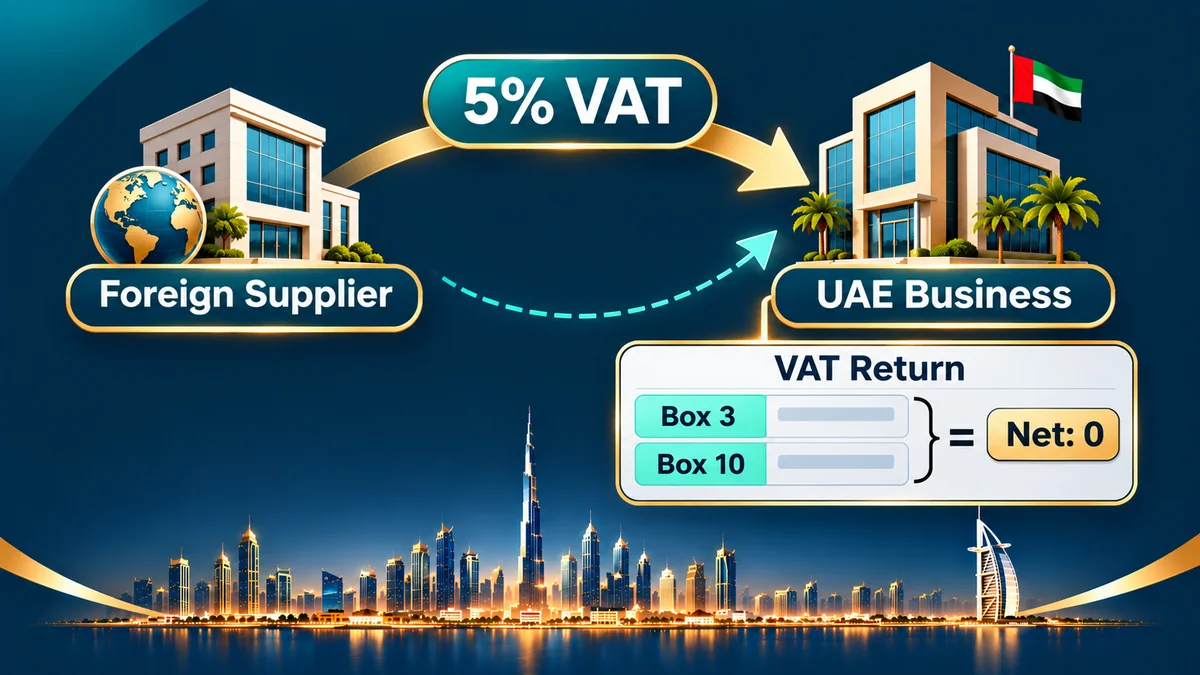
Quick Answer: The reverse charge mechanism (RCM) under UAE VAT shifts responsibility for accounting for VAT from the supplier to the VAT-registered recipient. Instead of paying VAT to the supplier, the recipient calculates the VAT itself, reports it as output tax in its VAT return, and, if entitled, recovers the same amount as input tax. For a fully taxable business, the net cash effect is usually zero. The reverse charge mainly applies to imported services, imported goods for VAT-registered importers, and certain domestic supplies between registered businesses: gold, precious metals and stones, electronic devices, hydrocarbons and metal scrap. In the VAT return, imported services go in Box 3, imported goods in Box 6, and recoverable reverse charge VAT in Box 10. Under the amendments made by Federal Decree-Law No. 16 of 2025, businesses no longer need to issue self-invoices for reverse charge supplies, but must keep supporting documents.
Almost every UAE business uses the reverse charge, often without realising it. Paying for Google Ads, a foreign software subscription, overseas consultants or imported stock usually means you, not the supplier, must account for UAE VAT. Get it wrong, and the FTA may treat it as undeclared output tax, even if the net VAT effect was zero.
This guide explains the reverse charge UAE VAT rules in practical terms: when they apply, how to calculate and report them, the domestic reverse charge sectors, and the most common mistakes, with VAT reverse charge examples for each scenario.
Reverse Charge Mechanism UAE VAT: Key Numbers at a Glance
| Figure | What it means |
|---|---|
| 5% | Standard UAE VAT rate applied under the reverse charge |
| Box 3 | VAT return box for supplies subject to reverse charge (e.g. imported services) |
| Box 6 | VAT return box for goods imported into the UAE by registered importers |
| Box 10 | VAT return box for recovering input tax on reverse charge supplies |
| AED 0 | Typical net VAT cost for a fully taxable business (output and input cancel out) |
| 5 categories | Domestic reverse charge sectors: gold/precious metals and stones, electronic devices, hydrocarbons, metal scrap |
| AED 375,000 | Mandatory VAT registration threshold, which includes imported services |
What Is the Reverse Charge Mechanism in UAE VAT?
Normally, the supplier charges VAT on its invoice, collects it from the customer and pays it to the FTA. Under the reverse charge mechanism, this is reversed:
- The supplier does not charge UAE VAT.
- The recipient (customer) calculates the VAT on the purchase.
- The recipient declares that VAT as output tax in its own VAT return.
- If the purchase relates to taxable business activities, the recipient recovers the same amount as input tax in the same return.
The rules are based mainly on Article 48 of Federal Decree-Law No. 8 of 2017 on VAT and its Executive Regulation, with sector-specific domestic reverse charge rules set by Cabinet Decisions.
Why it exists: The reverse charge keeps UAE VAT collection secure when the supplier is outside the UAE and cannot easily be made to register, or in high-risk domestic sectors where suppliers might collect VAT and disappear without paying it to the FTA.
Normal VAT vs reverse charge: side by side
| Step | Normal VAT | Reverse charge |
|---|---|---|
| Who charges VAT on the invoice | Supplier | Nobody. The invoice shows no UAE VAT |
| Who pays VAT to the FTA | Supplier | Recipient (through its VAT return) |
| Recipient’s input tax recovery | Based on VAT charged by supplier | Based on VAT self-accounted |
| Where it appears in the recipient’s return | Box 9 (standard-rated expenses) | Box 3 or Box 6 (output) and Box 10 or Box 9 (input) |
When Does the Reverse Charge Apply in the UAE?
| Scenario | Reverse charge applies? | Who accounts for VAT |
|---|---|---|
| Services bought from a foreign supplier by a UAE VAT-registered business | ✔ Yes | UAE recipient |
| Goods imported by a UAE VAT-registered business | ✔ Yes (VAT on import deferred to the return) | UAE importer |
| Goods bought from a foreign supplier and supplied/installed in the UAE by a non-resident | ✔ Generally yes, where the recipient is registered | UAE recipient |
| Gold, precious metals, stones and qualifying jewellery bought by a registered business for resale or manufacture | ✔ Yes (domestic reverse charge) | UAE recipient |
| Mobile phones, computers, tablets and parts bought by a registered business for resale or manufacture | ✔ Yes (domestic reverse charge) | UAE recipient |
| Crude/refined oil, unprocessed natural gas and other hydrocarbons between registered businesses for resale or energy production | ✔ Yes (domestic reverse charge) | UAE recipient |
| Metal scrap bought by a registered business for recycling or processing | ✔ Yes (domestic reverse charge) | UAE recipient |
| Ordinary domestic purchase from a UAE VAT-registered supplier | ✘ No | Supplier charges 5% |
| Purchase by a business not registered for VAT | ✘ Not through a VAT return | Import VAT is paid at customs for goods; services may trigger registration |
Reverse Charge on Imported Services in the UAE
This is the most common reverse charge situation. Imported services VAT in the UAE arises when a UAE VAT-registered business receives services from a supplier with no place of establishment or fixed establishment in the UAE.
Everyday examples of imported services
- Online advertising from foreign platforms (for example, Google Ads or Meta advertising billed from outside the UAE)
- Software-as-a-service subscriptions (CRM, accounting, design or cloud tools)
- Foreign consultants, freelancers and agencies
- Overseas legal, audit or advisory fees
- Licensing fees and royalties paid to foreign companies
- Cloud hosting and IT support from foreign providers
Check the invoice: If a foreign platform has registered for UAE VAT and charges 5% UAE VAT on its invoice with a UAE TRN, the reverse charge generally does not apply. Treat it as a normal purchase. If the invoice is issued without UAE VAT by a foreign entity, the reverse charge usually applies.
Worked example 1: foreign software subscription
A Dubai marketing agency (fully taxable, VAT-registered) pays a US software provider AED 10,000 for an annual subscription. No UAE VAT is charged.
| VAT return box | Entry | Amount (AED) |
|---|---|---|
| Box 3: Supplies subject to reverse charge | Value 10,000; VAT | 500 (output) |
| Box 10: Supplies subject to reverse charge (input) | Value 10,000; recoverable VAT | 500 (input) |
| Net VAT effect | 0 |
Worked example 2: the same purchase by a partially exempt business
A company that makes both taxable and exempt supplies, for example a business with significant residential rental income, can recover only 60% of its input tax under its apportionment method.
| Item | Amount (AED) |
|---|---|
| Output VAT under reverse charge (Box 3) | 500 |
| Recoverable input VAT, 60% (Box 10) | 300 |
| Net VAT cost to the business | 200 |
Key insight: The reverse charge is “neutral” only for fully taxable businesses. Partially exempt or exempt businesses can bear a real VAT cost on imported services.
Imported services and VAT registration
Imported services count towards the AED 375,000 mandatory VAT registration threshold. A UAE business with modest local sales but large foreign service purchases, such as advertising and software, may be required to register for VAT because of its imports. If you are close to the threshold, review our VAT registration services.
Reverse Charge on Imported Goods
For goods imported into the UAE by a VAT-registered business:
- The importer can defer import VAT to its VAT return instead of paying it at customs, provided its TRN is linked to its customs registration.
- The import VAT is declared as output tax in Box 6 (goods imported into the UAE). Any later corrections go in Box 7 (adjustments to goods imported).
- If entitled, the importer recovers the same VAT as input tax in Box 10.
Worked example 3: imported stock
A UAE trading company imports goods with a customs value of AED 200,000.
| VAT return box | Entry | Amount (AED) |
|---|---|---|
| Box 6: Goods imported into the UAE | Value 200,000; VAT | 10,000 (output) |
| Box 10: Recoverable input VAT | 10,000 (input) | |
| Net VAT effect | 0 |
Importers who are not VAT-registered generally pay import VAT at customs before the goods are released, and cannot recover it.
Domestic Reverse Charge in the UAE: Sector by Sector
The UAE also applies the reverse charge to certain local supplies between VAT-registered businesses in sectors with higher fraud risk.
| Sector | Legal basis | What’s covered | Key condition |
|---|---|---|---|
| Precious metals and stones | Cabinet Decision No. 127 of 2024 (replacing Cabinet Decision No. 25 of 2018) | Gold, silver, palladium, platinum; natural and synthetic diamonds, pearls, rubies, sapphires, emeralds; jewellery where the precious metal or stone value exceeds other components | Recipient is VAT-registered and buys for resale or to manufacture precious goods |
| Electronic devices | Cabinet Decision No. 91 of 2023 | Mobile phones, smartphones, computers, tablets and qualifying parts | Recipient is VAT-registered and buys for resale or manufacturing electronic devices |
| Hydrocarbons | VAT Executive Regulation | Crude or refined oil, unprocessed natural gas and other hydrocarbons | Recipient is VAT-registered and buys for resale or energy production |
| Metal scrap | Cabinet Decision No. 153 of 2025 | Metal waste and unusable metal that can only be used after processing | Recipient is VAT-registered and intends to recycle, reuse or process the scrap |
Domestic reverse charge: what the supplier and buyer must do
| Party | Obligations |
|---|---|
| Buyer (recipient) | Provide a written declaration to the supplier before the date of supply confirming VAT registration and the intended use (resale, manufacture or processing). Account for VAT under the reverse charge in its return |
| Supplier | Obtain and keep the declaration before the supply, verify the buyer’s VAT registration through FTA methods, issue a tax invoice stating that the reverse charge applies, and not charge VAT |
| If conditions are not met | The supplier must charge 5% VAT normally. Without the declarations, the buyer may face restrictions on recovering the VAT |
Worked example 4: domestic reverse charge on scrap metal
A Sharjah scrap trader sells AED 50,000 of metal scrap to a VAT-registered recycling company that has provided the required declaration.
| Party | VAT treatment |
|---|---|
| Supplier | Issues an invoice for AED 50,000 with no VAT, noting that the reverse charge applies |
| Recycler | Declares AED 2,500 output VAT (Box 3) and recovers AED 2,500 input VAT (Box 10), if entitled |
| Net effect for recycler | AED 0 (fully taxable) |
Zero-rated supplies are excluded. Exports of these goods that qualify for zero-rating remain zero-rated and are not subject to the domestic reverse charge.
Reverse Charge VAT Return: Which Boxes to Use
| Box | Name | What goes here |
|---|---|---|
| Box 3 | Supplies subject to the reverse charge provisions | Imported services and domestic reverse charge purchases (value and output VAT) |
| Box 6 | Goods imported into the UAE | Value and VAT of goods imported by a registered importer |
| Box 7 | Adjustments to goods imported into the UAE | Corrections to import values or VAT |
| Box 10 | Supplies subject to the reverse charge provisions (input) | Recoverable input VAT on reverse charge supplies and imports |
Common error: Declaring the input VAT in Box 10 but forgetting the output VAT in Box 3 or Box 6. This understates output tax, and the FTA can treat it as an error requiring correction, even if the net effect would have been zero.
Do You Still Need a Self-Invoice for the Reverse Charge?
No longer. Under the amendments introduced by Federal Decree-Law No. 16 of 2025, taxable persons are relieved from issuing self-invoices when applying the reverse charge.
However, businesses must still keep supporting documents for each reverse charge transaction, such as:
- the supplier’s invoice or contract
- proof of payment
- import declarations and customs documents (for goods)
- the buyer’s written declaration and registration verification (for domestic reverse charge)
- calculations of the VAT self-accounted
Strong documentation is your audit evidence. Our accounting and bookkeeping services in Dubai keep these records organised.
Common Reverse Charge Mistakes in the UAE
- Ignoring small foreign subscriptions. Each SaaS tool or ad platform invoice without UAE VAT may require reverse charge.
- Reporting input VAT without output VAT. Both sides must be declared.
- Applying reverse charge when the foreign supplier already charged UAE VAT. This double-counts VAT.
- Assuming the reverse charge is always cost-free. Partially exempt businesses bear a real cost.
- Domestic reverse charge without declarations. Missing buyer declarations or registration checks can invalidate the treatment.
- Forgetting imported services in the registration threshold. This can lead to late registration penalties.
- Wrong timing. Reverse charge VAT must be reported in the correct tax period under the normal time-of-supply rules.
- Using the wrong box. Imported goods belong in Box 6, not Box 3.
Found reverse charge errors in past returns? Missing reverse charge declarations should be corrected through a voluntary disclosure. Correcting proactively attracts a lower penalty than waiting for the FTA to find the error.
Reverse Charge Compliance Checklist
| Check | Done? |
|---|---|
| All foreign supplier invoices reviewed for UAE VAT | ☐ |
| Imported services declared in Box 3 with matching input in Box 10 | ☐ |
| Imported goods declared in Box 6 (with Box 7 adjustments if needed) | ☐ |
| Domestic reverse charge declarations obtained before supply | ☐ |
| Buyer VAT registration verified (for domestic reverse charge sales) | ☐ |
| Input tax recovery restricted correctly if partially exempt | ☐ |
| Imported services included in registration threshold monitoring | ☐ |
| Supporting documents filed for each transaction | ☐ |
How SmartBiz Helps With Reverse Charge VAT
The reverse charge is simple in principle and easy to get wrong in practice. SmartBiz helps UAE businesses get it right:
- VAT filing: correct reporting of imported services, imported goods and domestic reverse charge in the right boxes
- VAT registration: including threshold checks that count imported services
- Accounting and bookkeeping in Dubai: reverse charge tracking built into your books
- Business setup in Dubai, mainland company setup and Dubai CommerCity setup for e-commerce and trading businesses
- A single point of contact through our business services hub in Dubai
Not sure if your foreign purchases are reported correctly?
SmartBiz reviews your supplier invoices, identifies reverse charge transactions and makes sure your VAT returns report them correctly. Book a Consultation
Frequently Asked Questions
What is the reverse charge mechanism in UAE VAT?
It is a VAT rule where the VAT-registered recipient, not the supplier, accounts for VAT on a purchase. The recipient declares the VAT as output tax and, if entitled, recovers it as input tax in the same VAT return.
When does the reverse charge apply in the UAE?
It applies mainly to services bought from foreign suppliers, goods imported by VAT-registered businesses, and domestic supplies of precious metals and stones, electronic devices, hydrocarbons and metal scrap between registered businesses.
Which VAT return box is used for reverse charge in the UAE?
Imported services and domestic reverse charge purchases go in Box 3. Imported goods go in Box 6, with adjustments in Box 7. Recoverable input VAT on these supplies is claimed in Box 10.
Does the reverse charge cost money?
For a fully taxable business, the output VAT and input VAT cancel out, so the net cost is usually zero. Partially exempt or exempt businesses can only recover part of the VAT and therefore bear a real cost.
Is a self-invoice required for reverse charge in the UAE?
No. Under the amendments made by Federal Decree-Law No. 16 of 2025, businesses no longer need to issue self-invoices for reverse charge supplies. They must still keep supporting documents.
Do I need to apply reverse charge on Google Ads or Meta ads in the UAE?
If the advertising is billed by a foreign entity without UAE VAT, the reverse charge generally applies for VAT-registered businesses. If the invoice already includes 5% UAE VAT with a UAE TRN, treat it as a normal purchase.
Do imported services count towards the VAT registration threshold?
Yes. The value of imported services counts towards the AED 375,000 mandatory VAT registration threshold.
What is the domestic reverse charge in the UAE?
It is the application of the reverse charge to certain local supplies between VAT-registered businesses: gold, precious metals and stones, electronic devices, hydrocarbons and metal scrap. It applies when the buyer intends to resell, manufacture or process them, and provides the required declaration.
Sources and Legal References
- Federal Decree-Law No. 8 of 2017 on Value Added Tax: Article 48 (Reverse Charge)
- Federal Decree-Law No. 16 of 2025 amending the VAT Law (removal of self-invoicing for reverse charge)
- Executive Regulation of the VAT Law
- Cabinet Decision No. 127 of 2024 on reverse charge for precious metals and stones, and FTA Public Clarification VATP043
- Cabinet Decision No. 91 of 2023 on reverse charge for electronic devices
- Cabinet Decision No. 153 of 2025 on reverse charge for metal scrap
- Federal Tax Authority: tax.gov.ae
Disclaimer: This article provides general information based on UAE VAT legislation and FTA guidance available at the time of writing. It is not tax advice. Reverse charge rules depend on the facts of each transaction, so confirm your treatment with the FTA or a qualified tax adviser.